
Barred fruit tree tortrix
Pandemis cerasana
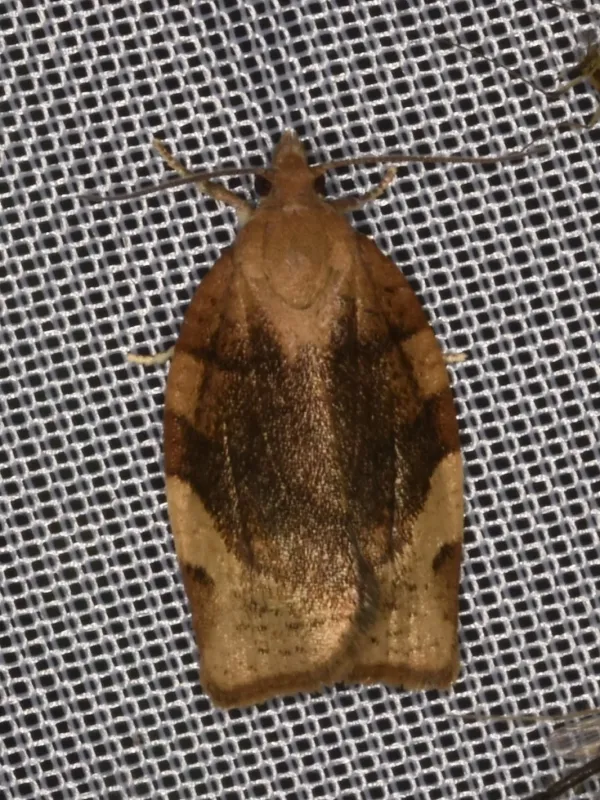
Description
How to identify
The barred fruit tree tortrix (Pandemis cerasana) is a member of the Tortricidae family within the order Lepidoptera. Adult moths typically have a wingspan of 18–24 mm, featuring brownish forewings with two distinct dark transverse bands.
Larvae are generally grass-green in color with a light brown head. They are highly active and often drop from leaves on silk threads when disturbed, which is a characteristic behavioral trait.
Females deposit eggs in flat, oval masses on the upper surface of leaves. Each egg mass can contain up to 150 eggs arranged in a scale-like, overlapping pattern.
The species overwinters as second or third-instar larvae within silk cocoons. These overwintering sites are usually located in bark crevices or at the forks of fruit tree branches.
Depending on the climatic zone, the moth completes one or two generations per year. Adults are typically active from late spring through the end of the summer.
What it damages
This pest is a significant polyphage affecting a wide variety of fruit trees, including apples, pears, cherries, plums, and apricots. It also infests various berry bushes.
Larval feeding on buds in the early spring can destroy the growing points of trees, leading to poor canopy development and reduced flowering capacity.
Fruit damage is the most critical economic concern. Larvae feed on the surface of young fruit, creating irregular pits that eventually lead to rot and secondary infections.
Severe infestations can result in significant leaf loss, which weakens the tree's vigor and reduces its ability to store energy for the subsequent growing season.
Second-generation larvae often attack maturing fruit close to harvest, which is particularly problematic as it directly reduces marketable yield and quality.
Signs of infestation
The most common sign of infestation is the presence of leaves tightly rolled or tied together with silken webbing. These structures serve as nests for the developing larvae.
Shallow, irregular feeding marks on the fruit skin are indicative of larval activity. Damaged fruit often shows visible signs of fecal matter near the feeding sites.
During spring, damaged or missing buds are clear indicators of early larval feeding after overwintering. These spots often fail to produce flowers or healthy foliage.
The presence of pale, scale-like egg masses on the foliage provides an early warning of an impending larval outbreak, allowing for timely intervention.
Observation of adult moths during the evening, or the use of pheromone traps, helps track the population density and identifies the optimal timing for control.
Control measures
Cultural control methods involve cleaning tree bark and removing debris to eliminate overwintering sites. This practice helps to significantly reduce initial spring populations.
Biological control, such as the use of Bacillus thuringiensis, is highly effective against early-instar larvae and is considered environmentally friendly for integrated pest management.
Chemical control focuses on applying targeted insecticides during peak larval hatching periods. It is crucial to monitor thresholds to avoid unnecessary applications.
Pheromone traps are essential for monitoring flight patterns and population size, allowing orchard managers to implement control strategies only when necessary.
- Regular inspection of foliage for rolled leaves.
- Removal of damaged fruit and fallen foliage to reduce pest pressure.
- Application of selective insecticides based on population monitoring.
Taxonomy
- Latin name
- Pandemis cerasana
- Order
- Lepidoptera (butterflies)
- Family
- Tortricidae
- EPPO code
- PANDRI
Discussion
No discussions yet — be the first.