
Fruitlet mining tortrix
Pammene rhediella
Description
How to identify
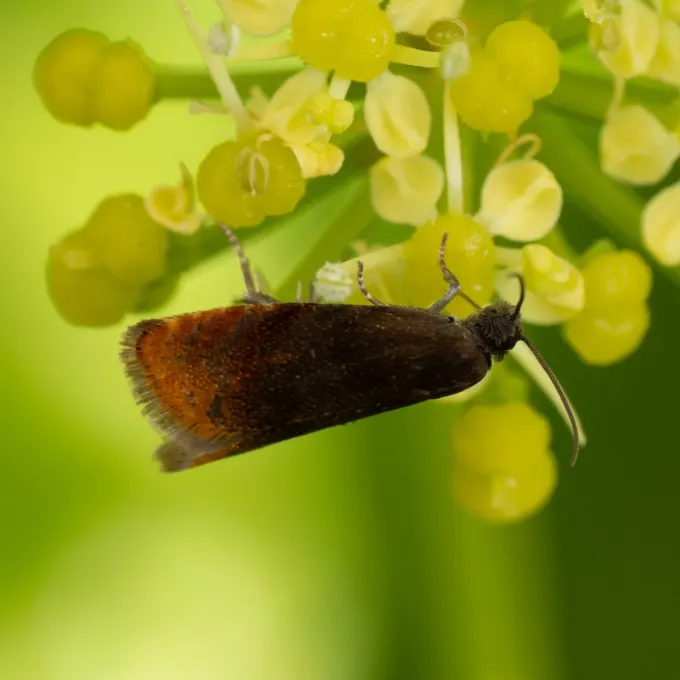
The fruitlet mining tortrix (Pammene rhediella) is a small moth belonging to the family Tortricidae. An adult specimen typically has a wingspan of 10 to 13 millimeters.
The forewings have a distinctive brownish-bronze appearance with a metallic sheen and light transverse bands, providing excellent camouflage against the bark of fruit trees.
Larvae, or caterpillars, reach about 10 mm in length when mature. They exhibit a pale pinkish or yellowish body color with a dark, well-defined head capsule.
The pupa is formed within a tough, silken cocoon. It is usually concealed in deep bark crevices or hidden within dried leaves and plant debris on the tree trunk.
Eggs are small, flattened, and translucent. They are typically laid singly or in small clusters on the surface of developing fruitlets or on the fruit stalks.
What it damages
This pest primarily attacks Rosaceae fruit trees, causing significant damage to apples, pears, plums, cherries, and apricots throughout the growing season.
Larval activity is most destructive during the early stages of fruit development. Caterpillars bore into the fruitlets, feeding on the internal tissues and seeds, which leads to premature fruit drop.
Large populations can destroy entire flower clusters by feeding on the buds before fruit has even set, significantly reducing the potential yield of the orchard.
Feeding often occurs in concealed spots, such as where two fruits touch, making it difficult to detect the infestation until physical damage becomes apparent.
The economic impact is twofold: quantitative loss of yield and qualitative loss of the remaining fruit, which often becomes prone to secondary fungal infections.
When it appears
Adult moths emerge in the spring, with their peak flight period coinciding with the blooming stage of apple trees, which is a critical observation period for growers.
The lifecycle is synchronized with the development of the fruit. After mating, eggs are laid on the developing buds and young fruit, ensuring a food source for emerging larvae.
By mid-summer, larvae finish their feeding period and begin the process of pupation. This species typically completes one generation per year, overwintering as mature larvae.
Overwintering sites include crevices in the tree bark and areas covered by moss or lichen, where the caterpillars remain protected until the following spring.
Environmental conditions during the spring, particularly temperatures during the flowering phase, play a decisive role in the reproductive success and overall infestation level of the pest.
Signs of infestation
A key indicator of infestation is the premature yellowing and dropping of young fruitlets, which, upon dissection, reveal tunneling damage caused by the larvae.
Webbing present on fruit clusters or buds is a common sign, as the larvae often use silk to draw adjacent fruitlets together for protection and easier feeding.
Visible entry holes on the fruit surface, often accompanied by the exudation of sap or gum, indicate active larval development inside the fruit tissue.
The presence of frass (larval excrement) near entry points or entangled in the webbing provides clear evidence of ongoing larval feeding activity.
- Premature fruit drop.
- Webbing connecting young fruitlets or buds.
- Small entry holes on the fruit surface.
- Signs of gumming or decay around feeding sites.
Control measures
Integrated Pest Management starts with monitoring using pheromone traps, which help determine the start of the moth flight and the timing of necessary control measures.
Mechanical control involves the removal and destruction of loose bark during the winter to eliminate overwintering sites, as well as the immediate cleanup of fallen fruit.
Chemical intervention should be strategically timed to target the larvae shortly after egg hatching, typically right after the blossom period ends.
Biological control, particularly the use of egg parasitoids like Trichogramma species, can effectively suppress population growth without the need for broad-spectrum insecticides.
Proper orchard management, including thinning of the canopy to improve airflow and maintaining tree health, creates a less favorable environment for the survival of the larvae.
Taxonomy
- Latin name
- Pammene rhediella
- Order
- Lepidoptera (butterflies)
- Family
- Tortricidae
- EPPO code
- PAMMRH
Discussion
No discussions yet — be the first.