
Palingenia longicauda
Palingenia longicauda
Description
How to identify
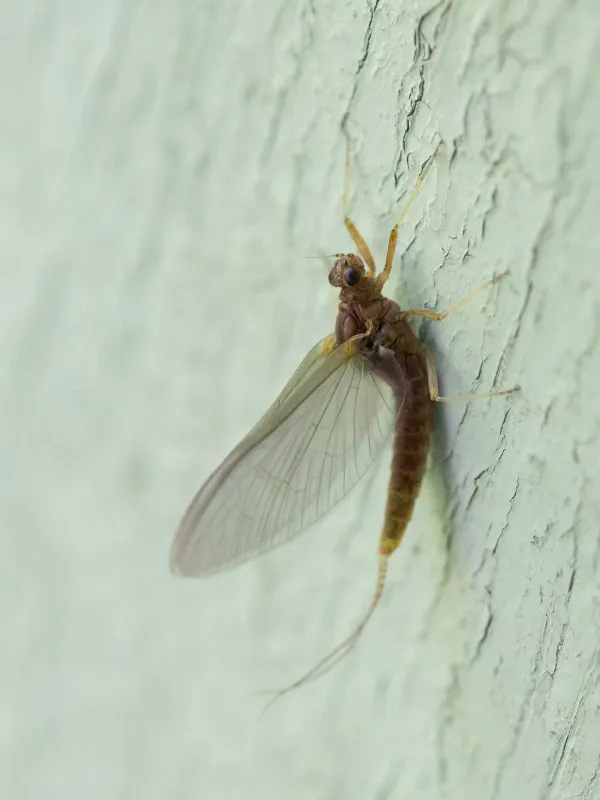
Palingenia longicauda, commonly known as the long-tailed mayfly, is the largest species of mayfly found in Europe. Adult specimens can measure up to 12 centimeters in length, including their characteristic caudal filaments.
Belonging to the family Palingeniidae and the order Ephemeroptera, this species is noted for its extremely short lifespan in the adult stage. The morphological structure of the adult is fragile and specialized for reproduction.
The larvae live in specialized burrows within the dense clay substrate of riverbeds. They possess robust mandibles adapted for digging, reflecting their unique lifestyle within oxygen-rich flowing waters.
Sexual dimorphism is evident, particularly during the mating swarm. Males exhibit elongated forelegs that serve as critical tools for grasping females during the rapid aerial mating process.
This species serves as an excellent bioindicator. Its presence is a testament to high water quality, as the sensitive larvae cannot survive in environments contaminated by heavy industry or excessive agricultural runoff.
What it damages
Palingenia longicauda is not categorized as an agricultural pest. It does not feed on crops, vegetables, or ornamental plants, posing zero threat to agricultural production or land-based farming operations.
Any negative interaction with human activity occurs only during its massive swarming event. Large congregations of mayflies can temporarily obscure visibility for motorists and potentially obstruct air intake vents or water pumps.
In terms of irrigation infrastructure, the accumulation of dead biomass after the swarm can lead to minor clogging of filters or drainage screens. However, this is a transient issue that occurs only once a year.
The ecological role of the larvae is highly beneficial; they act as filter feeders in riverbeds, processing organic matter and contributing to the self-purification of the aquatic ecosystem.
Because the species does not harm plants, there is no need for chemical control. The focus of environmental management is exclusively on the preservation of their delicate riverine habitats.
When it appears
The adult emergence, often referred to as the "river blooming," is highly synchronized and typically occurs in June. The entire reproductive cycle takes place within a very short window of a few days.
The larval stage is much more prolonged, lasting approximately three years. During this period, the insects remain submerged in the riverbed, developing steadily until the environmental conditions trigger the final metamorphosis.
Adults are strictly crepuscular or nocturnal. Mating and egg-laying happen in the evening hours, and the life cycle of the adult insect is completed within less than 24 hours.
Water temperature acts as a critical signal for the emergence. Unusually warm spring weather can cause the swarming to occur earlier than expected, potentially disrupting synchronization with food sources.
The seasonal regularity of this event is deeply ingrained in the species' genetics, adapted to the specific hydrological rhythms of large, slow-flowing rivers.
Signs of infestation
The primary visual sign of a Palingenia longicauda event is the formation of dense, cloud-like swarms above the water surface. These swarms can contain millions of individuals, creating a distinct auditory buzz.
Following the swarming, the water surface often becomes covered with a layer of spent adults, which is a natural conclusion of their life cycle and a significant food source for fish and birds.
On the riverbank or in underwater surveys, the presence of small, characteristic exit holes in clay sediments indicates the habitat of the developing larval population.
A noticeable spike in predatory fish activity near the river surface is a secondary sign, as fish congregate to exploit the sudden abundance of food provided by the mayfly emergence.
The absence of these signs in areas where the species was historically present is a reliable indicator of habitat degradation or chemical pollution in the riverbed sediments.
Control measures
Control measures are neither recommended nor necessary. In fact, many regions have implemented conservation programs to protect this rare and scientifically important species from extinction.
To mitigate issues with infrastructure during the swarm, passive methods such as fine-mesh screens on ventilation or lighting systems are sufficient to exclude adults.
Agricultural management near rivers should prioritize the reduction of pesticide and fertilizer runoff. This ensures that the clay-based riverbeds remain non-toxic to the long-lived larval stages.
Habitat preservation, specifically the avoidance of riverbed dredging or canalization, is the most effective way to maintain healthy populations of this unique mayfly species.
In cases where accumulation of dead insects becomes problematic, mechanical cleaning is the only appropriate response, strictly avoiding any use of insecticides or chemical biocides.
Taxonomy
- Latin name
- Palingenia longicauda
- Family
- Palingeniidae
- EPPO code
- PLNGLO
Discussion
No discussions yet — be the first.