
Maize weevil
Pagiocerus frontalis
Description
How to identify
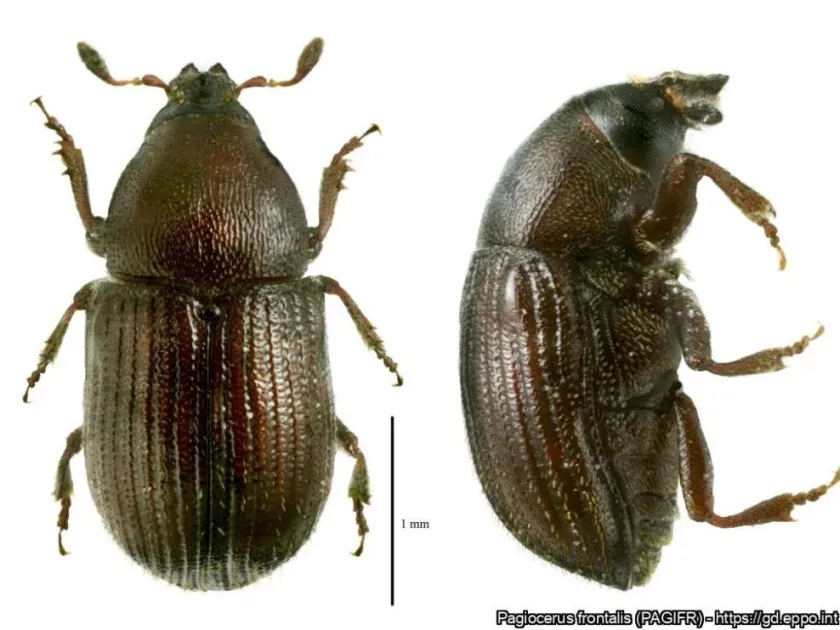
Pagiocerus frontalis, commonly known as a type of maize weevil or wood borer, belongs to the family Curculionidae and the subfamily Scolytinae. These insects are very small, usually measuring between 2 to 3 mm in length.
The adult beetle has a cylindrical body that is dark brown or black in color. The elytra (wing covers) are punctuated with longitudinal rows of small pits.
The larvae are apodous (legless), white in color, and characterized by a small, yellowish head. They remain hidden inside the seed throughout their developmental stage.
Identifying this species requires microscopic examination of the male genitalia and morphological features, as it closely resembles other stored grain pests.
Because they live inside the grain kernel, visual identification of the adult is often limited to the time of their emergence from the damaged seed.
What it damages
The maize weevil Pagiocerus frontalis is a significant pest that attacks corn kernels, often causing severe damage both in the field and in storage facilities.
The larvae bore into the grain, consuming the endosperm completely, which leaves behind only the empty husk and significantly reduces the weight and nutrient value.
Although it is primarily a pest of maize, it can also infest other seeds, including beans, making it a highly adaptable pest for stored grain ecosystems.
Infested seed loses its germination potential, causing substantial economic losses for farmers who rely on high-quality seeds for planting.
The presence of this pest facilitates the growth of secondary mold infections, which can make the grain toxic or unsuitable for animal and human consumption.
When it appears
In temperature-controlled storage facilities, Pagiocerus frontalis can maintain active reproduction cycles throughout the entire year.
In agricultural field environments, the pest activity generally aligns with the maturation phase of corn, specifically when the ears reach the dough and dent stages.
The rate of development is highly dependent on ambient temperature and relative humidity; warmer conditions significantly accelerate the life cycle.
Overwintering occurs in the adult stage or as larvae within remaining cob remnants, old grain debris, or within the structural cracks of barns and silos.
The entire developmental period from egg to adult can be as short as a few weeks, leading to multiple generations if environmental conditions remain favorable.
Signs of infestation
The most prominent sign of an infestation is the presence of tiny, circular exit holes on the surface of the corn kernels created by emerging adults.
Accumulation of fine, powdery "grain dust" or frass within the grain mass is a clear indicator that larvae are actively feeding inside the kernels.
An unusual, musty odor coming from the grain storage indicates that an infestation has reached a level where mold and fermentation are occurring.
Increased temperature within the stored grain mass (hot spots) is often a sign of intense biological activity caused by a large population of these pests.
- Circular emergence holes in kernels.
- Presence of grain dust or frass.
- Musty or sour smell.
- Self-heating of grain bulk.
Control measures
Sanitation is the first line of defense; cleaning grain storage areas thoroughly and removing old grain debris is crucial to preventing infestations.
Maintaining low moisture levels in stored grain (below 13%) is highly effective in inhibiting the development of the larvae and limiting population growth.
Fumigation of grain silos using approved pesticides is the primary chemical control method to eliminate established infestations at all life stages.
Implementing strict crop rotation and ensuring rapid harvesting of corn helps reduce the duration the crop is exposed to pests in the field.
Regular monitoring using pheromone traps and sieve analysis of grain samples allows for early detection, which is vital for effective and cost-efficient management.
Taxonomy
- Latin name
- Pagiocerus frontalis
- Order
- Coleoptera (beetles)
- Family
- Curculionidae
- EPPO code
- PAGIFR
Discussion
No discussions yet — be the first.