
Pagiocerus
Pagiocerus
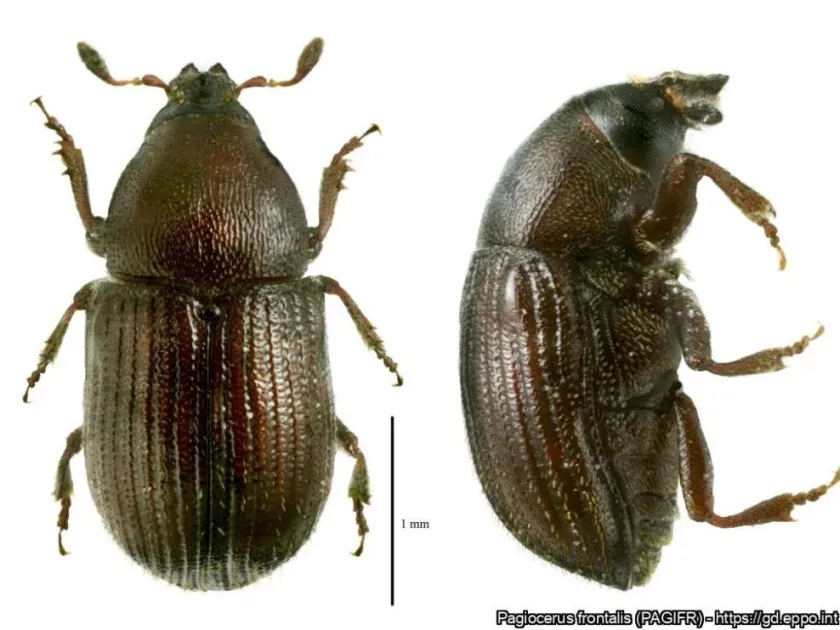
Description
How to identify
Pagiocerus is a genus of small beetles belonging to the family Curculionidae, specifically within the subfamily Scolytinae (bark beetles).
These insects are characterized by their small size, typically ranging from 2 to 3 mm in length, and a cylindrical, dark brown body structure.
The morphology includes a pronotum with fine punctures and a distinct shape, which is essential for taxonomic identification under a microscope.
The larvae are white, legless, and have a hardened head capsule, specifically adapted for boring into the kernels of stored grains.
Due to their cryptic behavior, they are often difficult to detect during the initial stages of an infestation without professional sampling techniques.
What it damages
Pagiocerus is a significant pest of stored maize, causing considerable damage to both raw kernels and processed grain products.
The adult beetles and larvae bore into the seeds, consuming the endosperm and leaving behind tunnels, which renders the grain unfit for human consumption.
Infestation results in significant weight loss of the stored product and a drastic reduction in seed germination rates, affecting the quality of the crop.
The presence of insect waste, such as frass and larval skins, contaminates the grain, leading to secondary mold growth and further deterioration.
Economic damage is particularly high in export markets, where even small populations of quarantine pests can lead to shipment rejections.
When it appears
In temperature-controlled storage environments, Pagiocerus is capable of reproducing throughout the entire year without seasonal diapause.
Ideal conditions for their rapid proliferation include temperatures ranging from 25 to 30 degrees Celsius and high grain moisture levels.
The life cycle is closely linked to environmental factors, with development times varying significantly based on temperature and humidity levels.
Females lay eggs directly onto or inside grain kernels, ensuring that the larvae have immediate access to food upon hatching.
Without proper management, populations can reach epidemic levels, causing rapid spoilage of entire grain stocks within storage facilities.
Signs of infestation
The presence of small, circular entry holes on the surface of maize kernels is the most visible sign of an active infestation.
Large amounts of fine, dusty debris or grain powder under the bulk material indicate that the beetles have been feeding on the internal structures.
A distinctive, musty odor often emanates from infested grain, caused by the accumulation of metabolic waste and associated fungal growth.
Physical inspection of the grain using sieves can help extract adults or larvae, confirming the presence of the pest population.
Laboratory analysis of grain samples is recommended to detect early-stage infestations that are not yet visible to the naked eye.
Control measures
Effective management requires strict sanitation of storage facilities, including the removal of residual grain and dust where pests might hide.
Fumigation using phosphine-based products is the standard procedure for eradicating Pagiocerus populations in bulk stored grain.
Drying grain to moisture levels below 13% creates an environment that is unfavorable for larval development and beetle survival.
Regular monitoring using pheromone traps and systematic grain inspections are crucial for preventing large-scale infestations.
- Seal silos to prevent pest entry and facilitate fumigation.
- Implement rigorous quarantine checks for incoming grain shipments.
- Use aeration systems to keep grain temperatures low and discourage breeding.
Taxonomy
- Latin name
- Pagiocerus
- Order
- Coleoptera (beetles)
- Family
- Curculionidae
- EPPO code
- PAGISP
Discussion
No discussions yet — be the first.