
Signal crayfish
Pacifastacus
Description
How to identify
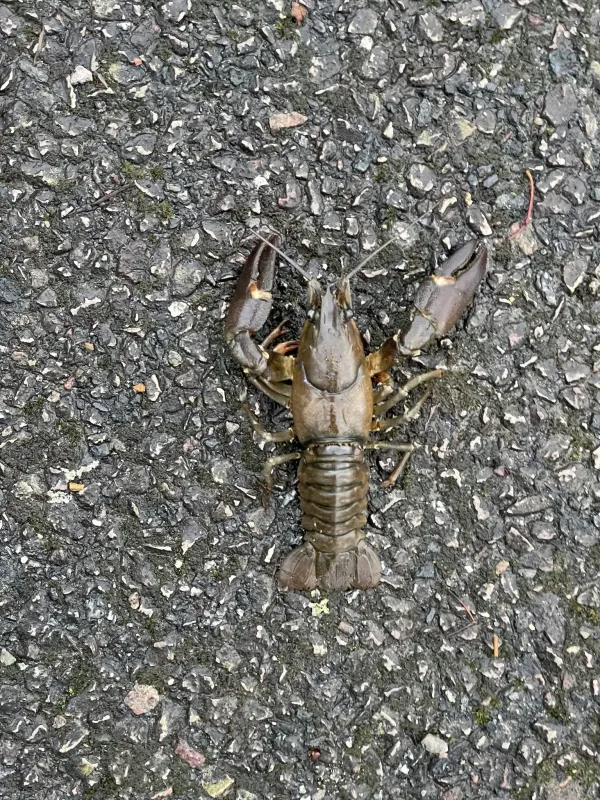
The signal crayfish (Pacifastacus leniusculus) is a crustacean belonging to the Astacidae family. It is easily identified by the distinct white or light blue patch on the hinge of its claws, which gives it the name "signal".
Adult individuals can reach lengths of 15–18 cm. Their exoskeleton is smooth and typically displays a range of colors from reddish-brown to dark olive, providing excellent camouflage in silty water.
As a highly invasive species, they possess an impressive ability to colonize new aquatic environments, often displacing indigenous crayfish species due to their larger size and resilience.
The species is known for its high reproductive rate and tolerance to fluctuating environmental conditions, making it a persistent nuisance in managed water bodies.
Taxonomically, they are decapods, and their robust anatomical build makes them highly efficient burrowers, which is the primary reason they are considered pests in agricultural engineering.
What it damages
The primary agricultural damage caused by Pacifastacus is the structural compromise of irrigation canals, dikes, and embankments due to their extensive burrowing activities.
By excavating deep, intricate tunnels into the banks, these crayfish create pathways for water leakage, which can lead to significant water loss and irrigation system failure.
Their burrowing behavior frequently triggers bank instability, causing soil erosion and potential collapse of the irrigation infrastructure vital for field crops.
In addition to structural damage, they can severely alter the local aquatic ecosystem by consuming submerged aquatic vegetation and competing with other species for resources.
Farmers operating in regions with established signal crayfish populations often face increased maintenance costs related to patching and reinforcing canal banks to prevent flooding and runoff.
When it appears
Signal crayfish are most active during the warmer months, typically from early spring to late autumn, when water temperatures support their metabolic processes.
The breeding season usually takes place in the autumn. Females carry fertilized eggs beneath their abdomens throughout the winter until the young hatch in the following spring.
Summer is the peak period for burrowing and maintenance of their tunnels, which coincides with the period of highest demand for irrigation water in the agricultural sector.
Although they exhibit reduced activity in winter, the structural damage caused by their burrows persists year-round, making them a constant threat to irrigation integrity.
Their life cycle is closely tied to water temperature, and their feeding patterns follow the availability of seasonal vegetation and organic detritus in the canals.
Signs of infestation
The most evident sign of a signal crayfish infestation is the presence of entrance holes on the banks of canals and drainage ditches.
Unexpected sediment collapses on the sides of embankments or localized wet patches on top of levees often indicate the presence of deep crayfish burrows.
A sudden, unexplained increase in water turbidity within irrigation channels can indicate active digging and habitat modification by the crayfish.
Finding discarded exoskeletons near sluices, trash screens, or pumps is a definitive indicator of a reproducing population in the immediate vicinity.
- Visible burrow entrances along canal embankments.
- Localized bank collapses or subsidence.
- Unexplained water leaks or pressure drops in irrigation lines.
Control measures
Controlling signal crayfish requires a multifaceted strategy focusing on structural protection of irrigation infrastructure and population management.
Installing hard barriers like geo-grids, stone rip-rap, or concrete lining in canal banks significantly reduces the crayfish's ability to create burrows.
Regular monitoring of irrigation networks is essential; prompt filling of discovered burrows helps prevent long-term structural degradation of the canal system.
Vegetation management within and along the banks of canals decreases the availability of cover and food, making the area less hospitable for the crayfish.
In extreme cases, intensive trapping programs can be employed to reduce the population density in critical agricultural zones, though eradication is rarely achievable.
Taxonomy
- Latin name
- Pacifastacus
- Family
- Astacidae
- EPPO code
- PACISP
Discussion
No discussions yet — be the first.