
Large pine weevil
Pachylobius
Description
How to identify
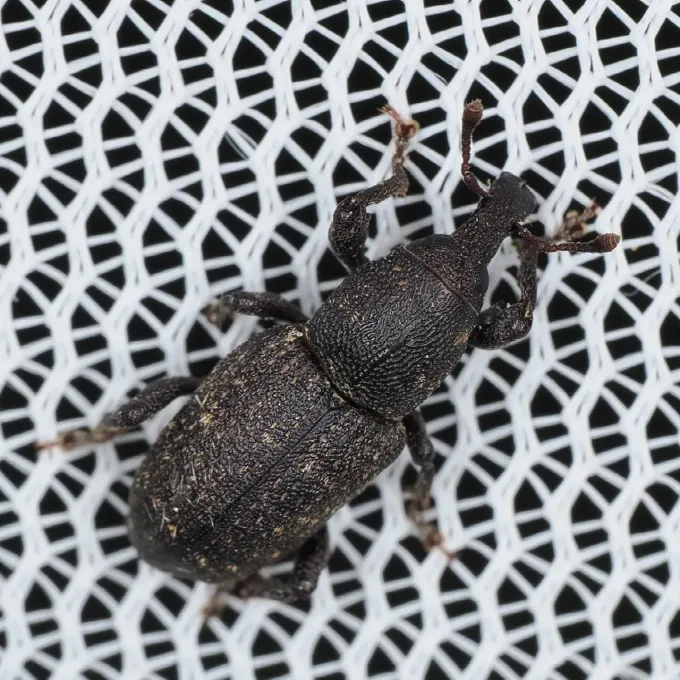
The adult beetle is 7 to 14 mm long, with a dark brown to black body covered in patches of golden-yellow scales that form distinct bands on the elytra.
It possesses a prominent, elongated rostrum (snout) typical of Curculionidae, which is used for feeding on bark and drilling holes for egg-laying.
The larvae are legless, cream-white grubs with a brown head capsule, specialized for tunneling within the roots of decaying or freshly cut stumps.
Pupation occurs in a specialized chamber known as a pupal cell, which the mature larva carves out in the wood of the root or in the surrounding soil.
Identification is best achieved by observing adult beetles on seedlings or under the bark of coniferous stumps in recently cleared forest areas.
What it damages
Adult weevils cause significant damage by feeding on the tender bark of young conifer seedlings, including pine, spruce, and larch.
Feeding often occurs at the root collar, where the beetles remove patches of bark, effectively girdling the tree and causing rapid death.
Young plantations up to 7 years old are most vulnerable, and severe infestations can destroy the vast majority of seedlings in a single season.
The larvae do not damage live trees; they strictly rely on the roots of dying or harvested trees, making stumps the primary breeding reservoir.
The economic impact includes high reforestation costs and severe loss of growth and stocking density in newly established coniferous stands.
When it appears
Adult weevils emerge from their overwintering sites in the leaf litter during early spring as soon as ground temperatures begin to rise.
The peak activity period for feeding and migration is typically between late spring and early summer, coinciding with the seedling growth season.
A second, smaller peak of activity often occurs in late summer, representing the emergence of a new generation of young adult beetles.
Overwintering takes place either as adults in the soil and leaf litter or as larvae of various developmental stages within the root systems of stumps.
The life cycle is highly variable, ranging from 1 to 3 years, heavily dependent on regional climate conditions and the availability of breeding material.
Signs of infestation
The primary symptom is the presence of irregular, notched bark wounds on the stems of young seedlings, often leading to total girdling near the soil line.
Frass (larval waste) and wood shavings found around the base of trees or under the bark of nearby stumps indicate an active infestation.
Wilting and browning needles on young trees are clear visual indicators that the vascular system is being compromised by adult feeding activity.
Inspecting the bark of nearby stumps reveals extensive, winding galleries carved by larvae, which confirms the area as a breeding source.
Beetles are nocturnal and often remain hidden in the soil during the day, so checking the soil surface near the stem base is a reliable diagnostic step.
Control measures
The most effective silvicultural practice is delaying replanting on fresh clear-cut sites for 2-3 years until the stumps are no longer suitable for breeding.
Utilizing container-grown seedlings (with closed root systems) significantly improves survival rates and resistance to initial weevil attacks.
Log traps (billets of fresh pine wood) can be placed throughout the forest area to attract adults, which are then collected and destroyed periodically.
Chemical treatments, involving the application of insecticides to seedlings before planting, are used in high-risk areas to protect vulnerable young trees.
Biological control options, such as the application of entomopathogenic fungi or nematodes to stumps, can help reduce the population of developing larvae.
Taxonomy
- Latin name
- Pachylobius
- Order
- Coleoptera (beetles)
- Family
- Curculionidae
- EPPO code
- PACLSP
Discussion
No discussions yet — be the first.