
Citrus root weevil
Pachnaeus opalus
Description
How to identify
The Citrus root weevil, Pachnaeus opalus, belongs to the family Curculionidae within the order Coleoptera. As a classic member of the weevil family, the adult is easily recognizable by its elongated snout and robust body structure, which is typical for this group.
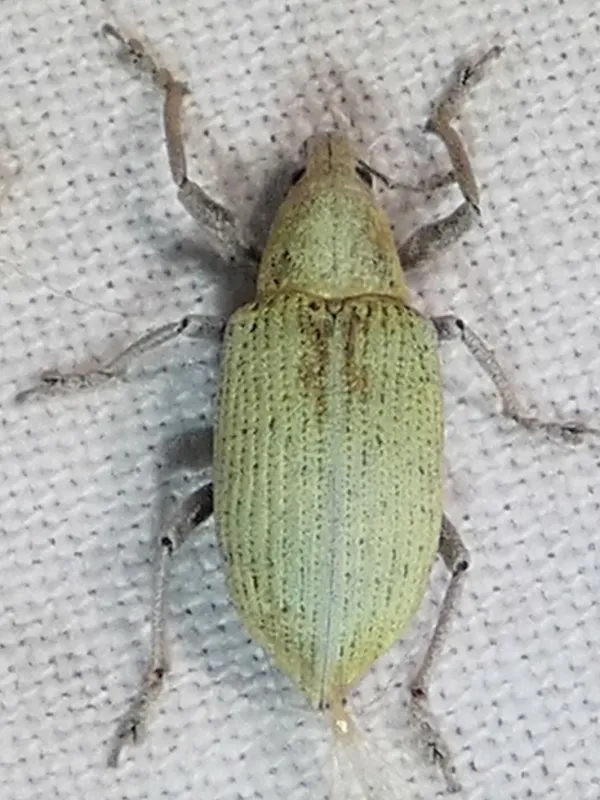
The adult weevils are characterized by a greenish-blue or opalescent appearance caused by tiny scales covering their exoskeleton. This coloration serves as effective camouflage against the foliage of citrus trees, making them difficult to spot during routine scouting.
Larvae are legless, white, and fleshy, with a distinctive C-shaped posture. Their head capsule is dark brown and highly sclerotized, adapted for chewing through tough root tissues, which is the primary food source for this developmental stage.
The lifecycle follows complete metamorphosis, including egg, larva, pupa, and adult stages. Because the larvae develop underground while adults reside in the canopy, effective management requires targeting both life stages separately.
Monitoring for this pest is best conducted by visual inspection of leaves for adult feeding activity and checking the root zone for larval presence, often involving soil sampling during the warmer months of the year.
What it damages
This weevil primarily targets the family Rutaceae, with citrus species like oranges, lemons, and grapefruits being the most economically significant hosts. Infestations can lead to severe stress on the plant and reduced fruit production.
Adults feed on the foliage by chewing irregular notches along the leaf margins. While this damage is rarely lethal to mature trees, high populations of adults can cause significant defoliation, which hampers the tree's photosynthetic capacity.
The most severe damage occurs at the larval stage, as the larvae feed on the roots. They target the fibrous roots first, eventually moving to larger lateral roots, causing lesions and girdling that severely restrict water and nutrient uptake.
Root damage serves as a secondary pathway for soil-borne pathogens, such as Phytophthora, which can induce root rot. This complication further accelerates the decline of the tree, manifesting as yellowing foliage and branch dieback.
In commercial orchards, persistent larval feeding leads to tree decline, reduced crop yields, and, in severe cases, the eventual death of the tree, necessitating replanting and substantial economic loss for growers.
When it appears
The activity of the Citrus root weevil is strongly dictated by seasonal temperature fluctuations. Adults typically emerge from the soil and move to the canopy during the late spring and summer months to mate and feed on new growth.
Egg-laying occurs shortly after mating, with females depositing eggs in protected areas such as on leaves or within crevices. The emerging larvae then drop to the soil, where they burrow to begin their feeding cycle on the tree's root system.
In tropical and subtropical environments, where temperature variations are less extreme, adults may be present for the majority of the year, although peak population density often correlates with active spring vegetative flushing.
Winter dormancy occurs primarily in the larval stage, where the insects survive deep in the soil profile. As soil temperatures rise in the spring, larvae resume feeding, and pupation begins, leading to the next cycle of adult emergence.
Understanding these seasonal patterns allows growers to time their pest control applications effectively, particularly targeting adults before they lay eggs and before larvae become deeply established in the root zone.
Signs of infestation
The most obvious symptom of an adult Citrus root weevil infestation is the characteristic notched leaf damage. These semicircular or irregular bites along the leaf margins are a tell-tale sign that weevils are feeding in the canopy.
Subtle signs of root damage include a decline in general tree vigor, characterized by chlorosis (yellowing) of the leaves, even when the tree is adequately irrigated. This happens because the root system can no longer supply sufficient water.
Dieback of branches is a critical indicator of advanced root damage. As the root mass is consumed by larvae, the tree loses the ability to support its upper growth, leading to premature leaf drop and the eventual death of small limbs.
Adults exhibit a defensive behavior known as thanatosis, where they feign death and drop to the ground when disturbed. Finding these beetles on the soil surface or the underside of leaves during the day is a confirmative sign of their presence.
- Notched leaf edges due to adult feeding.
- General yellowing of leaves (chlorosis).
- Slowed growth and lack of canopy density.
- Premature dropping of leaves and branch dieback.
Control measures
Managing the Citrus root weevil requires an integrated approach. Foliar applications of insecticides during the adult emergence phase are essential to reduce the number of beetles capable of egg-laying and causing further leaf damage.
Root protection is more complex and involves applying soil insecticides or utilizing biological control agents like entomopathogenic nematodes. These microscopic worms seek out and infect larvae in the soil, providing a sustainable suppression method.
Orchard management practices, such as maintaining optimal tree health, are crucial. A well-nourished and correctly irrigated tree is more resilient and can withstand and recover from light to moderate root-feeding pressure better than stressed trees.
Regular monitoring using trunk traps or canopy inspection helps determine the exact timing for control measures. By keeping track of adult activity, growers can maximize the efficacy of their treatments and minimize unnecessary chemical use.
Sanitation of the orchard floor and controlling alternative weed hosts can also help limit the population of the weevil. Keeping the area free of weeds reduces the shelter and supplemental food sources available for the adults during their life cycle.
Taxonomy
- Latin name
- Pachnaeus opalus
- Order
- Coleoptera (beetles)
- Family
- Curculionidae
- EPPO code
- PACNOP
Discussion
No discussions yet — be the first.