
Citrus root weevil
Pachnaeus litus
Description
How to identify
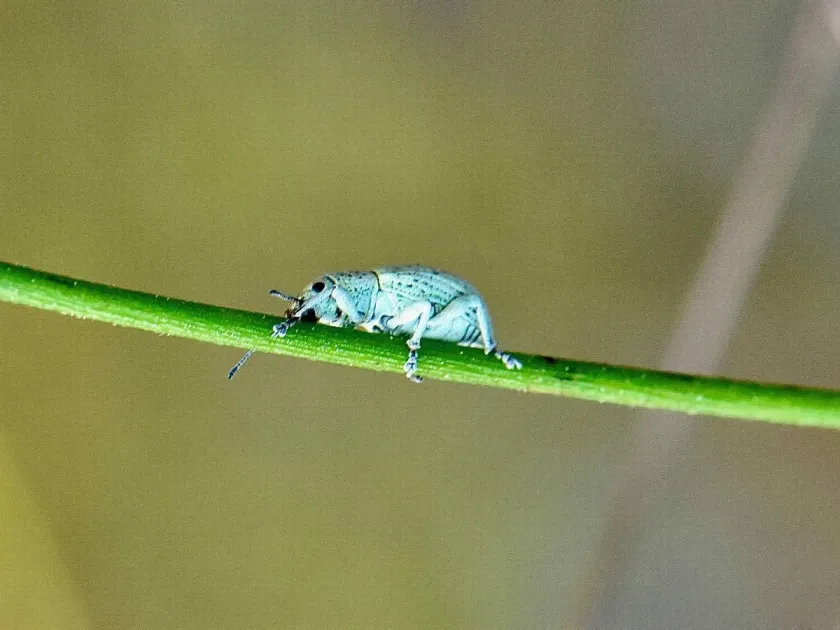
The Citrus root weevil, Pachnaeus litus, is a significant member of the Curculionidae family within the order Coleoptera. Adult beetles measure approximately 10–12 mm and display a distinct coloration ranging from light green to bluish-green, allowing them to blend into the canopy.
Their bodies are densely covered in minute scales that give them a matte appearance. The head features a characteristic snout (rostrum) typical of the weevil group, with elbowed antennae attached, which is a key diagnostic feature for visual identification.
The larval stage consists of legless, creamy-white grubs with a prominent brown head capsule. These larvae spend their entire life cycle underground, feeding on the root system, which makes them difficult to observe until significant damage has already occurred.
The insect undergoes a complete metamorphosis involving egg, larva, pupa, and adult stages. Females deposit eggs in clusters between glued leaves, after which the newly hatched larvae fall to the soil surface to begin their development.
Environmental factors, particularly soil moisture and temperature, play a crucial role in the survival rate of the population. The life cycle can span several months, leading to overlapping generations in warmer climates throughout the year.
What it damages
The pest primarily targets citrus species, including oranges, limes, and grapefruits. Both the adult stage, which feeds on foliage, and the larval stage, which feeds on roots, contribute to the overall decline of the host tree.
Adult weevils feed on leaves by creating characteristic semi-circular notches along the margins. While this foliage damage is rarely fatal, it significantly reduces the tree's photosynthetic capacity, especially in younger saplings.
Larval feeding is the most destructive part of the cycle. Grubs chew through fine feeder roots and strip the bark from larger lateral roots, severely restricting the tree's ability to uptake water and essential nutrients from the soil.
Tree symptoms include stunted growth, chlorosis, and premature fruit drop. In cases of severe infestations, the cumulative damage to the root system can result in the total collapse and death of the citrus tree.
Furthermore, larval feeding creates entry points for various soil-borne pathogens, including Phytophthora species, which can cause secondary root rot infections, further complicating the health of the orchard.
Signs of infestation
The most visible indicator of an infestation is the presence of irregular notches along the edges of the leaves. Observing the foliage during dusk or dawn, when beetles are most active, can confirm their presence.
Egg clusters found between two leaves glued together are a definitive sign of reproductive activity. Inspecting the top growth of the canopy during the summer months is highly recommended for early detection.
General tree stress, such as wilting during the hottest parts of the day despite adequate irrigation, is a major red flag indicating that the root system has been compromised by larvae.
Digging into the soil near the base of the tree often reveals the presence of white, grub-like larvae. Finding even a few individuals in the root zone suggests that an active population is present in the soil.
Reduced vigor and thin canopy cover, combined with poor fruit production, are strong indications that the infestation has reached a level requiring immediate intervention.
Control measures
Effective management of Pachnaeus litus relies on an integrated pest management (IPM) approach, combining mechanical, biological, and chemical strategies. Keeping the area under the tree canopy clear of debris is a good starting point.
The use of entomopathogenic nematodes (such as Steinernema riobrave) has proven highly effective in controlling the soil-borne larval stage. Applying these biological agents during periods of high soil moisture maximizes their effectiveness.
Chemical control focuses on targeting adults during the peak emergence periods using labeled insecticides. Treatments should be timed to minimize impact on non-target beneficial insects, such as bees.
Monitoring using light traps or sticky boards can help producers identify the onset of adult emergence, allowing for targeted spray applications rather than calendar-based spraying.
- Regular soil disturbance beneath the canopy.
- Application of entomopathogenic nematodes.
- Targeted insecticide applications during adult emergence.
- Removal and disposal of damaged canopy leaves.
Taxonomy
- Latin name
- Pachnaeus litus
- Order
- Coleoptera (beetles)
- Family
- Curculionidae
- EPPO code
- PACNLI
Discussion
No discussions yet — be the first.