
Pachnaeus
Pachnaeus
Description
How to identify
Pachnaeus is a genus of broad-nosed weevils belonging to the family Curculionidae, known for being a significant pest in agricultural sectors.
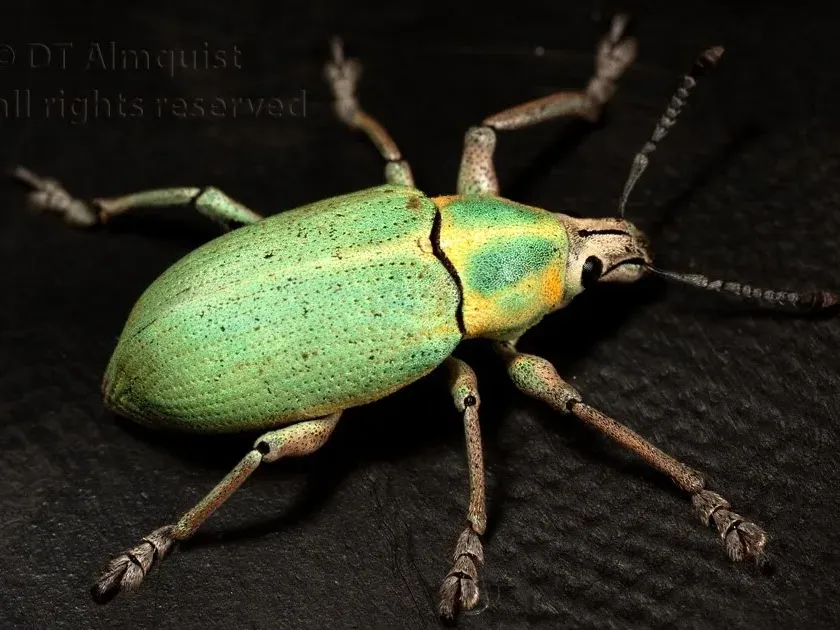
Adult beetles typically measure between 7 to 12 millimeters in length and feature a coloration ranging from bright green to grayish-blue.
Their bodies are densely covered with tiny scales, which provide excellent camouflage when they are resting on the leaves of host plants.
The larval stage consists of legless, creamy-white grubs with a characteristic C-shaped curvature, typically found living deep within the soil.
As coleopterans, they undergo a complete metamorphosis, progressing through egg, larval, pupal, and adult stages to complete their lifecycle.
What it damages
The primary economic damage is caused to citrus trees, including oranges, lemons, grapefruits, and various lime species in tropical and subtropical regions.
Beyond citrus, Pachnaeus can affect a variety of other host plants, including ornamental shrubs, avocado trees, and other fruit-bearing species.
Adults feed on the foliage, typically consuming the leaf margins, which creates a jagged, scalloped appearance and reduces the plant's photosynthetic surface.
The larvae are particularly destructive as they feed on the root systems of trees, stripping away the bark from roots and damaging fine feeder roots.
Root damage compromises the tree's ability to absorb nutrients and water, often leading to canopy thinning, yellowing leaves, and severe yield reduction.
Signs of infestation
The most distinctive sign of a Pachnaeus infestation is the scalloped leaf edges, which are highly visible after adults have been feeding in the canopy.
Tree decline, characterized by poor fruit set and leaf chlorosis, often points to an underlying infestation of larvae feeding on the root system.
During the warmer months, adults are frequently found on the leaves or stems of host plants, where they tend to be most active at dusk.
Stunted growth in young citrus groves is frequently linked to heavy larval pressure on roots, which restricts the tree's vigor and development.
Secondary infections often manifest in weakened trees, as the damage caused by the weevils provides entry points for various pathogens and fungi.
Control measures
Chemical control involving systemic or contact insecticides is often necessary to suppress adult populations and prevent further egg-laying.
Biological control methods, such as the application of entomopathogenic nematodes to the soil, have proven successful in managing larval populations.
Cultural practices, including regular tilling of the soil around the base of the trees, can help disrupt the larval stage and reduce successful pupation.
Monitoring programs using light traps or canopy inspections help determine the timing for interventions to prevent populations from reaching economic thresholds.
An integrated pest management (IPM) approach remains the best strategy, combining habitat modification, biological agents, and judicious insecticide use.
Taxonomy
- Latin name
- Pachnaeus
- Order
- Coleoptera (beetles)
- Family
- Curculionidae
- EPPO code
- PACNSP
Discussion
No discussions yet — be the first.