
Melaleuca weevil
Oxyops vitiosa
Description
How to identify
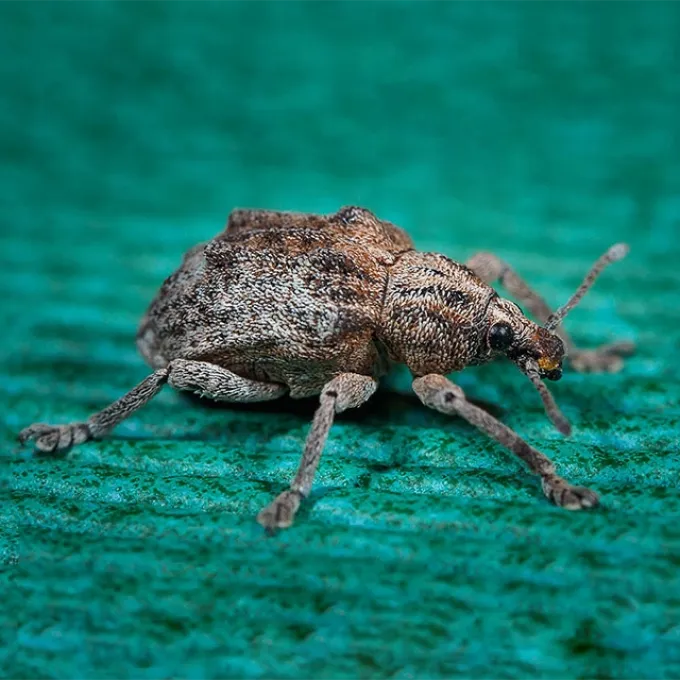
The Melaleuca weevil (Oxyops vitiosa) is a beetle belonging to the family Curculionidae. Adult weevils are roughly 8–10 mm long with a mottled brown and gray pattern on their exoskeleton, which serves as excellent camouflage against the bark of their host tree.
The larval stage is particularly distinct; larvae are yellowish-green and typically cover themselves in their own frass or a mucous-like substance. This protective coating serves as both a physical barrier against predators and a camouflage, making them resemble fresh plant buds.
The life cycle of Oxyops vitiosa is closely synchronized with the growth flushes of its host plants. Females deposit eggs on young leaves or the tips of expanding shoots, ensuring the larvae have immediate access to high-quality food upon hatching.
Development involves several larval instars followed by a pupation phase. Pupation occurs in the soil beneath the host plant, where the insect constructs a cocoon. Depending on the environmental temperature, the species can complete multiple generations within a single year.
This species is widely recognized as a successful biological control agent in programs aimed at suppressing the expansion of invasive Melaleuca trees in non-native environments, such as Florida.
What it damages
The primary host plants for the Melaleuca weevil are species within the genus Melaleuca, specifically Melaleuca quinquenervia. Both adults and larvae feed exclusively on the foliage, with a strong preference for tender, developing shoots and leaves.
Due to its high host specificity, the weevil does not threaten surrounding native vegetation or common agricultural crops. This trait makes it an ideal candidate for managing invasive plant populations in sensitive ecosystems.
Feeding damage by adults results in notched leaves and irregular patterns along the margins. While minor grazing is usually aesthetic, high populations can significantly defoliate the plant, reducing its ability to photosynthesize.
Larval feeding is more destructive, as they strip the surface of the leaves, often targeting the apical meristems. Constant removal of new growth stunts the plant's vertical development and reduces the tree's overall vigor.
In cases of severe infestation, young seedlings may experience reduced survival rates. For larger trees, chronic herbivory by the weevil can suppress flowering and seed production, limiting the plant's spread in the wild.
Signs of infestation
Early signs of infestation include jagged edges on new leaves, created by adult weevil feeding. The leaves often appear tattered, as adults consume large portions of the leaf blade between the main veins.
Larval tracks appear as thin, meandering, window-like scars on the leaf surface. These trails are often marked by trails of frass or debris, which are diagnostic indicators of larval presence on the foliage.
Stunted or deformed shoot tips are common indicators that larvae are feeding on the apical buds. If the tip of the shoot appears withered or blackened, it is often due to extensive grazing by the weevil larvae.
The presence of sticky, frass-covered larvae on the undersides of leaves or along stems is the most direct observation of an active infestation. During the day, larvae are often found clustered in areas with fresh, succulent growth.
Evidence of pupation can sometimes be found at the base of the tree in the form of small, earthen cocoons buried in the leaf litter or topsoil, indicating that the larvae have completed their development.
Control measures
In environmental management, the Melaleuca weevil is often protected as a beneficial insect. However, if they become problematic in ornamental settings, monitoring their population density is the first step for effective control.
Chemical control is rarely recommended unless the host plant is highly valued and the damage is severe. Systemic insecticides are the most effective method, as they are absorbed by the plant and provide long-lasting protection against larval feeding.
Integrated Pest Management (IPM) encourages the preservation of natural enemies, such as parasitic wasps or predatory bugs, which help keep the weevil population in check without the need for chemical intervention.
Pruning of heavily infested branches and their prompt removal is a safe mechanical control technique. This helps localize the infestation and prevents larvae from reaching the pupation stage in the soil.
Maintaining tree vigor through proper irrigation and balanced fertilization can help the plants better tolerate herbivory. Healthy trees can often compensate for the damage caused by the weevil, minimizing the aesthetic impact.
Taxonomy
- Latin name
- Oxyops vitiosa
- Order
- Coleoptera (beetles)
- Family
- Curculionidae
- EPPO code
- OXOPVI
Discussion
No discussions yet — be the first.