
Oxyops
Oxyops
Description
How to identify
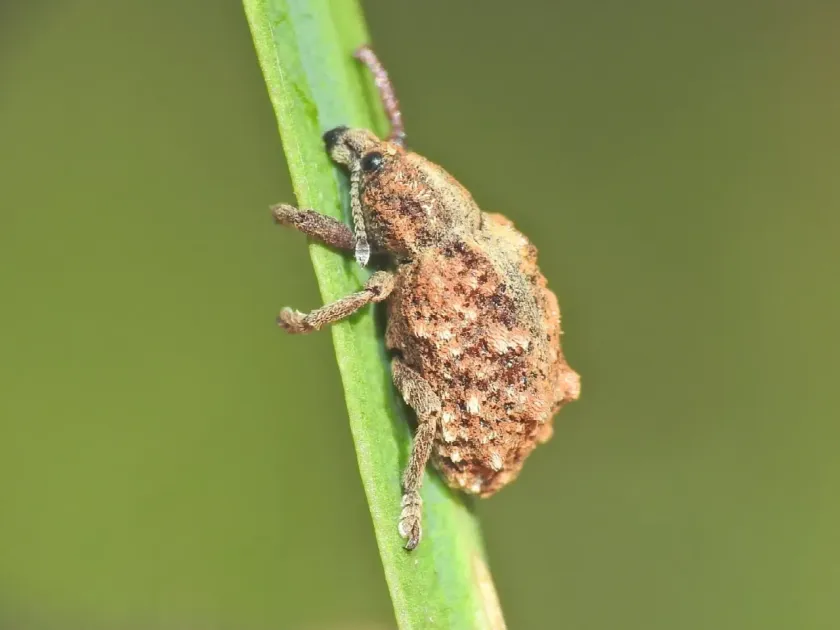
Oxyops belongs to the family Curculionidae (weevils) within the order Coleoptera. These insects are characterized by their distinct snout structure and often possess cryptic coloration, allowing them to blend in with tree bark or withered foliage.
Adult beetles generally have an elongated body, typically ranging from 5 to 12 mm in length. Their elytra may be covered with scales or fine hairs, making them difficult to spot against vegetation. They are known for being sluggish and often drop to the ground, playing dead when threatened.
The larvae of Oxyops often secrete a slimy covering or create a protective coating using their own frass, giving them the appearance of small slugs or bird droppings. This is a critical adaptation for survival on open leaves.
The life cycle undergoes complete metamorphosis, consisting of egg, larva, pupa, and adult stages. Depending on the specific species, the development cycle is often tightly synchronized with the phenological stage of the host plant.
Identification can be challenging due to the narrow host-specificity of many species within the genus. Precise identification often requires professional entomological examination, focusing on genital structures or specific body patterns.
What it damages
The primary hosts for most Oxyops species are plants within the family Myrtaceae, particularly various eucalyptus species. In certain regions, they pose a significant threat to forestry plantations and nurseries.
Larvae feed on the epidermis and parenchyma of young leaves, creating characteristic "windows" or skeletonizing the leaf blade. This feeding behavior causes significant deformation of young shoots and reduces the plant's photosynthetic capacity.
Adults also feed on leaves, chewing irregular edges or drilling circular holes into the leaf surface. High pest populations can lead to mass defoliation, which severely weakens the host tree.
Young saplings are most vulnerable, as damage to the terminal buds can stop growth and cause permanent stem curvature. Repeated infestations throughout the season may eventually lead to the death of the young plants.
The economic impact of Oxyops is significant in commercial eucalyptus plantations grown for essential oils or timber, as biomass reduction directly translates to lower overall productivity.
Signs of infestation
One of the primary indicators of an Oxyops infestation is the presence of characteristic skeletonized patterns on young eucalyptus leaves. Over time, these damaged areas turn brown and necrotic, resulting in a scorched appearance.
During inspection, the larvae themselves can be found on the foliage, appearing as moist, shiny organisms. They are frequently found aligned along the central vein of the leaf, which helps in identifying their presence.
The presence of fecal matter, which larvae use to cover their bodies as a protective shield, acts as a specific indicator of the pest's activity. These often appear as small, dark, lumpy deposits on the leaf surface.
Stunted overall growth in trees, in the absence of obvious root diseases or water stress, can be an indirect sign of concealed shoot damage caused by Oxyops.
- Deep, irregular notches along leaf edges.
- Deformation and curling of young leaf blades.
- Discovery of pupae in silk-like cocoons on the bark or leaf surfaces.
Control measures
Chemical control involves the application of systemic insecticides that translocate through plant tissues, effectively targeting larvae that feed on the epidermis. Applications are most effective during the larval hatch period.
Biological control strategies emphasize the use of natural enemies. In their native ranges, Oxyops populations are regulated by specialized parasitic wasps and predatory bugs.
Cultural control measures, such as regular pruning and the removal of heavily infested shoots, help reduce the overall population density within a nursery. Maintaining spatial isolation for young plantings is also recommended.
Monitoring using yellow sticky traps allows growers to pinpoint the peak activity period of adult beetles, enabling timely and targeted spray applications. This helps minimize the number of chemical treatments required per season.
The use of entomopathogenic fungi, such as Beauveria bassiana, has shown promise under humid conditions, effectively infecting both larvae and adult stages of the pest.
Taxonomy
- Latin name
- Oxyops
- Order
- Coleoptera (beetles)
- Family
- Curculionidae
- EPPO code
- OXOPSP
Discussion
No discussions yet — be the first.