
Four-toothed platypodid
Oxoplatypus quadridentatus
Description
How to identify
The four-toothed platypodid (Oxoplatypus quadridentatus) is a species of ambrosia beetle belonging to the family Curculionidae, subfamily Scolytinae.
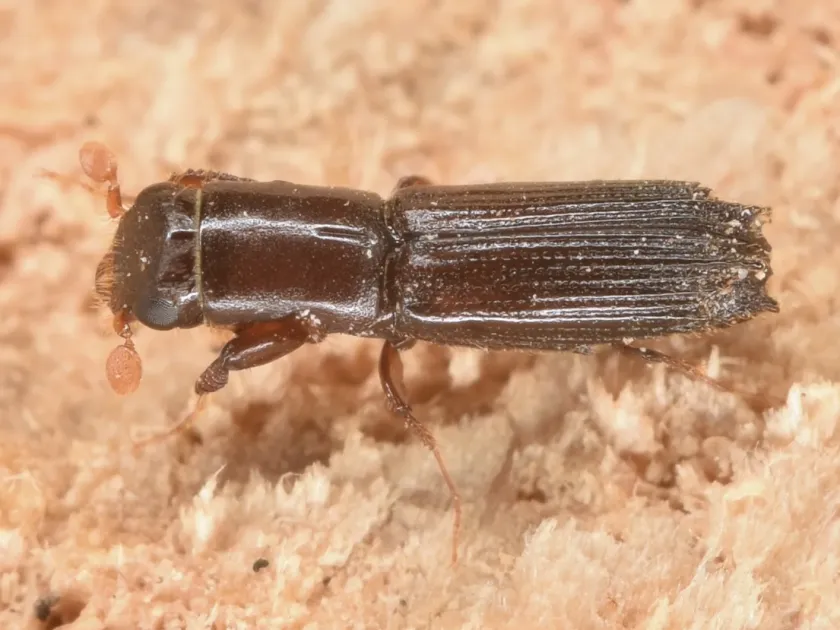
These beetles are characterized by a slender, cylindrical body shape, which is highly adapted to tunneling deep into the wood of host trees.
Adults are typically dark brown to black, with distinct anatomical features on their elytra, specifically the four tooth-like structures on the declivity.
They live in complex galleries that they excavate within the xylem, where they cultivate symbiotic fungi that serve as the primary food source for their larvae.
Identification often requires examining the characteristic entrance holes and the specific pattern of galleries found within the infested timber.
What it damages
This species predominantly attacks hardwoods, showing a preference for stressed, dying, or recently felled timber.
The larvae and adults bore into the sapwood and heartwood, creating extensive networks of tunnels that structurally weaken the wood.
By introducing wood-decay fungi, they accelerate the degradation of the timber, making it unsuitable for high-quality commercial or construction use.
In forest stands, repeated attacks can lead to the death of trees, especially if the beetles exploit environmental stressors to infest more susceptible hosts.
The financial impact involves significant losses in timber volume and value, coupled with the costs associated with sanitation and pest management efforts.
Signs of infestation
The most visible indicator of an infestation is the presence of fine, wood-colored boring dust (frass) accumulating at the base of the tree or in bark crevices.
Small, perfectly round entrance holes on the bark surface are a definitive sign that beetles have begun burrowing into the tree.
Staining of the wood tissue around the galleries is common, caused by the ambrosia fungi that the beetles farm within the tree trunk.
As the infestation progresses, internal damage can manifest as branch dieback or canopy thinning, signaling that the structural integrity of the tree is compromised.
Debarking or inspecting freshly cut logs often reveals the presence of tunnels, sometimes accompanied by the insects themselves or their larval offspring.
Control measures
Effective management begins with strict sanitation, including the prompt removal and processing of infested wood to prevent the spread of the population.
Avoiding the accumulation of logging debris in the forest is crucial, as this material provides an ideal breeding ground for the beetles.
Monitoring programs using pheromone traps can help track beetle activity and determine the timing of specific management interventions.
Promoting the health of the forest through proper silvicultural practices increases the natural resistance of trees to attack by these pests.
When high-value specimens are at risk, systemic insecticide treatments may be applied by professional arborists to prevent colonization during peak flight periods.
Taxonomy
- Latin name
- Oxoplatypus quadridentatus
- Order
- Coleoptera (beetles)
- Family
- Curculionidae
- EPPO code
- OXPLQU
Discussion
No discussions yet — be the first.