
Platypod
Oxoplatypus
Description
How to identify
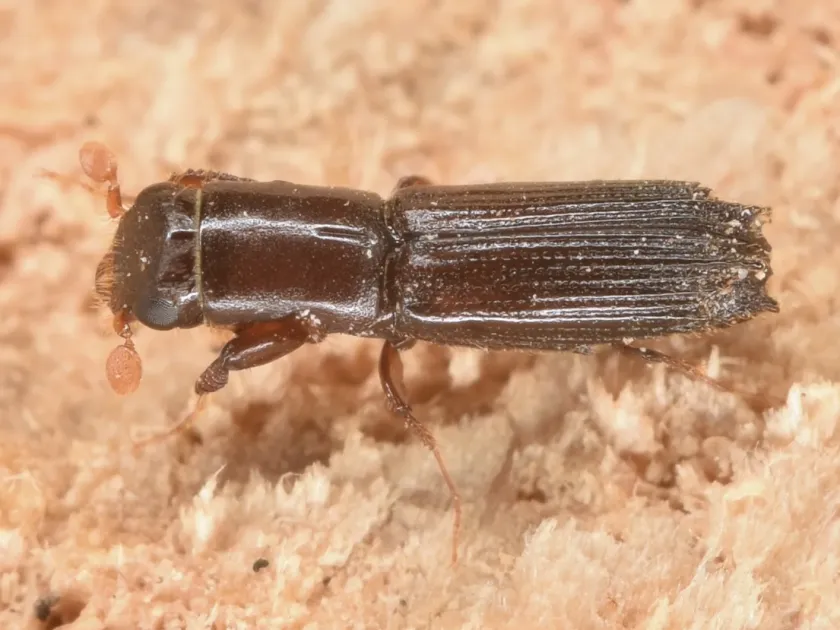
Platypod beetles (genus Oxoplatypus) belong to the family Curculionidae, subfamily Scolytinae. These are slender, cylindrical beetles that lead a hidden lifestyle within wood tissue.
Adult beetles possess an elongated body structure, specifically adapted for navigation through narrow tunnels deep inside tree trunks and branches.
A distinctive biological feature of these beetles is the presence of specialized organs called mycangia, which are used to carry fungal spores for cultivation.
The larvae are white, legless, and possess a well-developed head capsule, specialized for feeding on wood conditioned by the ambrosia fungi.
Systematically, they are classified within the tribe Platypodini, distinguished by unique leg and mouthpart structures that facilitate their specialization as xylophagous insects.
What it damages
Platypods are typical wood-boring pests that primarily infest weakened, stressed, or fallen trees of various broad-leaved and coniferous species.
Their host range includes valuable timber species, such as oak and beech, as well as several conifers depending on the specific beetle species.
They cause significant economic losses in forestry by infesting freshly cut logs, which leads to a sharp decline in timber grade due to deep tunnel penetration.
These pests do not consume wood directly as their primary nutrient source; instead, they farm ambrosia fungi within their tunnels, which serves as food.
Mass infestations can lead to the death of even relatively healthy trees during periods of extreme drought or severe environmental stress on forest stands.
When it appears
The activity of these beetles is closely linked to ambient temperature, typically beginning when air temperatures reach 15–18 degrees Celsius.
The first flight of overwintering adults usually occurs during the spring, coinciding with the start of active sap flow in host trees.
Multiple generations can develop within a single season, provided that climatic conditions remain favorable for their reproduction and larval development.
Activity concludes in the autumn as temperatures drop, at which point the beetles enter a dormant state within the protection of the wood.
Overwintering occurs inside the maternal tunnels, which provide the necessary thermal insulation for the adults to survive low winter temperatures.
Signs of infestation
A primary indicator of infestation is the accumulation of fine wood dust, or "frass," either light or dark in color, found at the base of the tree trunk.
The surface of the bark will often feature numerous small, perfectly circular entry holes, which are characteristic signs of Platypod boring activity.
Cross-sectioning the infested wood reveals deep, radially oriented tunnels that often exhibit a dark discoloration due to the presence of cultivated fungi.
External symptoms of tree decline include premature yellowing of the foliage, dieback of individual branches, and bark shedding in heavily infested areas.
A musty or moldy odor often emanates from the wood, signaling the active fungal growth maintained by the beetle colony within the tree.
Control measures
The most effective preventative measure is consistent sanitary logging and the removal of logging residues and deadwood from forest areas.
It is critical to minimize the duration that freshly cut timber is stored in the forest during the spring and summer months to avoid colonization.
The use of pheromone-based traps is highly recommended to monitor population dynamics and to time protective chemical interventions accurately.
In nurseries and botanical gardens, trunk injections of systemic insecticides can be an effective method to suppress outbreaks in high-value trees.
- Adhere to sustainable forestry practices.
- Rapid transportation of harvested timber.
- Encouragement of natural predators and parasitoids.
Taxonomy
- Latin name
- Oxoplatypus
- Order
- Coleoptera (beetles)
- Family
- Curculionidae
- EPPO code
- OXPLSP
Discussion
No discussions yet — be the first.