
Great bustard
Otis
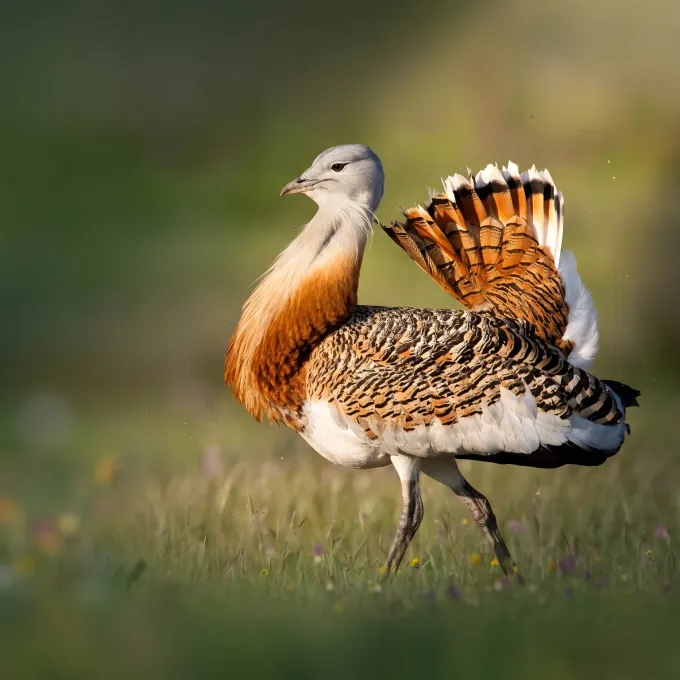
Description
How to identify
The Great Bustard (Otis tarda) is a large bird species belonging to the Otididae family and the order Otidiformes. It is one of the heaviest flying birds in the world, characterized by a robust body, a powerful neck, and a distinctive mottled plumage that provides excellent camouflage in open grassland habitats.
Males are significantly larger than females and develop impressive neck plumage and long whiskers during the breeding season. These birds are extremely wary and prefer open plains where they can maintain clear visibility of their surroundings.
The biology of this species is tied to vast, open agricultural landscapes, which provide nesting and foraging grounds. Because of their size, they are primarily terrestrial and tend to walk, only taking flight when they feel severely threatened.
Their cycle of development involves seasonal movements and a concentrated breeding period in the spring. During this time, they are highly sensitive to disturbances and agricultural machinery operations.
As a species with high conservation value, the Great Bustard must be identified carefully, and any field management practices must respect strict environmental regulations protecting this endangered bird.
What it damages
The Great Bustard impacts agricultural fields by foraging on sprouting crops, including cereals, legumes, and oilseed crops. They primarily feed on the tender shoots of seedlings, which can cause significant damage to young plants.
In fields of winter crops, these birds can graze heavily on the vegetation, leading to sparse plant stands and reduced overall crop yield. The mechanical damage caused by their heavy walking and trampling further exacerbates the problem.
While they feed on various plant tissues, the most critical period for economic impact is during the initial growth phase of the crop. Large flocks of bustards can cause noticeable gaps in crops if they remain in one area for extended periods.
Beyond the direct consumption of plant material, their foraging activity can damage the root systems of young plants, hindering the ability of the crop to recover after the disturbance.
However, the total damage is usually localized and dependent on the proximity of the field to established nesting territories rather than a systematic widespread infestation across all agricultural areas.
When it appears
The highest level of bird activity on fields is observed in early spring, when they require high-protein forage to recover after wintering or during the pre-nesting period. This is when cereal seedlings are most vulnerable.
During the summer months, the birds stay close to their nesting sites. While their feeding continues, the crops are generally more established and can withstand light grazing better than at the seedling stage.
Autumn brings pre-migratory flocking, where birds gather in larger groups. During this season, they often frequent harvested fields or stubble, causing minimal impact on standing crops.
Daily activity patterns are usually restricted to dawn and dusk, when the birds are most active in their foraging. During the heat of the day, they prefer to remain in sheltered or less exposed locations.
Seasonal fluctuations in the birds' presence are closely linked to the phenology of the crops and weather conditions that influence the availability of alternative natural food sources.
Signs of infestation
The most reliable sign of the Great Bustard's presence is the identification of their large, deep tracks on the soil. These tracks are distinct and indicate a heavy, walking animal rather than a small bird or rodent.
Foraging signs are often visible as patches of missing or "clipped" seedlings where the birds have grazed. When flocks are large, these patches become clear, bare spots within the field.
Droppings left in the field are a common secondary sign of recent bird activity. These can be used to monitor how long a flock has been inhabiting a specific portion of the farm.
Direct visual identification using binoculars in the early morning is the standard method for confirming the presence of the bustard on a specific plot of land.
The absence of typical pest indicators, such as rodent burrows or insect leaf damage, can help distinguish bird-related damage from other common agricultural issues.
Control measures
Management of the Great Bustard must prioritize non-lethal deterrence methods due to their status as a strictly protected species in most of their range. Direct harm to the birds is legally prohibited.
Bioacoustic deterrents, such as systems playing recorded predator calls, are highly effective in encouraging the birds to move to less sensitive areas without the need for physical interaction.
Visual repellents, including kites, reflectors, and silhouettes, can be used, provided they are rotated regularly to prevent the birds from habituating to the stimuli.
Strategic land management, such as creating dedicated buffer zones or green strips with natural forage, can entice the birds away from highly productive commercial crop areas.
- Bioacoustic bird scarers.
- Visual deterrents (kites and reflectors).
- Cooperation with local conservationists.
- Strategic buffer zones for wildlife.
Taxonomy
- Latin name
- Otis
- Family
- Otididae
- EPPO code
- OTISSP
Discussion
No discussions yet — be the first.