
Black vine weevil
Otiorhynchus sulcatus
Description
How to identify
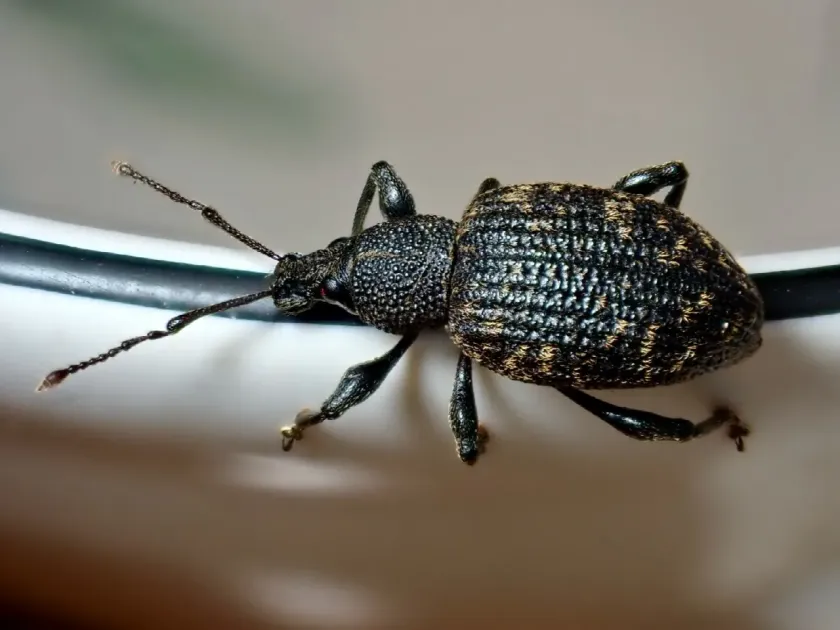
The Black vine weevil (Otiorhynchus sulcatus) is a significant pest belonging to the order Coleoptera and the family Curculionidae. The adult weevil is 8–11 mm long, typically dark brown or black in color with small patches of light scales on its wing covers.
The insect body has a rugged texture with distinct grooves, which gives the species its common name. Notably, these weevils are flightless, meaning they rely on crawling to move, which restricts their natural dispersal range but allows for persistent localized infestations.
The larvae are legless, C-shaped grubs with creamy white bodies and distinct tan-colored heads. They reach about 10–12 mm in length and live entirely underground, focusing their damage on the root systems of host plants.
This species reproduces parthenogenetically, meaning populations consist entirely of females capable of laying fertile eggs without mating. This reproductive strategy allows a single introduced individual to initiate a new infestation within a garden or greenhouse.
Adult weevils are strictly nocturnal, remaining inactive and hidden during the day. This behavior makes early detection challenging for many gardeners until significant damage to the plant foliage has already occurred.
What it damages
Black vine weevils are polyphagous and feed on a vast range of plants, including strawberries, rhododendrons, yews, grapes, and various greenhouse ornamentals. Both adults and larvae cause distinct types of injury to the plant.
Adults feed on foliage, creating characteristic semi-circular or crescent-shaped notches along the leaf margins. While these feeding scars are unsightly and weaken the plant, they rarely cause total plant collapse on their own.
Larval feeding is far more destructive. The grubs feed on the root hairs and eventually move to the main roots, often consuming the bark and girdling the stem base. This action effectively severs the plant's nutrient and water transport systems.
Heavy larval infestations frequently lead to the sudden wilting and collapse of established plants, even when irrigation is sufficient. In container-grown plants, the entire root ball can be completely consumed by the larvae.
Secondary damage often occurs through opportunistic infections. The wounds created by larvae allow soil-borne pathogens, such as Phytophthora or other root rots, to enter the plant, often accelerating the decline process initiated by the insect.
When it appears
Adult weevils typically emerge from the soil in late spring, around May or June, and continue their activity throughout the summer months. During this phase, they feed at night and begin laying eggs in the soil near the base of host plants.
Each female can produce hundreds, sometimes over a thousand eggs throughout the summer. These hatch into larvae within 2 to 3 weeks. These larvae then burrow into the soil to begin feeding on the root system.
The late summer and autumn are the peak periods for larval growth and feeding. As temperatures drop in late autumn, the larvae usually move deeper into the soil to overwinter as partially grown grubs.
Development resumes when soil temperatures increase in the spring. In greenhouse environments or protected structures, development can occur year-round without a period of diapause, causing constant pressure on nursery crops.
Monitoring for adults is most effective from late spring through summer using nocturnal inspections or placing traps on the ground. Understanding this cycle is crucial for timing the application of biological or chemical control agents.
Signs of infestation
The primary visual sign of a Black vine weevil infestation is the scalloped leaf edges caused by adult feeding. These notches are unmistakable and serve as the first warning that weevils are present in the immediate area.
Sudden wilting or chlorosis (yellowing) of foliage is a common symptom of larval damage to the roots. When a plant stops growing unexpectedly or begins to die without an obvious cause, checking the root zone is essential.
In container plants, the most diagnostic sign is when a plant comes out of the pot easily or shows total detachment of the root mass from the stem. If you pull the plant and it has no lower roots, larvae are almost certainly the cause.
The presence of C-shaped white larvae within the root zone soil confirms the infestation. Gardeners should dig into the top 5–10 cm of soil around the base of wilting plants to search for these grubs.
Finding nocturnal adults hiding under debris, mulch, or pots during the day is another clear sign. Placing boards or pieces of carpet on the soil surface at night and checking under them in the morning is a reliable monitoring technique.
Control measures
Biological control using entomopathogenic nematodes (such as Heterorhabditis bacteriophora) is the gold standard for managing vine weevil larvae. These microscopic organisms must be applied to moist, warm soil to actively hunt and parasitize the grubs.
Chemical control can be used against adults by spraying the foliage with appropriate insecticides during the evening when the insects are active. This helps reduce the number of adults capable of laying eggs for the next generation.
Cultural control includes maintaining clean environments and reducing mulch layers near the base of susceptible plants. Regularly turning the soil during the summer can also expose eggs and young larvae to natural predators or dry conditions.
Strict nursery sanitation is vital for greenhouse growers. Always inspect new plants for signs of larval damage or the presence of grubs in the growing medium before introducing them into the main collection.
For container plants, placing pots on raised stands or using physical barriers like sticky bands can inhibit the movement of flightless adults. This prevents them from crawling into the pots to lay eggs in the potting medium.
Taxonomy
- Latin name
- Otiorhynchus sulcatus
- Order
- Coleoptera (beetles)
- Family
- Curculionidae
- EPPO code
- OTIOSU
Discussion
No discussions yet — be the first.