
South snout beetle
Otiorhynchus meridionalis
Description
How to identify
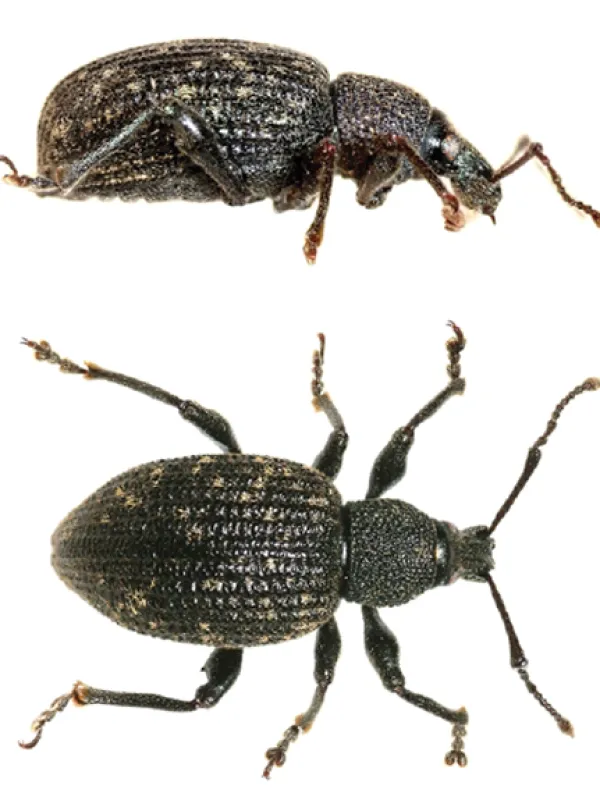
The South snout beetle (Otiorhynchus meridionalis) is a member of the Curculionidae family, commonly known as a root weevil. Adults typically measure between 7 and 9 mm in length and possess a characteristic oval-shaped body.
Their coloration ranges from dark brown to black, often covered with fine scales that give them a matte appearance. These beetles are nocturnal, spending their daylight hours hiding in soil crevices or under plant debris.
The larvae are legless, C-shaped, and creamy-white in color with a distinctive brown head capsule. They spend their entire developmental period in the soil, feeding on plant roots.
The species reproduces primarily through parthenogenesis, meaning females can produce offspring without mating, leading to rapid population growth in favorable conditions.
Adults possess strong mandibles adapted for gnawing leaf edges, which is a key diagnostic feature for gardeners and agronomists inspecting crops.
What it damages
This pest is a polyphagous insect, meaning it feeds on a wide variety of host plants. Both adults and larvae contribute to significant economic damage in agricultural and ornamental settings.
Primary host plants include fruit trees, berries (especially strawberries), potatoes, and various shrubs. Damage to the root system is often hidden, making the pest particularly dangerous to young plantings.
Larvae consume small roots and strip the bark off larger roots. This disrupts water and nutrient uptake, causing stunted growth, leaf chlorosis, and in severe cases, the death of the host plant.
Adult beetles feed on leaves, creating distinct semi-circular notches along the edges, often referred to as "notching." Severe defoliation can weaken the plant and reduce its photosynthetic capacity.
Wounds caused by the beetle's feeding can serve as entry points for secondary pathogens, such as soil-borne fungi and bacteria, leading to further plant decay.
When it appears
Adult emergence typically begins in the spring as soil temperatures rise. Peak adult activity usually occurs during May and June when they emerge from the soil to feed.
During the heat of mid-summer, adult activity may decrease slightly, but they continue to feed at night throughout the season until the onset of cooler autumn temperatures.
Eggs are laid in the soil near the base of host plants. Upon hatching, the larvae move deeper into the root zone to feed, where they remain throughout their development.
The species primarily overwinters in the larval stage, residing at depths of 20 to 30 cm in the soil to avoid freezing temperatures during the winter months.
Pupation occurs in the soil during the spring, completing the lifecycle before the new generation of adults emerges to repeat the process.
Signs of infestation
The most visible sign of an infestation is the presence of characteristic semi-circular or irregular notches along the leaf margins of host plants.
Wilting, yellowing leaves, and a general lack of vigor in plants without an obvious cause often indicate severe root damage caused by larvae.
Nocturnal observation with a flashlight allows for the easy detection of adult beetles on the foliage, as they are most active during the night.
Digging around the base of the plant during the growing season can reveal the presence of legless, creamy-white larvae within the root zone.
In berries and fruit trees, a decline in fruit set and premature fruit drop are common indicators that the plant's health has been compromised by a weevil population.
Control measures
Integrated pest management (IPM) is essential for controlling this beetle. Cultural practices, such as deep soil cultivation in the fall, can expose and kill overwintering larvae.
The use of sticky barriers applied to the trunks of trees and shrubs effectively prevents flightless adults from climbing up to feed on the foliage.
Chemical control should be targeted at night when adults are active and feeding on the leaves, using appropriate insecticides registered for this pest.
Maintaining a weed-free area around crops is vital, as weeds often provide alternative food sources and shelter for the beetles during the season.
Biological control using entomopathogenic nematodes is highly effective, as these microscopic worms seek out and infect the larvae within the soil.
Taxonomy
- Latin name
- Otiorhynchus meridionalis
- Order
- Coleoptera (beetles)
- Family
- Curculionidae
- EPPO code
- OTIOME
Discussion
No discussions yet — be the first.