
Alfalfa snout beetle
Otiorhynchus ligustici
Description
How to identify
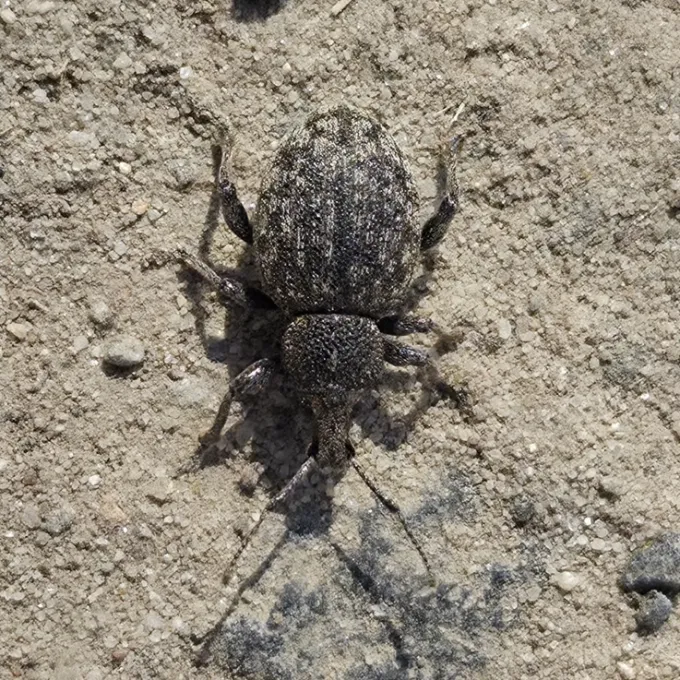
The alfalfa snout beetle (Otiorhynchus ligustici) is a significant pest belonging to the Curculionidae family. Adult beetles are 10–13 mm long with a pear-shaped body covered in grey or brownish scales, often giving them a mottled appearance.
A key diagnostic feature of this species is its short, broad snout. It is important to note that this species reproduces via parthenogenesis, meaning that all individuals are females, which allows for rapid population expansion in favorable conditions.
The larvae are legless, C-shaped, and creamy-white with a brown head capsule. They live exclusively underground, feeding on the roots of host plants, which makes them difficult to detect without careful soil examination.
Eggs are oval and yellowish-white, typically deposited in the upper soil layers near the base of host plants. This strategic placement ensures that neonate larvae can immediately begin feeding on root tissues upon hatching.
Pupae develop within earthen cells in the soil. After metamorphosis, the young adult beetle emerges, although it often remains in the soil until environmental cues signal it is time to emerge for surface feeding and reproduction.
What it damages
This beetle is a polyphagous pest that primarily targets alfalfa, sainfoin, and other forage legumes. It also poses a threat to sugar beets, vineyards, and various orchards located near infested fields.
The most severe damage is caused by the larvae, which feed on the taproot and lateral root system. This feeding reduces the plant's ability to absorb nutrients and water, leading to stunting, wilting, and eventually plant death.
Adult beetles cause damage to the foliage by feeding on the leaf margins, creating characteristic scalloped edges. In heavy infestations, they can strip the plant of almost all leaf tissue, leaving only the midribs.
Young stands are particularly vulnerable to larval feeding, which can cause significant thinning of the crop stand. Once a stand becomes thinned, it is less competitive against weeds and more susceptible to secondary environmental stress.
Reduced vigor and lower forage yields are typical consequences of an alfalfa snout beetle infestation. If left unmanaged, the pest can cause such severe root loss that entire fields may require early plowing and reseeding.
When it appears
The lifecycle of the alfalfa snout beetle typically spans two years, making it a persistent threat. Both adults and larvae can overwinter deep in the soil profile, providing them with protection against cold temperatures.
Adults emerge from the soil in early spring when temperatures rise, coinciding with the beginning of the alfalfa growth season. They engage in supplemental feeding and mating activities primarily at night.
Egg-laying occurs throughout the spring and early summer. The resulting larvae begin their feeding cycle on roots, which continues throughout the summer, autumn, and the following year, as their development is slow.
Pupation usually occurs in late spring or early summer of the second year. After the pupal stage, the new generation of adults emerges, feeds for a short period, and then enters the soil to overwinter before beginning their own reproductive cycle.
Because of this multi-year cycle, populations can build up to damaging levels over several years in the same field. Understanding this cycle is crucial for planning effective crop rotation and management strategies.
Signs of infestation
The most visible sign of infestation is the presence of patches of wilting plants that do not recover with moisture. When these plants are pulled, they often come out easily due to severed root systems.
Leaf notching is a clear indicator of adult beetle activity. Inspecting the field at night with a flashlight or checking beneath soil debris during the day can help confirm the presence of the beetles themselves.
Digging in the root zone is the best way to detect larvae. Finding white, C-shaped larvae in the soil around dying plants confirms a snout beetle problem and indicates the need for immediate management intervention.
In sugar beet fields, the sudden appearance of bare patches in the spring often signals that overwintering adults have emerged and are feeding on seedlings, often cutting the stem just below the soil surface.
If the field shows a general decline in productivity despite good agronomic practices and sufficient fertilizer, it is likely that the root system is being compromised by underground pests.
Control measures
Deep fall tillage is the cornerstone of control, as it physically disrupts the soil cells where larvae and pupae reside, exposing them to desiccation, predation by birds, and adverse weather conditions.
Crop rotation is essential for suppressing populations. Removing host crops like alfalfa for 3-4 years prevents the beetles from completing their life cycle and significantly reduces the larval pressure in the soil.
Chemical control can be utilized when beetle numbers exceed economic thresholds. Insecticides are most effective when applied at night during the period of peak adult activity, ensuring contact with the pests as they feed.
Border treatments can be effective when the infestation is localized or migrating from adjacent fields. Applying insecticides to the perimeter helps create a barrier that limits the spread of the beetles into new plantings.
Biological control options, such as the use of entomopathogenic nematodes, show promise in reducing larval populations in the soil. These beneficial organisms must be applied according to soil moisture and temperature requirements to be successful.
Taxonomy
- Latin name
- Otiorhynchus ligustici
- Order
- Coleoptera (beetles)
- Family
- Curculionidae
- EPPO code
- OTIOLI
Discussion
No discussions yet — be the first.