
Otiorhynchus dubius
Otiorhynchus dubius
Description
How to identify
Otiorhynchus dubius, commonly known as a type of root weevil, is a member of the Curculionidae family. These insects are significant pests that cause damage to various agricultural and horticultural crops.
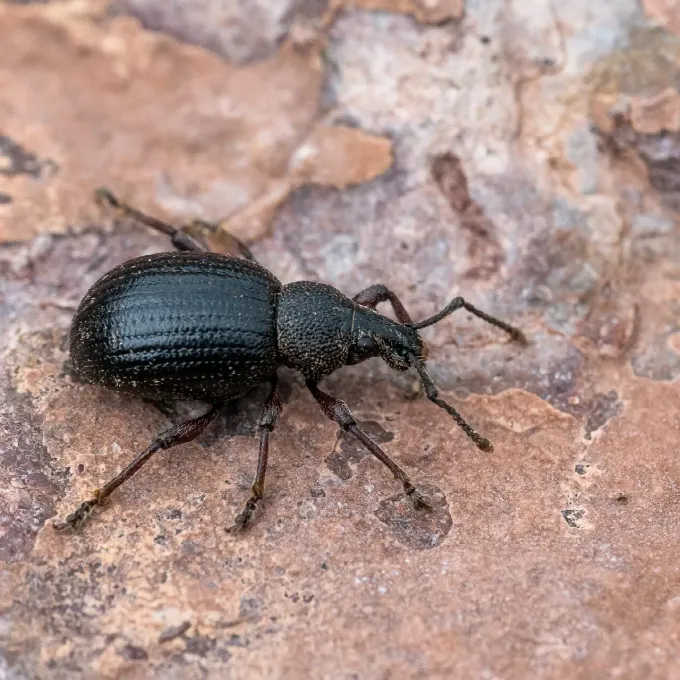
Adult weevils are typically 7–10 mm long, featuring a dark, hardened body with a snout. Their coloration allows them to blend perfectly with the soil, making them difficult to spot during daytime.
The larvae are legless, C-shaped, and creamy white with a brown head capsule. They live entirely underground, which protects them from many environmental factors and predators.
Adults are nocturnal, emerging from soil crevices at night to feed. Their mobility is limited mostly to crawling, as they do not typically fly to colonize new plants.
The life cycle involves multiple stages, and since they inhabit the soil, managing their population density requires a combination of subterranean and surface control tactics.
What it damages
The pest is highly polyphagous, meaning it feeds on a wide range of host plants. Major targets include strawberries, raspberries, and many ornamental shrubs like roses and rhododendrons.
Adults cause aesthetic and structural damage to leaves by feeding along the margins, creating characteristic scalloped or notched edges on the foliage.
Larval damage is far more severe, as they feed on roots, root hairs, and the root crown. By consuming these vital tissues, they severely disrupt the plant's nutrient and water intake.
Severe infestations often result in stunted growth, yellowing foliage, and eventually total wilting and death of the plant, especially during high-stress periods like summer heat.
In nursery environments, the presence of these larvae can result in significant financial losses due to the destruction of root systems in containerized or field-grown stock.
When it appears
Adult weevils emerge in the spring, typically starting in May, as temperatures begin to rise and soil conditions become favorable for their activity.
Throughout the summer, adults are active at night, feeding and laying eggs in the soil around the base of host plants. This is the peak period for surface-based monitoring.
Larvae develop during the late summer and autumn, feeding greedily on root systems before they prepare for the winter months by moving deeper into the soil.
Overwintering occurs primarily in the larval stage deep within the soil profile, though some adults may survive in sheltered areas to emerge early the following season.
Depending on the climatic zone, the life cycle may take one or two years to complete, which complicates the timing of eradication programs.
Signs of infestation
The most visible sign of infestation is the notched appearance of leaves, often referred to as "leaf-notching." Seeing this pattern is a clear indication that adults are present.
Sudden wilting or chlorosis in otherwise healthy-looking plants is a strong indicator of larval damage to the root system below the soil surface.
Examining the soil around the root zone often reveals the presence of white, C-shaped larvae. They are typically concentrated around the main root mass.
Using boards or thick paper as night traps near the base of plants can help capture adults during their active nocturnal feeding period.
- Scalloped edges on leaves.
- General decline and stunted development.
- Sudden wilting during dry, hot weather.
- Easily dislodged plants due to severed roots.
Control measures
Cultural control measures focus on disturbing the soil during the egg-laying period. Regular cultivation can expose eggs to desiccation and reduce the overall larval population.
Biological control using entomopathogenic nematodes (e.g., Heterorhabditis species) is highly effective, as these parasites actively hunt larvae within the soil profile.
Chemical control should be timed to coincide with adult activity. Applying insecticides in the evening ensures maximum contact as the weevils emerge to feed.
Good sanitation practices, such as removing heavily infested plants and debris, help break the life cycle and prevent the pest from spreading to clean areas.
Integrated Pest Management (IPM) strategies, which monitor adult flight and larval presence, allow for precise timing of interventions and minimize the need for broad-spectrum chemicals.
Taxonomy
- Latin name
- Otiorhynchus dubius
- Order
- Coleoptera (beetles)
- Family
- Curculionidae
- EPPO code
- OTIODU
Discussion
No discussions yet — be the first.