
Arctic weevil
Otiorhynchus arcticus
Description
How to identify
The Arctic weevil (Otiorhynchus arcticus) is a beetle belonging to the Curculionidae family, known for its resilience in various soil environments.
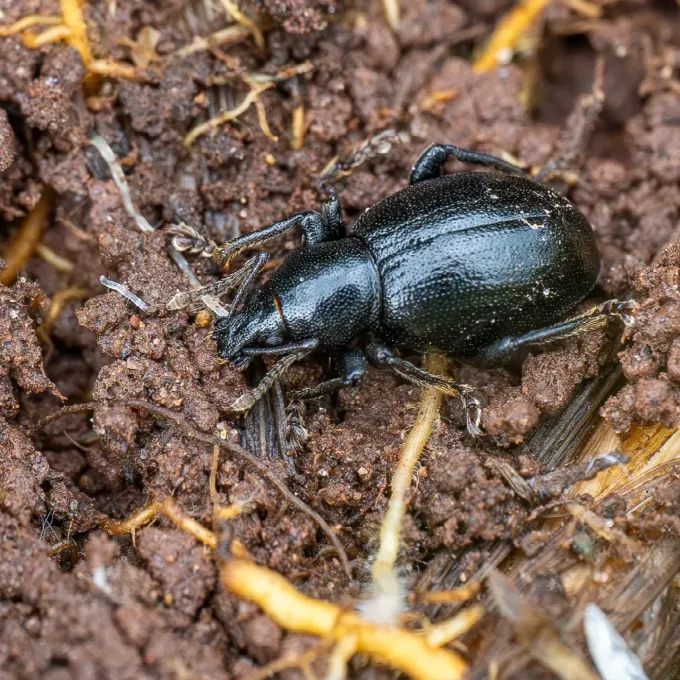
Adult beetles typically measure 6 to 9 mm in length and possess a dark brown or black appearance, making them difficult to spot against the soil.
The elytra have distinct textures with sparse hairs, and the pronotum is characterized by rough, granular projections that help distinguish it from related species.
Larvae are legless, C-shaped grubs with creamy-white bodies and distinct brownish head capsules, which reside primarily in the root zone of plants.
These insects are nocturnal by nature, remaining stationary under debris or in topsoil during daylight hours, which often conceals their presence from growers.
What it damages
Adult Arctic weevils are polyphagous pests that consume the foliage of various plants, creating signature notches along the margins of the leaves.
While leaf damage is aesthetic and rarely fatal, it is a significant indicator of a larger infestation that poses a severe threat below the soil surface.
The larvae cause the most critical damage by feeding on the root system, stripping the root bark and consuming smaller roots entirely.
This feeding behavior disrupts the plant's ability to uptake water and nutrients, resulting in stunted growth, leaf yellowing, and plant collapse.
In high-density infestations, the loss of root integrity often leads to the death of young seedlings and nursery stock, causing significant economic losses.
When it appears
The life cycle of the Arctic weevil is highly influenced by temperature, with adults emerging from the soil in late spring as the weather warms.
Active feeding by adults peaks during the early summer months, coinciding with their peak period of reproduction and egg-laying in the soil.
Larvae hatch shortly thereafter and begin feeding on plant roots throughout the summer and into the autumn months until the soil temperature drops.
The species is known for its ability to overwinter as larvae in the soil, which allows it to resume activity quickly once the spring season begins.
Generations may overlap, meaning that multiple developmental stages can often be found within the soil profile simultaneously during the growing season.
Signs of infestation
The primary visual sign of an Arctic weevil infestation is the scalloped or notched appearance along the leaf edges of affected garden plants.
Wilting of plants during the warmest part of the day, despite adequate irrigation, is a classic sign of root damage caused by larval feeding.
Growers can confirm an infestation by carefully digging into the soil around the base of the plant to check for the presence of the legless, white larvae.
General lack of vigor or failure to thrive in healthy soil conditions often points to subterranean insect damage that is not immediately visible.
- Semi-circular notches on leaf edges.
- Unexpected plant decline or sudden death.
- Presence of C-shaped grubs in the rhizosphere.
- Reduced shoot growth in spring.
Control measures
Managing the Arctic weevil requires an integrated strategy that focuses on both the adult population above ground and the larval population in the soil.
Hand-picking adults at night using a flashlight is a simple but effective way to reduce the breeding population on small-scale garden plots.
Cultivation and soil turning in the late autumn can expose larvae to cold temperatures and natural predators, significantly reducing their survival rate.
Chemical control involving soil-drenching with appropriate insecticides is recommended when larval counts exceed economic thresholds in professional nursery settings.
Biological controls, such as the application of entomopathogenic nematodes, offer a targeted approach to managing larval populations without harmful chemicals.
Taxonomy
- Latin name
- Otiorhynchus arcticus
- Order
- Coleoptera (beetles)
- Family
- Curculionidae
- EPPO code
- OTIOAR
Discussion
No discussions yet — be the first.