
Marsh rice rat
Oryzomys palustris
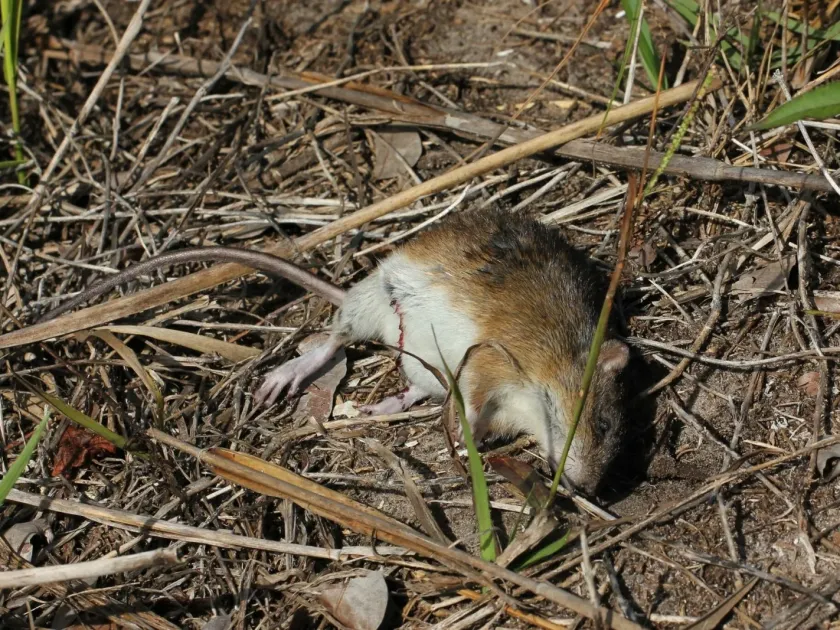
Description
How to identify
The marsh rice rat (Oryzomys palustris) is a small rodent belonging to the Cricetidae family. It is distinct for its semi-aquatic habits, making it uniquely adapted to environments like rice paddies.
Adults typically measure 12–15 cm in body length with a tail that is often longer than the body. Their fur is brownish-gray, providing camouflage in damp, vegetative environments.
This species is an excellent swimmer and frequently traverses irrigation canals and flooded fields with ease. It tends to be nocturnal, hiding in burrows or nests in dense vegetation during the day.
Its reproductive potential is high, with females producing multiple litters during the warmer months, allowing populations to surge if conditions remain favorable.
They are particularly well-suited to the conditions found in agricultural wetlands, where food and shelter are abundant throughout the growing season.
What it damages
The marsh rice rat primarily feeds on rice plants, causing damage during all developmental stages from seedlings to ripening grain heads.
By gnawing on stems and roots, these rodents can cause significant thinning of rice stands, leading to yield loss and potential lodging of the crop.
Beyond feeding, they cause structural damage by digging extensive burrow systems into levees and dams, which leads to water leaks and disrupted irrigation.
The loss of water control on rice paddies can have severe consequences for crop maturation, as precise flooding levels are required for optimal yield production.
In high-density populations, the cumulative impact of herbivory and infrastructure destruction results in significant economic losses for rice farmers.
When it appears
Activity levels follow the rice growing cycle, with populations moving into fields as soon as irrigation begins in the spring.
Summer months provide peak conditions for foraging and breeding, with high rice availability ensuring rapid growth of localized populations.
As harvest approaches in the autumn, these rodents migrate toward field margins, canal banks, and wild vegetation to find winter shelter.
Their winter survival is dependent on the availability of cover and food sources, though they remain active year-round in warmer climates where rice is grown.
Farmers must monitor fields closely throughout the growth cycle, particularly when crops are vulnerable and provide optimal shelter for the rats.
Signs of infestation
Typical signs include chewed rice stalks and damaged panicles where kernels have been harvested by the rodents rather than by machinery.
The presence of burrow entrances along irrigation levees and canal banks, often concealed by tall grasses, indicates an established colony.
Well-defined paths or runways through dense vegetation leading toward the rice fields are strong indicators of active foraging routes.
Footprints found in the soft mud along water edges can confirm the presence of these rodents, distinguishing them from other smaller mice species.
Droppings found near water sources or within nesting sites are clear evidence of occupancy that necessitates management intervention.
Control measures
Integrated pest management starts with sanitation: clearing weeds and brush from field margins to reduce available nesting and hiding sites.
Maintaining the integrity of irrigation levees and dams through regular inspections and reinforcement prevents the creation of burrow sites.
Rodenticides, if necessary, should be used in moisture-resistant bait stations designed to protect the bait from water and non-target species.
Promoting natural biological control, such as encouraging avian predators like owls or hawks to nest nearby, can help keep population levels in check.
Consistent monitoring and early detection of infestation sites allow for timely intervention, effectively preventing large-scale crop losses.
Taxonomy
- Latin name
- Oryzomys palustris
- Order
- Rodents
- Family
- Muridae
- EPPO code
- ORYOPA
Discussion
No discussions yet — be the first.