
Pine engraver beetle
Orthotomicus spinifer
Description
How to identify
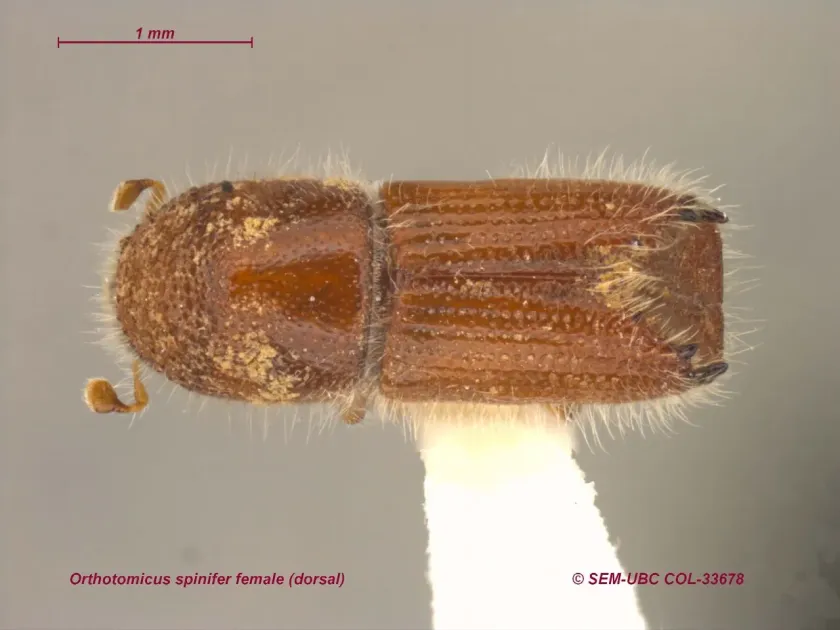
The Pine engraver beetle (lat. Orthotomicus spinifer) is a small bark beetle belonging to the family Curculionidae and subfamily Scolytinae. Typically measuring 3 to 4 millimeters in length, these beetles are cylindrical and dark brown to black in appearance.
The defining feature of this species is the structure of the elytral declivity, which bears distinct teeth, characteristic of the genus Orthotomicus. These teeth are used by the beetle to push out sawdust and frass from their galleries.
Larvae are white, legless, and have a chitinized, yellowish-brown head. They develop exclusively in the inner bark and cambium layer, hidden from predators and the external environment.
Pupation occurs within small oval chambers, or cradles, excavated by the larvae at the end of their feeding tunnels. Once the transition to adulthood is complete, the beetles emerge through circular boreholes.
These insects have evolved specialized sensory systems to detect chemical signals from weakened host trees, allowing them to locate suitable sites for reproduction efficiently.
What it damages
The primary hosts of this beetle are coniferous trees, with a strong preference for Pinus species. They also occasionally infest spruce and fir trees under specific environmental conditions.
The damage is caused by both adults and larvae feeding on the phloem and cambium. By mining galleries, they effectively girdle the tree, interrupting the flow of nutrients and water from the roots to the crown.
In addition to physical destruction, these beetles often introduce wood-staining fungi into the tree, which further accelerates decay and weakens the tree's internal defense mechanisms.
During outbreaks, this species can kill even relatively healthy trees by overwhelming them with sheer numbers. This mass attack prevents the tree from producing enough resin to "pitch out" the invading beetles.
Timber quality is severely degraded by the tunnels, which makes the wood unsuitable for construction or high-quality furniture, leading to significant economic losses in the forestry sector.
When it appears
Adult beetles begin their flight in early spring when temperatures become consistently favorable for mating and colonization. Activity typically peaks in late spring and early summer.
Depending on the local climate and temperature, this species can produce one or two generations per year. Warmer seasons allow for faster development and more frequent reproduction cycles.
The lifecycle from egg to adult is relatively fast, often taking less than two months. This short developmental time allows populations to grow exponentially under favorable conditions.
As autumn approaches and temperatures drop, adults enter hibernation. They typically overwinter in the bark of standing trees or move to the ground litter at the base of the tree to survive the winter cold.
Monitoring the flight period is essential for pest management, as interventions are most effective when the adult beetles are seeking new hosts and are exposed on the bark surface.
Signs of infestation
One of the earliest signs of an infestation is the accumulation of fine, reddish-brown boring dust on the bark surface or in the bark crevices near the base of the tree.
Fading needles are a classic symptom of advanced infestation. As the tree's vascular system is compromised, the foliage changes color from healthy green to yellow and eventually reddish-brown.
Close inspection of the bark reveals entry holes, often surrounded by sap flow, although severely weakened trees may be unable to produce sufficient resin to trap the beetles.
Increased activity of woodpeckers on a specific tree is a strong indicator of bark beetle presence, as these birds seek out the larvae and adult beetles beneath the bark.
If a piece of bark is removed, the characteristic galleries beneath can be clearly seen. These patterns are often species-specific and diagnostic of the presence of Orthotomicus spinifer.
Control measures
Sanitation cutting is the primary method of control. Removing and disposing of infested trees before the new generation of beetles emerges is crucial for limiting the spread of the population.
Pheromone traps are used for both monitoring population levels and mass trapping. By deploying these in forest stands, managers can detect outbreaks early and mitigate the impact.
Silvicultural practices, such as maintaining healthy stand density and promptly removing logging debris, reduce the availability of breeding material for the beetles and help keep populations low.
Chemical control is rarely practical in wide forest areas but can be used for high-value ornamental trees. Applications must be timed precisely with the beetle flight period to be effective.
Promoting tree vigor through appropriate site selection and maintaining soil health ensures that trees are better equipped to produce natural resin defenses against beetle attacks.
Taxonomy
- Latin name
- Orthotomicus spinifer
- Order
- Coleoptera (beetles)
- Family
- Curculionidae
- EPPO code
- ORTCSN
Discussion
No discussions yet — be the first.