
Long-legged bark beetle
Orthotomicus longicollis
Description
How to identify
The long-legged bark beetle, scientifically known as Orthotomicus longicollis, is a small beetle species belonging to the order Coleoptera and the family Curculionidae (subfamily Scolytinae).
Adult beetles are approximately 3.5 to 4.8 mm in length, possessing a cylindrical body shape that is typical for bark beetles, allowing them to navigate efficiently beneath the bark of host trees.
Identification is primarily based on the morphology of the posterior declivity of the elytra, which features distinct tubercles or teeth, distinguishing it from other species within the genus Orthotomicus.
Larvae are legless, white, and possess a well-defined head capsule, specifically adapted for feeding on the phloem and cambium layers of host coniferous trees.
As a forest-dwelling insect, it is a specialized decomposer and pest that plays a complex role in the ecological dynamics of coniferous forest stands throughout Eurasia.
What it damages
This beetle primarily targets trees from the family Pinaceae, with a strong preference for the genus Pinus (pine) and occasionally Picea (spruce).
It attacks the inner bark and cambium, causing significant disruption to the nutrient transport system, which ultimately leads to the weakening and eventual death of the host tree.
While often acting as a secondary pest that colonizes already stressed or fallen wood, it can transition into a primary pest during outbreaks, attacking even healthy tree stands.
The economic impact is considerable in forest management, as widespread infestations lead to timber degradation and substantial losses in wood quality and volume.
Infestations are frequently linked to environmental stressors such as prolonged drought or historical logging activities that leave residual woody debris in the forest.
When it appears
Activity begins in the early spring, typically triggered by rising air temperatures that encourage the overwintering adults to emerge and seek suitable host trees for colonization.
The flight period can span several months depending on regional climatic patterns, during which mating and the establishment of new galleries occur beneath the bark.
Development from egg to adult is a temperature-dependent process that usually takes one full growing season, although two generations per year are possible in warmer regions.
Winter survival is achieved primarily at the adult stage, with the beetles sheltering under the bark of infested trees or in the leaf litter at the base of the tree.
The beetle’s lifecycle is tightly synchronized with the health status of its host, allowing it to rapidly exploit available resources as they become stressed.
Signs of infestation
The most visible sign of an infestation is the presence of frass (fine, powdery wood dust) visible near entry holes or around the base of the trunk.
As the larval galleries disrupt the flow of sap, the needles of the infested tree begin to lose their vibrant color, turning yellow and then a diagnostic rusty-red.
Small, circular entrance holes on the trunk are characteristic, and in resilient trees, these may be associated with resin flows as the tree attempts to pitch out the invaders.
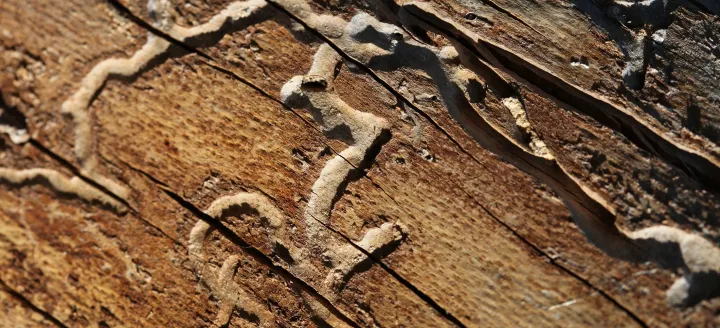
Bark sloughing is a late-stage symptom, revealing the complex patterns of the maternal and larval tunnels etched into the sapwood and inner bark layers.
In silent forest environments, the subtle audible scratching of larvae feeding beneath the bark can sometimes be detected during the peak of an outbreak.
Control measures
Effective management begins with strict sanitation measures, specifically the timely removal and processing of infested or fallen timber to break the beetle’s reproductive cycle.
Pheromone-based trapping systems are widely utilized to monitor population density and to act as a deterrent in high-value forest stands during peak flight seasons.
Promoting forest resilience through proper silvicultural practices, such as maintaining optimal stand density, helps reduce the susceptibility of trees to colonization.
Biological control, focusing on the preservation and augmentation of natural predators like Clerid beetles, plays an essential role in regulating bark beetle population levels.
Chemical control is generally restricted to high-value areas, such as nurseries or ornamental parks, where individual tree health is a priority over broader forest ecosystem management.
Taxonomy
- Latin name
- Orthotomicus longicollis
- Order
- Coleoptera (beetles)
- Family
- Curculionidae
- EPPO code
- IPSXLG
Discussion
No discussions yet — be the first.