
Lesser pine shoot beetle
Orthotomicus latidens
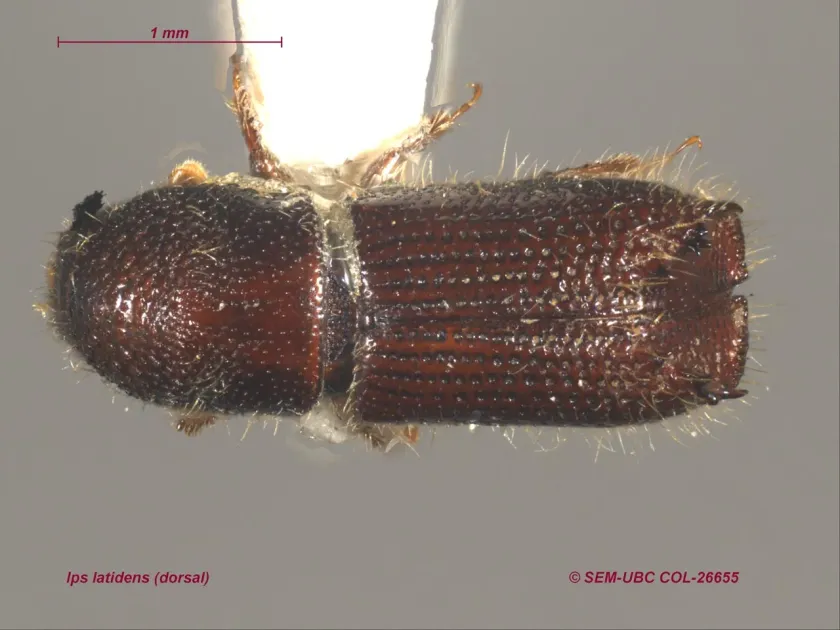
Description
How to identify
The Lesser pine shoot beetle (Orthotomicus latidens) is a small bark beetle belonging to the Curculionidae family. Adult beetles are typically 2.2 to 3.2 mm long and have a cylindrical, reddish-brown to dark brown body.
Identification is mainly based on the elytral declivity, which features distinct small teeth. This morphological character distinguishes it from other species of the Orthotomicus genus, which often inhabit similar environments.
The larvae are legless, white with a distinct brown head capsule, and curved in a typical C-shape. They feed exclusively under the bark, excavating individual galleries within the phloem and cambium layer.
Beetles are most active during warm spring days when they emerge to find host trees for mating and oviposition. They thrive in managed forest stands and natural woodlands alike.
The species has a significant presence throughout the Northern Hemisphere, where it follows the distribution of its primary coniferous host plants.
What it damages
The primary hosts of this beetle are pine species, particularly Pinus sylvestris. It can also infest spruce or cedar if the trees are significantly stressed or dying.
The pest primarily targets weakened, diseased, or fire-damaged trees. However, during outbreaks, even healthy trees can be overwhelmed by mass attacks that lead to rapid colonization.
The damage is caused by both adults and larvae feeding on the phloem. This disrupts the tree's nutrient transport system, leading to crown yellowing and eventual tree death.
These beetles also act as vectors for bluestain fungi, which further weaken the host and reduce the commercial value of the timber by staining the wood.
Large-scale infestations can cause significant economic losses in the forestry sector by damaging young stands and timber production areas.
When it appears
Beetle activity starts in early spring when temperatures consistently exceed 12-15°C. The first flights mark the beginning of the breeding season for the new generation.
Depending on the latitude and local climate, one or two generations can occur per year. The summer generation is often responsible for the expansion of existing infestation sites.
As temperatures drop in autumn, adults migrate toward overwintering sites. They often settle at the base of trees or under the forest litter to survive the cold winter months.
Climate change, specifically increased frequency of drought, has been shown to shorten the life cycle and increase the success rate of beetle colonization.
Forest managers use pheromone lures to monitor the seasonal peak of adult beetle activity, which is critical for timely implementation of control measures.
Signs of infestation
The most reliable sign of an active infestation is the presence of boring dust—fine wood particles ejected by the beetles—found on the bark or at the base of the trunk.
Small, circular entrance holes in the bark are visible upon close inspection. Resin droplets may also appear if the tree is attempting to repel the attacking beetles.
- Crown discoloration, starting from the top and moving downwards.
- Loose or falling bark patches in the infested areas of the trunk.
- Specific gallery patterns revealed after removing the bark.
- Increased foraging activity by woodpeckers on the tree trunk.
- Reduced needle density in the canopy before the tree turns completely brown.
Control measures
Sanitation logging is the most important control method. Removing infested trees before the next generation of beetles emerges is crucial to stopping the spread.
Proper forest management includes the prompt removal of storm-damaged trees and slash from the logging site, as these serve as breeding hubs for the beetles.
Pheromone traps are used to suppress local populations and to provide an early warning system for foresters regarding the density of the pest in the area.
Biological control involves maintaining a healthy ecosystem with natural predators, such as parasitic wasps and predatory beetles that keep bark beetle populations in check.
In ornamental or nursery settings, systemic insecticides may be applied to protect high-value trees during peak flight periods to prevent successful colonization.
Taxonomy
- Latin name
- Orthotomicus latidens
- Order
- Coleoptera (beetles)
- Family
- Curculionidae
- EPPO code
- IPSXLT
Discussion
No discussions yet — be the first.