
Six-toothed bark beetle
Orthotomicus erosus
Description
How to identify
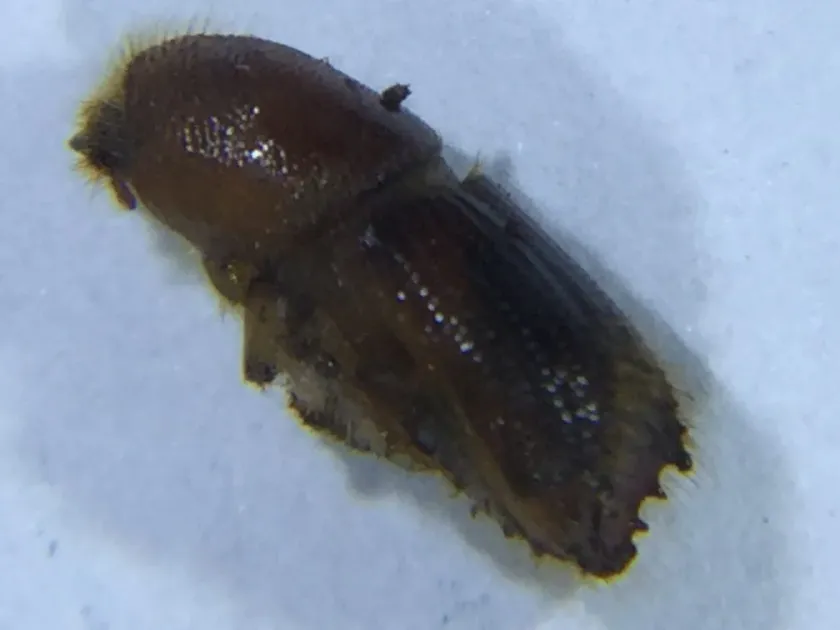
The six-toothed bark beetle (Orthotomicus erosus) is a small wood-boring insect belonging to the family Curculionidae and subfamily Scolytinae.
Adult beetles are cylindrical in shape, typically ranging from 2.2 to 4.0 mm in length, and exhibit a dark brown or black coloration.
The most reliable identification feature is the rear declivity of the elytra, which features three distinct teeth on each side in males.
The larvae are legless, creamy-white in color with a dark head, and spend their entire developmental phase feeding within the host tree's bark.
Eggs are minute, white, and oval, carefully deposited in niches along the main maternal galleries created by the female beetle under the bark.
What it damages
This species primarily attacks coniferous trees, with a strong preference for various pine species (Pinus), including Scots pine and maritime pine.
The beetles burrow into the bark, constructing galleries that destroy the cambium layer, which is essential for transporting nutrients and water.
Continuous feeding by larvae and adults severely weakens the tree, leading to crown yellowing, dehydration, and eventual tree death.
Outbreaks of this beetle cause significant economic losses in commercial forestry, as infested timber loses its structural and commercial value.
Trees affected by the beetle are often further compromised by secondary infections, such as blue-stain fungi, which spread rapidly through the galleries.
When it appears
The flight period typically commences in early spring when temperatures consistently rise above 15°C, usually between April and May.
Depending on local climatic conditions, this species is capable of completing two to three generations per year, leading to rapid population growth.
Summer months represent peak activity periods where mating and egg-laying occur most intensely across the infested forest stands.
As autumn approaches, the beetles prepare for winter, seeking shelter in the forest litter, crevices of the bark, or deeper inside the wood.
The overwintering stage consists primarily of adults, although some larvae may survive in warmer conditions if sheltered within the thick bark.
Signs of infestation
The presence of fine, sawdust-like bore dust (frass) on the bark surface or near the base of the tree is the most common early detection sign.
Small, perfectly round entry holes, approximately 1.5 mm in diameter, are visible on the outer bark where adult beetles have penetrated.
The crown of an infested tree undergoes a progressive color change, shifting from healthy green to yellow and finally to a rusty-red hue.
Peeling the bark reveals complex, radiating patterns of galleries, indicating long-term infestation and significant structural damage to the tree.
In severe cases, the bark may begin to slough off in large patches, and the tree may become an attractive site for additional secondary pests.
Control measures
Prompt sanitary felling and removal of infested trees before the new generation of beetles emerges is the primary method of population control.
The deployment of pheromone-baited traps is highly effective for monitoring local populations and managing potential outbreak scenarios.
Trap logs, which are intentionally placed cut timber, can be used to attract beetles and should be destroyed before the brood matures.
Maintaining forest hygiene by removing slash and logging debris prevents the buildup of beetle populations in the surrounding forest stands.
Silvicultural practices that promote tree health and vigor are essential for increasing the natural resistance of coniferous forests to beetle attacks.
Taxonomy
- Latin name
- Orthotomicus erosus
- Order
- Coleoptera (beetles)
- Family
- Curculionidae
- EPPO code
- IPSXER
Discussion
No discussions yet — be the first.