
Orthotomicus caelatus
Orthotomicus caelatus
Description
How to identify
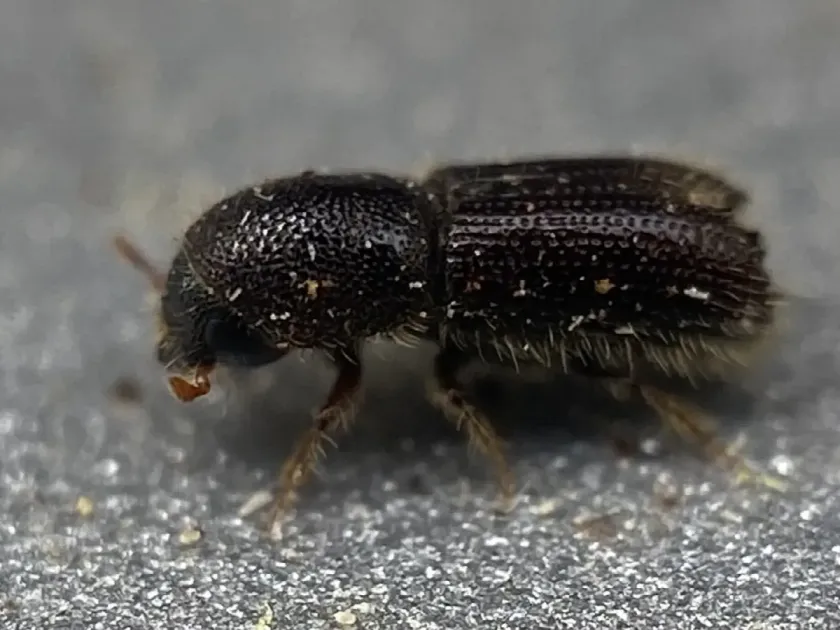
Orthotomicus caelatus, commonly known as the five-spined engraver or simply as a species of bark beetle, is a member of the Curculionidae family and the Scolytinae subfamily.
These beetles are small, cylindrical, and typically measure between 2 and 3.5 mm in length. Their coloration ranges from dark reddish-brown to black, allowing them to blend into the bark.
A distinctive feature of this species is the declivity of the elytra, which possesses a set of small teeth or spines in males, facilitating the ejection of frass from the galleries.
The larvae are white, legless, and C-shaped, living in the inner bark (phloem) and cambium layer of coniferous trees, where they feed and grow.
Identification in the field often requires examining the gallery patterns beneath the bark, as well as the morphological characteristics of the adult beetles under magnification.
What it damages
Orthotomicus caelatus primarily attacks various coniferous species, including spruce, pine, and larch, especially those that are already stressed or weakened.
They usually prefer the lower portions of the trunk and the root collar area, where the bark is thick enough to provide protection and nourishment for the larvae.
By excavating galleries in the cambium, the beetles interrupt the tree's vascular system, preventing the flow of nutrients and eventually leading to the death of the tree.
Outbreaks often occur following natural disturbances such as droughts, windstorms, or fires, which compromise the defense mechanisms of healthy trees.
The damage is exacerbated by the introduction of blue-stain fungi into the tree, which can cause rapid wood decay and lower the economic value of the timber.
When it appears
The flight period of these beetles usually commences in early spring, once temperatures are sufficiently high to initiate emergence from their overwintering sites.
During the spring and early summer, the adults seek suitable hosts to establish new galleries and lay eggs, continuing the cycle for the next generation.
Depending on the climatic conditions of the region, the beetle may complete one or two generations per year, with activity peaking during the warmest months.
Young adults emerge from under the bark during the summer, either to attack new trees or to transition toward the dormant stage as the season cools.
Overwintering occurs primarily in the adult stage, often deep in the bark of the host tree or within the forest litter near the base of the tree.
Signs of infestation
The most visible sign of an infestation is the presence of fine sawdust, or frass, collected in the crevices of the bark or around the base of the trunk.
Small, circular entrance holes indicate where the beetles have penetrated the bark, sometimes accompanied by resin flow on the trunk surface.
As the tree's health declines due to the interruption of water transport, the foliage may begin to fade, turning from green to yellow, and eventually to brown.
Beneath the bark, complex gallery systems can be found, consisting of a central nuptial chamber and radiating egg galleries where larvae develop.
In advanced stages, the bark may begin to slough off, exposing the wood and the intricate network of galleries made by the beetles and their progeny.
Control measures
Effective management focuses on sanitation, primarily through the removal and destruction of infested timber before the new generation of beetles can emerge.
- Sanitation logging to remove infested trees.
- Proper disposal of slash and wood debris.
- Use of pheromone traps for monitoring beetle populations.
- Application of preventive insecticides for high-value ornamental trees.
- Maintaining forest health through consistent thinning and management.
Regular surveys of coniferous stands are essential for detecting early signs of infestation and mitigating the spread of the beetle to healthy neighboring trees.
Promoting a healthy environment with adequate tree spacing and biodiversity can naturally increase the resilience of the forest to bark beetle attacks.
Taxonomy
- Latin name
- Orthotomicus caelatus
- Order
- Coleoptera (beetles)
- Family
- Curculionidae
- EPPO code
- ORTCCA
Discussion
No discussions yet — be the first.