
Orthotomicus
Orthotomicus
Description
How to identify
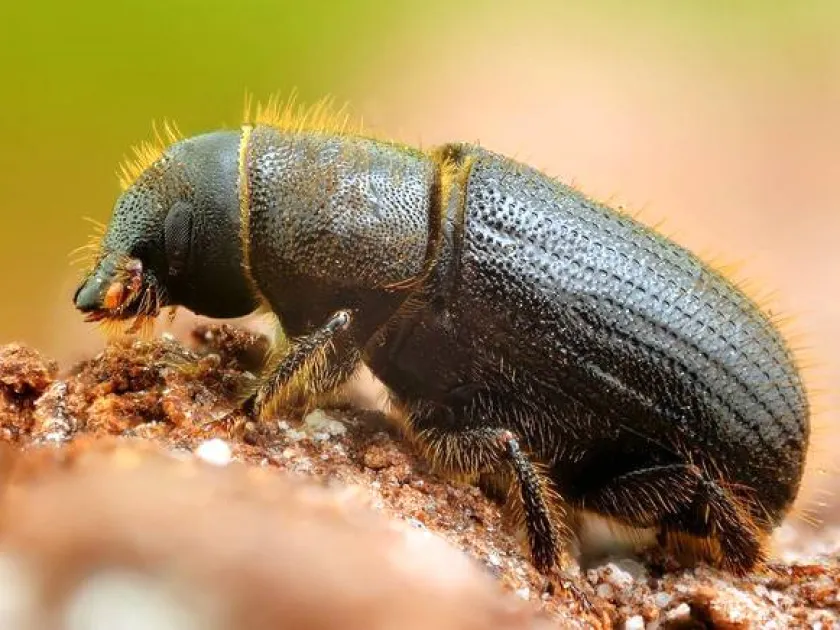
Orthotomicus is a genus of bark beetles within the family Curculionidae (subfamily Scolytinae). These small, cylindrical beetles typically measure between 3 and 5 millimeters in length.
Their bodies are generally dark brown to black and feature a characteristic elytral declivity (the slope at the end of the wing covers) with teeth, which they use to clear frass from their galleries.
The larvae are legless, C-shaped, and creamy white with a brownish head. They develop exclusively under the bark, feeding on the phloem and cambium layers of the host tree.
Pupation occurs within small chambers carved into the wood or bark, followed by the emergence of new adults that bore through the bark to the surface.
Identification often requires careful examination of the elytral declivity, as subtle differences in these features help distinguish between various species within the genus.
What it damages
These beetles primarily attack coniferous trees, including various species of pine, spruce, and larch. They frequently target trees weakened by drought, disease, or mechanical damage.
By boring galleries under the bark, they disrupt the tree's vascular system, preventing the transport of nutrients and water, which eventually leads to the desiccation of the tree.
In cases of high population density, they can attack seemingly healthy trees, making them a significant secondary pest in managed forest stands.
The galleries created by Orthotomicus also serve as entry points for fungi, particularly blue-stain fungi, which further degrade the quality of the timber and accelerate the tree's death.
The economic impact involves timber quality loss, increased mortality rates in pine and spruce plantations, and the necessity of costly salvage logging operations.
When it appears
The flight period of adult beetles typically begins in the spring, once temperatures are sufficiently high to stimulate movement, usually from late April onwards.
Depending on the climatic zone and temperature conditions, one or more generations can be produced within a single growing season.
Summer is the peak season for gallery construction and egg-laying, as the warmer temperatures accelerate the development of larvae within the host tree.
As autumn approaches, the development slows down, and adults seek suitable sites for overwintering, often choosing the base of the trees or protected crevices in the bark.
The duration of the life cycle is strictly regulated by ambient temperature; heat waves during the summer can significantly shorten the development time of subsequent generations.
Signs of infestation
The presence of boring dust, resembling fine sawdust, on the bark surface or around the tree base is one of the earliest indicators of an ongoing infestation.
Entry holes are often visible on the trunk, sometimes surrounded by small accumulations of resin if the tree is attempting a defensive response.
Needle discolouration, shifting from green to yellow or reddish-brown, is a classic sign of vascular disruption caused by extensive larval and adult gallery formation.
Peeling away a piece of bark will reveal the intricate patterns of maternal and larval galleries, which are diagnostic features of bark beetle activity.
Loose, sloughing bark indicates that the tree is in advanced stages of decay, making it a potential source of infestation for surrounding healthy timber.
Control measures
Sanitation is the most important management strategy; this involves the prompt removal and processing of infested wood to prevent the maturation and dispersal of new adults.
Pheromone traps are widely used for monitoring population levels and can be effective in capturing significant numbers of adults during the initial flight periods.
Trap trees (freshly cut logs) can be deployed to attract beetles, which are then destroyed after the larvae have colonized the logs but before they reach adulthood.
Maintaining forest hygiene by clearing wind-felled trees and managing stand density improves the overall resilience of the forest to beetle outbreaks.
Biological control, involving the protection of woodpeckers and natural parasitic wasps, can help regulate populations, although it is rarely sufficient to stop a major outbreak on its own.
Taxonomy
- Latin name
- Orthotomicus
- Order
- Coleoptera (beetles)
- Family
- Curculionidae
- EPPO code
- ORTCSP
Discussion
No discussions yet — be the first.