
Klug's Weevil
Orthorhinus klugi
Description
How to identify
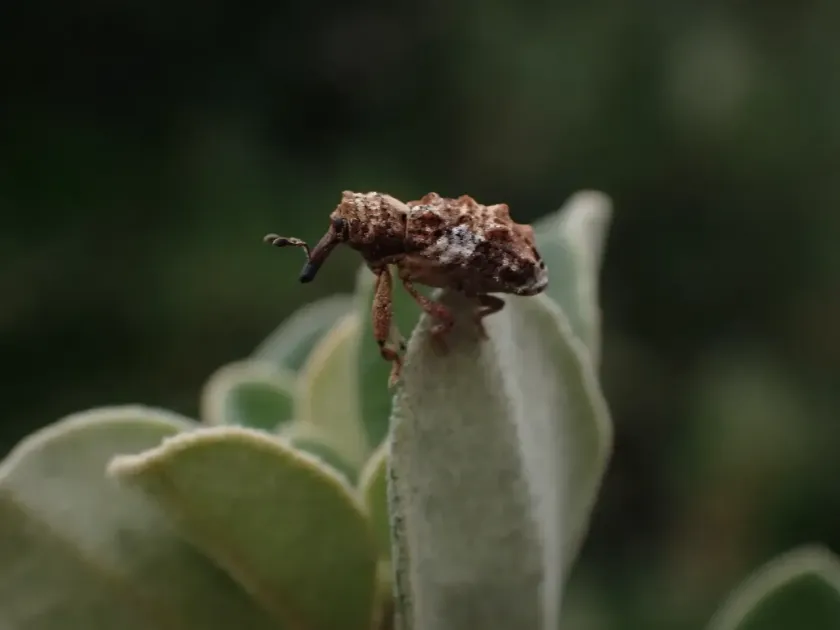
Klug's Weevil (Orthorhinus klugi) is a significant beetle of the Curculionidae family, easily recognized by its exceptionally long rostrum, or snout.
Adults possess a sophisticated camouflage appearance, ranging from grey-brown to dark tones, which allows them to blend perfectly with tree bark and lichens.
The beetle's body is robust and densely covered in small scales that mimic the texture of bark, providing an excellent defense against predators.
Larvae are typical of the weevil family, being legless, fleshy, and cream-colored, with a heavily sclerotized head designed for tunneling through wood.
The size of mature adults can vary significantly depending on the nutritional quality of the wood the larva consumed during its developmental stage.
What it damages
The primary hosts of this pest include various hardwood species, particularly Eucalyptus and several orchard fruit trees located within its distribution range.
Damage is caused by both adults, which chew on buds and young shoots, and larvae, which cause structural harm to the tree.
Larvae tunnel extensively under the bark and deep into the wood, causing significant disruption to the plant's vascular system and nutrient transport.
Severe infestation weakens the tree, making it highly susceptible to secondary attacks from other pests, fungal infections, and eventual branch or tree death.
Economic damage is most pronounced in nurseries and young plantations, where larval boring can lead to the complete destruction of valuable saplings.
When it appears
The life cycle of Klug's Weevil is strictly synchronized with the phenology of its host plants, with adult activity peaking during the spring and summer months.
Females deposit eggs into small crevices chewed into the bark or trunk, providing the developing larvae with a safe environment within the host plant tissue.
The larval stage is the most prolonged, as the pest spends a considerable amount of time feeding and burrowing deeper into the heartwood of the tree.
Pupation occurs within a specially prepared chamber inside the wood, after which the young beetles emerge by chewing characteristic exit holes.
In warmer climatic regions, generations can overlap, resulting in the presence of multiple developmental stages throughout most of the year.
Signs of infestation
One of the most obvious signs of infestation is the presence of small, perfectly circular exit holes on the bark left by beetles emerging from their pupal chambers.
In areas where eggs are laid, trees often exhibit gumming or sap flow, which serves as a defensive reaction to the mechanical injury of the tissues.
Removing a layer of bark or sawing into affected branches reveals winding larval tunnels tightly packed with "frass" or fine wood-colored waste material.
Visually, affected trees may show symptoms such as leaf yellowing, canopy dieback, or loss of turgor in specific branches.
Often, the presence of other wood-boring insects on weakened trees acts as a secondary indicator, which can complicate the diagnosis of the primary pest.
Control measures
The primary control strategy involves strict adherence to orchard sanitation: the timely removal and disposal of infested branches and dead or dying trees.
Preventive insecticide sprays during the adult emergence period are highly effective at reducing the population before egg-laying begins.
For high-value ornamental trees, systemic insecticide injections directly into the tree trunk can be used to protect the plant from internal wood borers.
Good agricultural practices, such as maintaining optimal tree health and minimizing stress factors, are crucial to preventing successful pest colonization.
- Regular monitoring and inspection of plantation health.
- Prompt removal of infested woody debris to break the life cycle.
- Use of pheromone traps to monitor adult population levels and provide mass trapping.
Taxonomy
- Latin name
- Orthorhinus klugi
- Order
- Coleoptera (beetles)
- Family
- Curculionidae
- EPPO code
- ORTRKL
Discussion
No discussions yet — be the first.