
Orthogalumna terebrantis
Orthogalumna terebrantis
Description
How to identify
Orthogalumna terebrantis is a species of oribatid mite belonging to the family Galumnidae within the order Sarcoptiformes. These mites are specialized organisms adapted to life in aquatic or semi-aquatic environments.
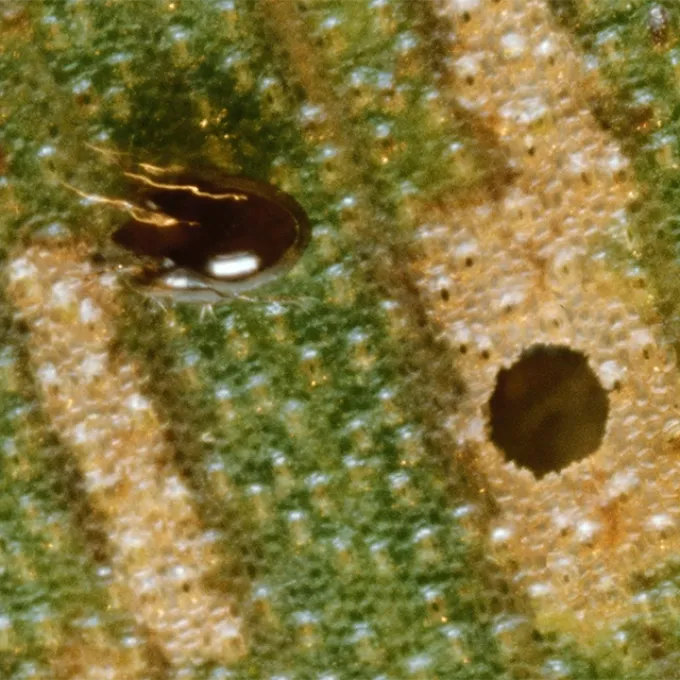
Adult mites are characterized by a dark, shiny, and hard exoskeleton. Their small size allows them to navigate across the surface of floating or submerged aquatic plants, which serve as their primary habitat.
The lifecycle consists of egg, larva, several nymphal stages, and the adult phase. Unlike most oribatid mites, this species has evolved specific adaptations that allow it to withstand water immersion.
Females deposit their eggs directly into the plant tissues. The juvenile stages develop internally, feeding on the plant's internal structures, which provides them with constant protection and a steady nutrient source.
This mite is highly specialized and is most commonly found associated with specific aquatic macrophytes, exhibiting a high degree of fidelity to its host plant throughout its development.
What it damages
The primary host plant for Orthogalumna terebrantis is the water hyacinth (Eichhornia crassipes). The mite has been studied as a potential biological control agent due to its ability to damage host tissues.
By tunneling into the leaves and petioles, the mites disrupt the plant's vascular and cellular integrity. This physical damage leads to a reduction in the plant's photosynthetic efficiency and overall growth vigor.
In its native range, the mite effectively manages the population density of the water hyacinth. However, when introduced to non-native areas or in controlled garden settings, it may cause damage to ornamental aquatic flora.
Feeding activities leave trails and necrotic lesions on the plant surface. Prolonged infestation significantly weakens the plant, making it prone to opportunistic bacterial and fungal diseases.
Severe infestations lead to yellowing, browning, and subsequent death of the leaves, resulting in a noticeable decrease in the plant population within a water body.
Signs of infestation
The early signs of an infestation include the appearance of tiny, light-colored spots on the leaf surface. These spots are the entry points for the mites into the plant tissue.
Upon closer inspection, one can observe thin, irregular channels or tunnels burrowed within the epidermis of the leaves and stems, indicating the presence of active feeding nymphs and adults.
Leaves under attack eventually lose their turgidity and begin to show signs of wilting. As the tunnels increase in number, the structural integrity of the leaf is compromised, leading to premature decay.
Secondary infections often manifest as dark, mushy spots around the damage sites, indicating that pathogens have successfully colonized the weakened plant tissue.
Visual identification requires the use of a hand lens or microscope to detect the dark-bodied mites moving along the leaf surfaces or resting near the points of entry.
Control measures
Management of Orthogalumna terebrantis in ponds or decorative water features focuses on non-chemical approaches to preserve the health of the aquatic ecosystem and surrounding fauna.
Mechanical control, such as the routine removal of heavily infested leaves and petioles, is highly effective in reducing the mite population and preventing further spread to healthy plants.
Maintaining the water quality and ensuring adequate plant vigor through balanced nutrients can help the plants tolerate low levels of mite pressure.
Biological control agents or specific, pond-safe botanical extracts can be employed in severe cases. It is essential to avoid harsh chemical insecticides that could be toxic to fish and beneficial insects.
Integrated management practices include:
- Regular monitoring of aquatic flora for early signs of tunnels.
- Physical removal of damaged plant parts.
- Maintaining proper water circulation and light levels.
- Quarantine procedures when introducing new aquatic plant species.
Taxonomy
- Latin name
- Orthogalumna terebrantis
- Order
- Mites
- Family
- Galumnidae
- EPPO code
- ORTGTE
Discussion
No discussions yet — be the first.