
Golden oriole
Oriolus oriolus
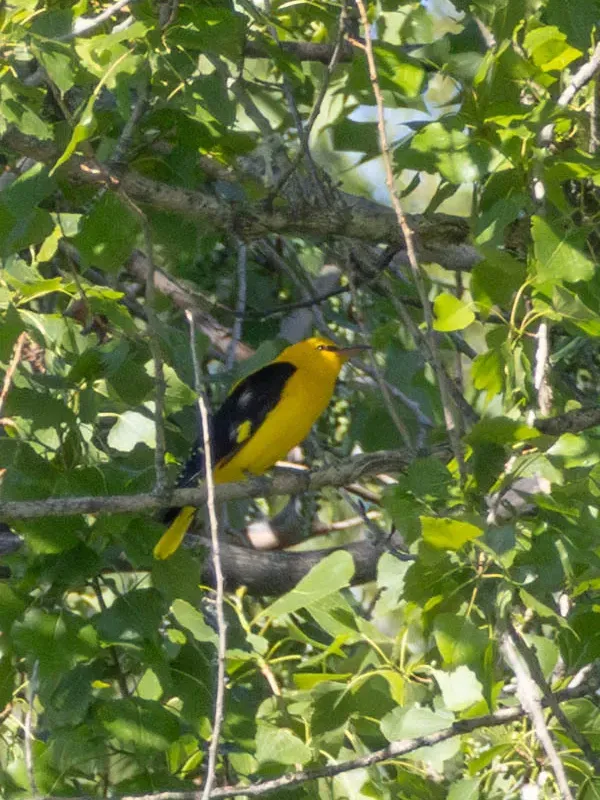
Description
How to identify
The golden oriole (Oriolus oriolus) is a passerine bird belonging to the Oriolidae family. Males are easily recognized by their striking golden-yellow plumage with contrasting black wings and tail.
Females exhibit a more cryptic, greenish-yellow color, which serves as camouflage while they inhabit the dense foliage of trees where they build their characteristic hanging nests.
Despite their bright coloration, these birds are famously elusive and prefer to remain hidden in the upper canopy, making visual observation difficult.
Their presence is often revealed by their melodic, flute-like song, which is a common sound in woodlands and orchards throughout the summer season.
While they consume insect larvae and beetles during the nesting phase, their feeding habits shift toward fruits as the season progresses, impacting agricultural productivity.
What it damages
The golden oriole is considered a pest in orchard environments due to its penchant for feeding on high-quality, ripening fruits and berries.
Their primary targets include sweet cherries, sour cherries, grapes, and various early-ripening berry crops that provide high sugar content.
Birds inflict damage by pecking into the fruit, which often results in the loss of entire bunches or fruits, as the damaged produce becomes susceptible to decay and pathogen infection.
The economic impact is most severe in commercial vineyards and cherry orchards where aesthetics and fruit integrity are critical for market value.
In addition to direct consumption, the birds often damage more fruit than they eat by pecking multiple items in search of the perfect specimen, significantly increasing waste.
When it appears
As a migratory species, the golden oriole arrives in its breeding range during late spring, typically in May, after the migration from warmer regions.
The period of maximum damage to crops occurs from mid-summer through late August, which coincides with the final ripening stages of most stone fruits and grapes.
During the post-fledging period, family groups move through orchard areas more frequently, leading to an increase in bird pressure on the ripening harvest.
By late August or early September, the birds begin their southward migration, effectively ending their activity in the orchards for the season.
The duration and intensity of the damage often correlate with local weather conditions, particularly droughts, which force birds to seek moisture from fruits.
Signs of infestation
A primary indicator of golden oriole activity is the presence of fruit with small, ragged beak-shaped punctures scattered across the orchard canopy.
Dropping of partially consumed or damaged fruits on the ground is a common occurrence, serving as a clear sign of bird feeding in the upper branches.
On vineyards, the damage is characterized by hollowed-out berries within the cluster, often leaving the vine stems intact but rendering the cluster unsalable.
The distinct, resonant song of the male serves as a constant reminder of their presence, allowing growers to monitor the activity levels throughout the day.
Finding molted yellow or greenish feathers near the berry bushes or fruit trees provides further evidence that these birds are utilizing the orchard as a food source.
Control measures
Physical exclusion remains the most effective method for protecting valuable fruit crops, typically achieved by installing bird-proof netting over trees or vine rows.
Bioacoustic devices, which emit recordings of predator calls or distress signals, are effective at creating an environment that encourages birds to avoid the area.
Visual deterrents, including holographic ribbons or reflective scare objects, provide temporary protection but generally require frequent relocation to remain effective.
Good agricultural practices, such as prompt harvesting as soon as the fruit reaches maturity, are crucial to reducing the window of opportunity for bird damage.
- Installation of bird netting.
- Use of bioacoustic deterrents.
- Timely harvesting of ripening crops.
- Strategic placement of visual scarecrows.
Taxonomy
- Latin name
- Oriolus oriolus
- Family
- Oriolidae
- EPPO code
- ORIOOR
Discussion
No discussions yet — be the first.