
Golden Oriole
Oriolus
Description
How to identify
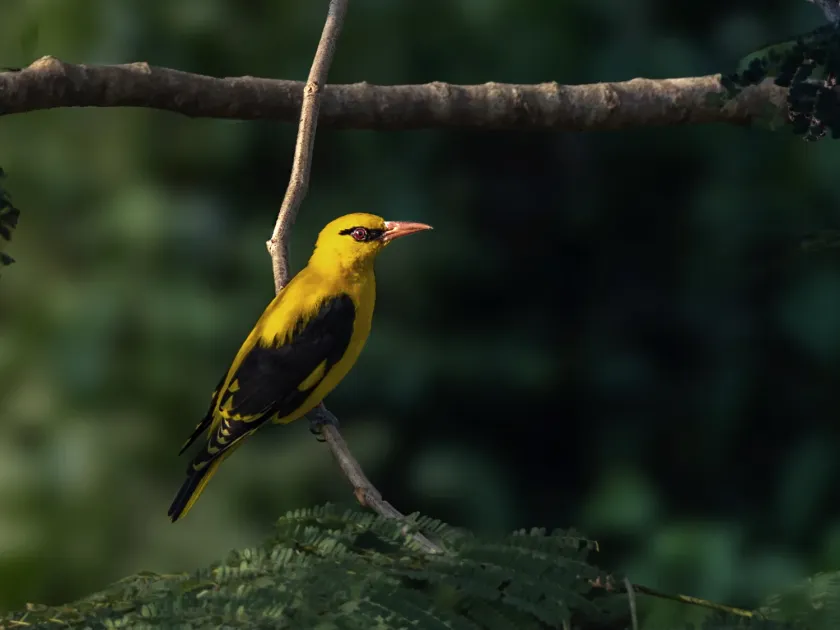
The Golden Oriole (Oriolus oriolus) is a migratory bird belonging to the Passeriformes order and Oriolidae family. The male is characterized by bright golden-yellow plumage with contrasting black wings and tail, while the female has a more subtle olive-green coloration.
These birds prefer to nest in the high crowns of dense trees, making them difficult to spot. Their presence is easily identified by their melodic, flute-like song, which can be heard over long distances during early morning or evening hours.
The bird's biology is deeply integrated into forest ecosystems; however, during the ripening season, they frequently visit orchards and gardens to supplement their diet with sugary fruits.
They are known for their agility and extreme caution, rarely landing on the ground. They prefer foraging in the upper canopy where they have an excellent vantage point and can escape quickly if threatened.
With an average lifespan of up to 10 years in the wild, established populations can become habitual visitors to fruit-rich areas, returning to the same orchards year after year.
What it damages
The Golden Oriole poses a significant threat to fruit and berry plantations during the peak ripening season. The most susceptible crops include cherries, apricots, and various table grape varieties.
The birds specifically target the ripest and juiciest fruits, leading to substantial losses in commercial value. One damaged fruit often initiates decay in an entire cluster or bunch, increasing the scale of loss.
Grape vineyards are particularly at risk. The orioles often puncture or hollow out the berries, leaving only the skin and seeds behind, which ruins the appearance and quality of the entire harvest.
Beyond direct consumption, the birds create entry points for secondary infections such as grey mold, and attract other pests like wasps and fruit flies, which swarm to the damaged fruit.
Orchards located near woodlands or old parks are significantly more prone to these attacks due to the easy flight paths provided to the flocks, allowing them to commute between forest cover and food sources.
When it appears
The Golden Oriole's activity as a pest occurs during the summer months, specifically from mid-June to early August, when the young have fledged and the adults shift to a sugar-rich diet.
Early-ripening cherry varieties are the first to suffer in June. Activity levels tend to spike during hot and dry summers when natural forest water sources and wild berries are less available.
In July and August, the pressure shifts to late-season stone fruits and grapes. During this period, the birds form small family groups or flocks that systematically forage through orchards.
The southward migration begins in August. As the birds prepare for their long journey to Africa, they gradually abandon the gardens, switching back to wild berries found along their migration routes.
Agronomists should schedule preventive measures well before the fruit reaches full technical maturity to avoid the peak damage period associated with the birds' peak feeding frenzy.
Signs of infestation
The primary sign of an oriole invasion is the presence of damaged fruit with distinct beak marks—usually deep punctures or hollowed-out sections—found hanging on trees or lying on the ground.
In vineyards, the classic sign is a "skeletonized" cluster where berries have been methodically removed or damaged, leaving behind bare stems that are impossible to sell.
The presence of bird droppings beneath the trees is another indicator. Their loud, sometimes harsh, cat-like call when competing for food can also alert the grower to their presence in the canopy.
In cases of severe infestation, there is a visible and rapid thinning of fruits in the upper parts of the tree crowns, as the birds prefer these areas for their safety.
While looking into the dense canopy can be challenging, the accumulation of fruit fragments on the orchard floor is a clear signal that immediate protective action is required.
Control measures
The most reliable method of control is the installation of protective anti-bird netting. This physical barrier effectively keeps the birds away from the canopy and grape trellises.
Acoustic deterrents that broadcast recorded predator calls, such as those of hawks or falcons, can be effective if the timing and frequency of the sounds are varied to prevent habituation.
Visual deterrents, including reflective tapes or owl decoys, are only moderately successful for short-term use, as the intelligent birds quickly realize there is no actual threat.
Good orchard management involves timely harvesting. Picking fruits as soon as they reach the required maturity level limits the time they are exposed to hungry flocks.
- Use fine-mesh netting (up to 25mm) for complete tree protection.
- Deploy bio-acoustic systems during the peak ripening phase.
- Clean up all fallen fruit regularly to reduce orchard attractiveness.
- Combine multiple methods to keep the birds from adapting to a single strategy.
Taxonomy
- Latin name
- Oriolus
- Family
- Oriolidae
- EPPO code
- ORIOSP
Discussion
No discussions yet — be the first.