
Orchid weevil
Orchidophilus
Description
How to identify
The orchid weevil (Orchidophilus) belongs to the order Coleoptera and the family Curculionidae. It is a highly specialized pest that primarily targets orchids grown in tropical and greenhouse environments.
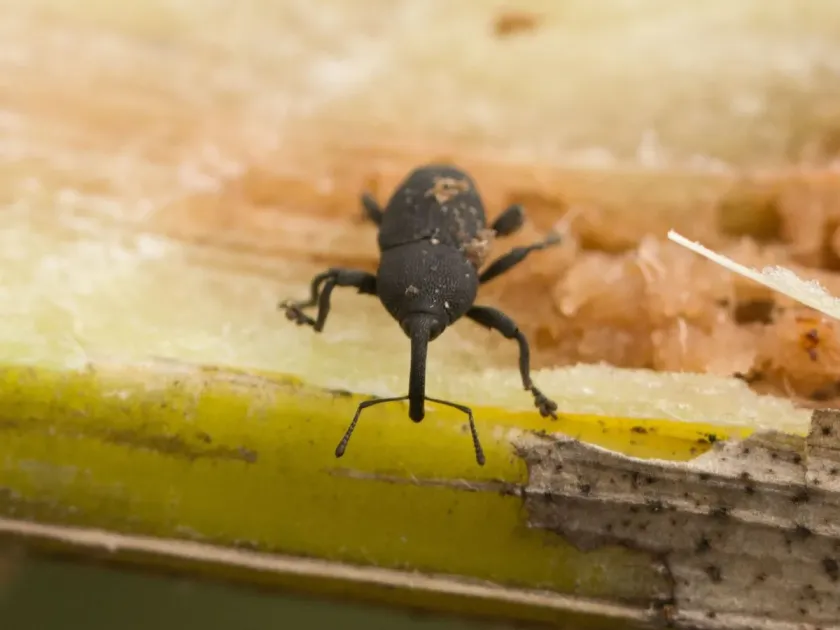
The adult beetle is small, typically dark-colored, with a characteristic long snout or rostrum used for feeding and laying eggs into the plant tissue.
The life cycle involves internal development, as eggs are deposited inside the orchid’s stems or pseudobulbs, where larvae hatch and begin feeding immediately.
Larvae are legless, white, and fleshy, staying protected inside the host plant, which makes them difficult to spot without physical damage to the orchid.
These insects are nocturnal, meaning they remain hidden in leaf axils or crevices during the day, emerging only under cover of darkness to move or feed.
What it damages
Orchid weevils primarily damage epiphytic orchid species such as Dendrobium, Cattleya, and Vanda, which are valued for their decorative pseudobulbs.
Adult beetles cause cosmetic damage by feeding on the epidermis of leaves and stems, creating small, pinprick-like holes that can mar the appearance of the foliage.
The primary economic damage is caused by the larval stage, which creates tunnels throughout the pseudobulbs, effectively destroying the plant's vascular system.
This internal damage interrupts water and nutrient transport, leading to a loss of turgor, softening of the pseudobulbs, and eventual collapse of the orchid.
Furthermore, the tunnels created by the larvae serve as entry points for bacterial and fungal pathogens, often leading to secondary rots that kill the plant faster than the pest itself.
Signs of infestation
An early sign of infestation is the presence of small, puncture-like holes on the leaves and young shoots that do not heal over time.
Frass, which resembles fine sawdust or dark powder, appearing near the base of the plant or in the leaf axils, is a definitive sign of active larval feeding inside the stem.
Soft, dark-colored patches on the pseudobulbs indicate internal damage, and pressing these areas may reveal that the structure is hollowed out.
Orchids showing signs of overall poor vigor, such as drooping leaves, arrested growth, or yellowing despite adequate care, are often heavily infested by larvae.
While adults are rarely seen, finding them during evening inspections is the most direct way to confirm their presence in the collection.
Control measures
Effective management begins with strict quarantine protocols for all incoming orchid plants to ensure no pests are introduced into a healthy collection.
Systemic insecticides are the most reliable control method, as they are absorbed by the plant and kill larvae residing within the stems or pseudobulbs.
Any plant material showing signs of tunnels or severe decay should be pruned back to healthy tissue and treated with fungicides to prevent secondary infections.
Maintaining a clean growing environment and monitoring for pests during warm, active growth seasons are essential for long-term prevention.
- Quarantine new plants for at least 30 days.
- Use systemic insecticides (e.g., imidacloprid).
- Sanitize pruning tools with alcohol between cuts.
- Remove and destroy severely infested pseudobulbs.
- Monitor regularly for frass and pinprick leaf holes.
Taxonomy
- Latin name
- Orchidophilus
- Order
- Coleoptera (beetles)
- Family
- Curculionidae
- EPPO code
- ORCHSP
Discussion
No discussions yet — be the first.