
Shore hopper
Orchestia gamarella
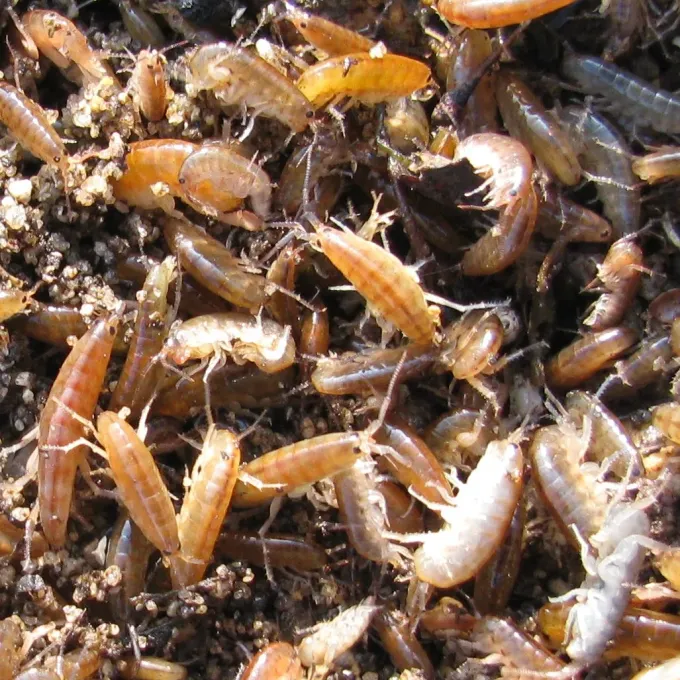
Description
How to identify
The shore hopper (Orchestia gamarella) is a small crustacean belonging to the family Talitridae within the order Amphipoda. Unlike typical aquatic crustaceans, these are semi-terrestrial.
Adult individuals typically measure 10–15 mm in length. Their bodies are laterally compressed, and they exhibit a grayish to olive-brown coloration for effective camouflage.
They possess strong mandibles adapted for grazing on decaying organic matter, but they can adapt to feeding on living plant tissues under humid conditions.
These organisms require high humidity to keep their gills functional, which restricts their natural range to damp soil, coastal areas, and waterlogged garden beds.
The life cycle involves multiple molts, and they are highly prolific in environments with constant moisture and abundant organic decomposition.
What it damages
Shore hoppers primarily damage young seedlings and succulent vegetable crops grown in damp, poorly drained areas or in damp greenhouses.
Commonly affected crops include lettuce, cabbage, cucumbers, and young ornamental plants. They tend to attack the stems and leaf bases at the soil surface level.
Feeding injury appears as ragged edges on leaves and scarred or severed stems, which can lead to the wilting and total death of young transplants.
Severe infestations can result in significant economic loss, especially during early spring when seedlings are most vulnerable and soil moisture is at its peak.
In addition to direct damage, their presence often correlates with poor soil management, such as excessive mulching near stems in cold and damp conditions.
Signs of infestation
The primary sign of infestation is the observation of small, jumping crustaceans when the soil surface is disturbed by hoeing or irrigation.
Plants often exhibit irregular leaf damage similar to that caused by slugs, but the absence of slime trails and the presence of small, jumping organisms confirm the presence of Orchestia gamarella.
Stems of seedlings may show shallow pits or surface erosion, eventually causing the plant to collapse and wither at the base.
Accumulation of leaf litter or decaying plant debris in damp corners of the garden provides a clear indicator of potential shore hopper nesting sites.
A musty odor in the mulch layer, combined with a dense population of small crustaceans under cover, confirms an active colony.
Control measures
The most effective management strategy involves improving soil drainage to reduce the high humidity levels that are essential for the survival of these crustaceans.
Frequent cultivation and tilling of the soil disrupt the surface microclimate, causing the shore hoppers to lose their protective damp environment.
Sanitation is crucial; removing decomposing organic matter and excess mulch around the base of vegetable plants eliminates their food source and shelter.
Barriers such as wood ash or lime applied around the base of plants can create a drying effect on the soil surface, discouraging the pests from approaching seedlings.
If populations reach damaging levels, the use of iron phosphate-based bait products is a recommended control method that is safe for most garden environments.
Taxonomy
- Latin name
- Orchestia gamarella
- Family
- Talitridae
- EPPO code
- ORCTGA
Discussion
No discussions yet — be the first.