
Steppe flea weevil
Orchestes steppensis
Description
How to identify
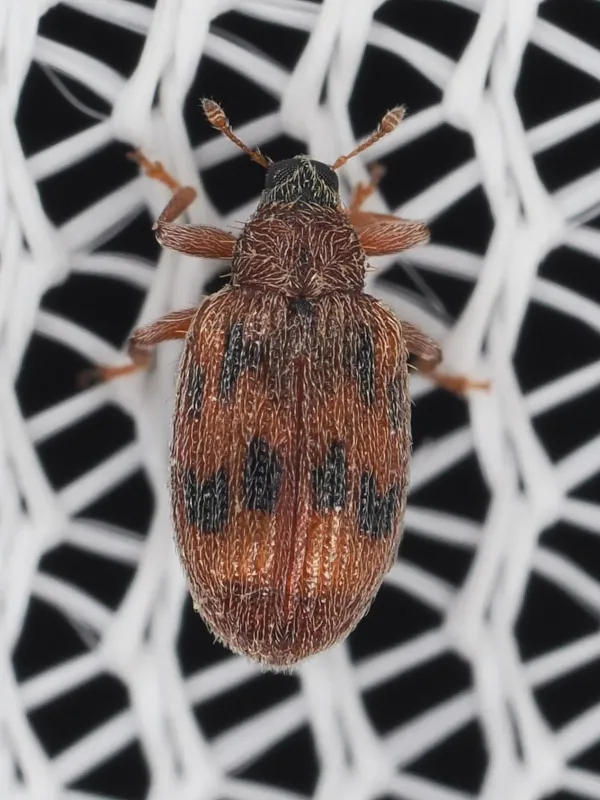
The steppe flea weevil (Orchestes steppensis) is a small beetle belonging to the family Curculionidae, order Coleoptera. It is named for its ability to jump using enlarged hind femora, similar to flea beetles.
Adults typically measure between 2 and 3 millimeters in length. Their bodies are covered with fine, dense setae, which provide a dull, brownish-to-black coloration, helping them blend with the bark and soil.
The larvae are apodous (legless) and exhibit a specialized body structure adapted for life within plant tissues. They have a well-developed chewing mouthpart designed for mining leaf parenchyma.
Identification often requires careful inspection of the leaf surface for characteristic damage patterns. In laboratory conditions, specific morphological features of the elytra and male genitalia are used for precise confirmation.
These insects prefer temperate climates and are primarily found in steppe and forest-steppe zones. They remain cryptic throughout much of their lifecycle, which helps them evade avian predators.
What it damages
The primary hosts of the steppe flea weevil include members of the Rosaceae family, with Spiraea species being the most commonly cited targets for infestation.
Adult beetles damage foliage by chewing small, circular holes in the leaf blades. This form of injury is often referred to as shot-hole damage, which reduces the total photosynthetic area of the plant.
Larval damage is more destructive, as they consume the interior leaf tissue while forming mines. These tunnels appear as winding, whitish tracks on the leaf surface, which eventually turn necrotic.
Heavy infestations can lead to massive defoliation, particularly in ornamental shrubs. This weakens the plant, making it susceptible to secondary stressors such as drought or fungal pathogens.
Cumulative damage throughout the growing season impacts the vigor of the plant, often leading to reduced growth rates and poor flower production in host species.
When it appears
Adult weevils emerge from their overwintering sites in early spring, synchronized with the bud break and initial leaf development of their host plants.
Following emergence, beetles feed actively and mate. Females lay their eggs by inserting them directly into the leaf tissue, ensuring protection and immediate food access for the larvae.
Larval development occurs entirely within the leaf, lasting several weeks depending on ambient temperatures. The larvae pass through several instars before pupating inside a specialized chamber within the mine.
The new generation of adults typically emerges in mid-to-late summer. These adults continue to feed on foliage to build energy reserves before entering hibernation for the winter.
The univoltine lifecycle (one generation per year) implies that populations are relatively stable, but can build up to damaging levels if environmental conditions favor survival.
Signs of infestation
The earliest sign of an infestation is the appearance of numerous small, clean-cut circular holes on the leaves, indicating adult feeding activity.
The formation of distinct leaf mines is the most diagnostic feature of larval presence, appearing as thin, pale, meandering lines across the leaf blade.
As the larvae grow, the mines may broaden and become more visible, often accompanied by leaf browning and dehydration along the path of the tunnel.
Visible leaf wilting or early leaf drop in late summer is a strong indicator of a high larval population density within the canopy.
- Small circular perforations on leaves.
- Meandering whitish tracks (mines) on foliage.
- Early yellowing and senescence of infested leaves.
Control measures
Sanitation is a critical control measure, involving the gathering and burning of all leaf litter in autumn to destroy overwintering adults and pupae.
Pruning and removing infested branches during the early stages of infestation can help prevent the spread of larvae to healthier sections of the shrub.
Systemic insecticides are generally the most effective chemical intervention, as they are absorbed into the leaf tissue to reach the mining larvae.
Monitoring using sticky traps can provide data on adult population spikes, allowing for targeted application of control measures at the right time.
Integrated Pest Management (IPM) strategies, including the promotion of natural enemies like parasitic wasps, can help keep populations below the economic injury level.
Taxonomy
- Latin name
- Orchestes steppensis
- Order
- Coleoptera (beetles)
- Family
- Curculionidae
- EPPO code
- ORKEST
Discussion
No discussions yet — be the first.