
Flea weevil
Orchestes
Description
How to identify
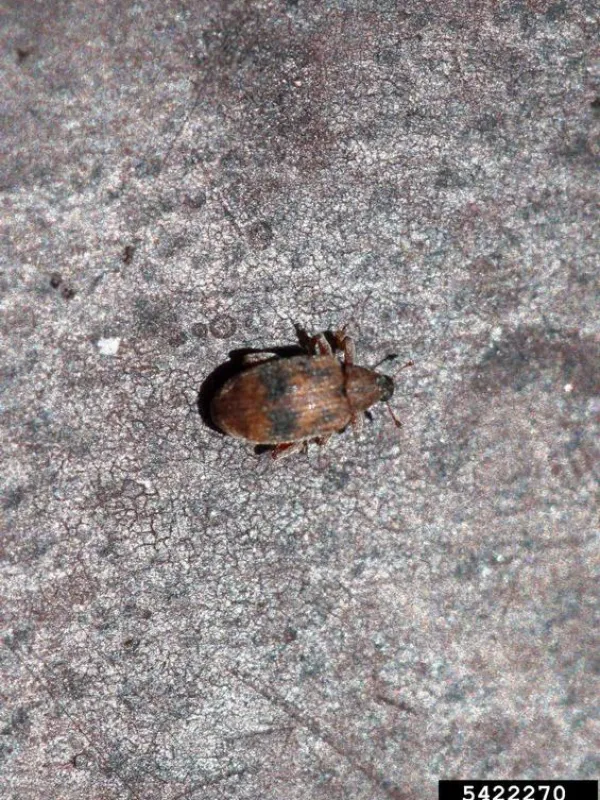
The flea weevil (genus Orchestes) is a small beetle belonging to the Curculionidae family, easily recognized by its enlarged hind femora.
These specialized legs allow the insect to jump away quickly when disturbed, a behavior similar to that of flea beetles, hence the common name.
Adult weevils are generally small, typically ranging from 2 to 3 millimeters in length, and often feature a variety of colors depending on the species.
They possess a distinct, elongated snout typical of weevils, which they use to pierce plant tissue for both feeding and egg-laying purposes.
Larvae are legless, white, and soft-bodied, specifically adapted to thrive within the confined spaces between the upper and lower leaf surfaces.
What it damages
Flea weevils are significant pests of various deciduous trees and shrubs, showing preferences for birch, alder, oak, and willow species.
Adult beetles cause damage in early spring by feeding on swelling buds, which can result in reduced leaf production or complete bud death.
The primary damage is caused by larvae, which tunnel into the leaf tissues to feed on the parenchyma, creating characteristic mining patterns.
These mines interrupt the plant's ability to photosynthesize, leading to reduced overall vigor, leaf yellowing, and eventually premature leaf drop.
High infestations in forests or gardens can cause extensive cosmetic damage and stunt the growth of young, sensitive saplings.
When it appears
The life cycle begins in early spring when adult weevils emerge from their overwintering sites, such as leaf litter, debris, or tree bark crevices.
After mating, females insert their eggs individually into the leaf tissue, ensuring that larvae emerge directly into their food source.
Larval development takes place entirely inside the leaf mine, where they feed and grow through several instars before pupating inside the same leaf.
The transition from egg to adult occurs throughout late spring and early summer, with the new generation emerging in mid-to-late summer.
The new generation of adults feeds on leaves throughout the summer months before seeking protected spots to spend the winter in diapause.
Signs of infestation
The most prominent sign of a flea weevil infestation is the presence of leaf mines, which can be serpentine or blotch-shaped, depending on the species.
Initially, one might observe tiny, pin-prick-sized holes on the foliage caused by adult feeding before the larger mines become apparent.
As the infestation progresses, the mined areas turn brown, brittle, and may cause the surrounding leaf tissue to curl or twist awkwardly.
If a leaf is held against the light, the larvae or their pupal cases can often be seen inside the translucent brown patches of the leaf mine.
- Characteristic leaf mining patterns on foliage.
- Small perforations in developing tree buds.
- Premature yellowing and leaf shedding during summer.
- Visible larvae inside clear sections of the leaf.
Control measures
Sanitation is a critical control measure, involving the collection and disposal of fallen leaves during autumn to destroy overwintering populations.
For ornamental trees, physical removal of infested leaves can be effective if the infestation is caught early in the season.
Chemical control, if necessary, should be applied during the early adult emergence phase to prevent egg-laying and minimize larval damage.
Systemic insecticides are particularly useful because they are absorbed into the leaf tissue, targeting the larvae safely hidden inside the mines.
Promoting a healthy environment for natural predators like parasitoid wasps can help keep flea weevil populations below economic damage levels.
Taxonomy
- Latin name
- Orchestes
- Order
- Coleoptera (beetles)
- Family
- Curculionidae
- EPPO code
- ORKESP
Discussion
No discussions yet — be the first.