
Fruit fly Opius
Opius bellus
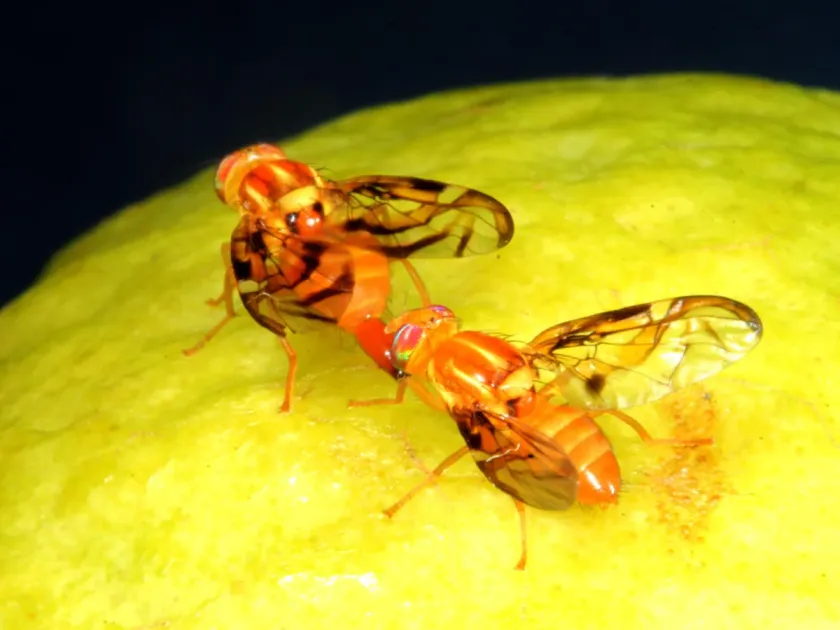
Description
How to identify
Adult Opius bellus insects belong to the Braconidae family, a group often associated with parasitism, but this specific species is known for damaging plant fruits.
These are tiny insects whose life cycle is intricately linked to the developmental stages of their host plants, making them difficult to spot without traps.
Morphologically, they resemble common fruit flies, but possess specialized ovipositors designed for piercing the skin of developing fruits.
Correct identification often requires entomological trapping or detailed inspection of damaged tissue to distinguish them from beneficial parasitoid species.
These insects are primarily active during the fruiting season, and their small size allows them to hide effectively within the dense canopy of host trees.
What it damages
The primary damage is caused by larvae that feed inside the fruits, creating internal tunnels and compromising the fruit's integrity.
Hosts include various fruit and berry plants, particularly those in the Rosaceae family, which are highly susceptible to their infestation.
Larval feeding destroys the internal structure of the fruit, often leading to premature ripening, decay, and eventual fruit drop before harvest time.
Infested produce is unfit for commercial sale or fresh consumption due to both physical destruction and increased risk of secondary fungal infection.
In cases of high population density, these pests can cause significant financial losses by destroying a large percentage of the crop yield.
When it appears
The activity of adult Opius bellus typically begins in late spring, aligned with the early fruit development and formation phase.
The period of egg-laying is critical and usually coincides with the time when fruits start to swell and their skin becomes soft enough to pierce.
Developmental speed is highly dependent on environmental temperature, with warmer conditions leading to faster turnover of generations.
As the season comes to an end, the pest enters a dormant phase, usually overwintering in the soil beneath the canopy of host plants.
Proactive monitoring during the flowering and fruit-set stages is essential for effective pest management strategies throughout the growing season.
Signs of infestation
The earliest sign of infestation is the presence of microscopic puncture marks on the fruit surface, which are often invisible to the naked eye.
As larvae develop inside, localized dark spots and softening of the tissue become visible, indicating the internal consumption of the fruit.
Opening an infested fruit often reveals the larva itself or clear evidence of its activity, such as brown trails and accumulated excrement.
Sudden and premature fruit drop is a strong indicator that the infestation has reached a level requiring immediate intervention.
- Visible punctures on fruit skin.
- Soft patches and decay.
- Premature fruit shedding.
Control measures
The most effective strategy involves a combination of sanitation and chemical controls, starting with the prompt removal and destruction of fallen fruit.
Fungal infection can be prevented by maintaining healthy orchards and using pheromone traps to monitor adult insect activity throughout the season.
Systemic insecticides should be applied during the peak flight period of the adults to prevent them from successfully laying eggs.
Autumn soil cultivation under host trees disrupts the overwintering pupae, significantly reducing the population for the following year.
Integrating biological controls where possible and choosing resistant plant varieties can also contribute to a long-term pest management program.
Taxonomy
- Latin name
- Opius bellus
- Order
- Hymenoptera
- Family
- Braconidae
- EPPO code
- OPIUBE
Discussion
No discussions yet — be the first.