
Hoatzin
Opisthocomus hoazin
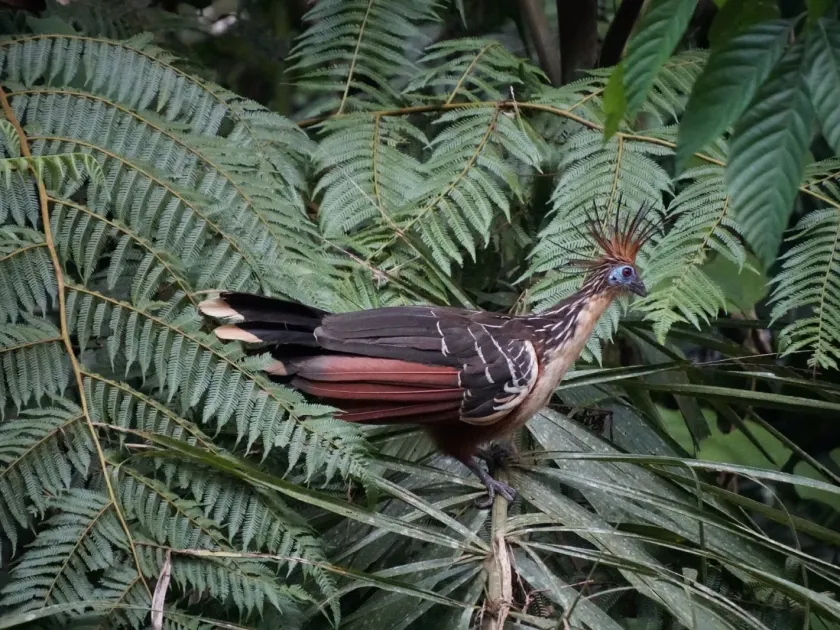
Description
How to identify
The hoatzin is a unique tropical bird species belonging to the order Opisthocomiformes, exclusively found in the swamps and forests of South America.
It is scientifically recognized as Opisthocomus hoazin and is famous for its primitive characteristics, such as the chicks having functional claws on their wings.
The bird has a distinct appearance with a spiky crest, reddish eyes, and a blue face, making it easily distinguishable from other avian species in the region.
Its digestive system is highly specialized, involving foregut fermentation, which is unique among birds, making it the only avian "ruminant" in the world.
Due to this digestive process, the hoatzin emits a strong, manure-like odor that serves as a deterrent to some predators but also marks its presence clearly.
What it damages
Hoatzins are strictly herbivorous, feeding primarily on the leaves, buds, and fruits of aquatic and riparian vegetation near water bodies.
In agricultural settings adjacent to their natural habitat, they can become pests by consuming the tender leaves and terminal buds of young fruit tree saplings.
This feeding behavior stunts the growth of plants and can lead to structural damage, negatively impacting the development and yield of the trees.
If grain crops or vegetables are planted too close to riverbanks or marshy areas, hoatzins may consume seedlings, causing localized but significant losses.
The damage is typically concentrated on young, succulent plant tissues, as the birds prefer vegetation that is easy to ferment in their specialized crops.
When it appears
The hoatzin is active throughout the year, as it inhabits tropical regions where seasonal food availability remains relatively consistent.
Feeding pressure tends to increase during the breeding season, as adult birds forage more intensively to support their energetic requirements during nesting.
Seasonal flooding in the Amazon and Orinoco basins forces the birds to congregate in specific areas, which can lead to increased pest pressure on local crops.
During drier spells, when their primary forest food sources might be less nutritious, hoatzins may demonstrate broader feeding habits near human agriculture.
Their population dynamics are closely linked to the water level cycle, which dictates the accessibility of their primary forage areas.
Signs of infestation
The most prominent sign of a hoatzin colony is the characteristic pungent, musky odor that permeates the air around their nesting and feeding sites.
Observation of uneven, ragged edges on leaves of young plants or trees is a primary indicator of their feeding activity, distinct from insect damage.
The presence of large amounts of bird droppings on branches and the ground beneath trees is a telltale sign of a roosting or feeding location.
Visual identification of the birds themselves, especially their crests and characteristic movements in the canopy, confirms their presence on the property.
- Pungent musky odor in the vicinity of crops.
- Ragged leaf edges on young tree terminals.
- High concentration of avian droppings in the canopy.
Control measures
As the hoatzin is a unique, ecologically significant species, non-lethal management strategies are the only recommended approach for crop protection.
Physical exclusion, such as the use of netting, is highly effective for protecting individual saplings or high-value small garden plots from bird intrusion.
Acoustic deterrents that simulate predator calls or introduce varying, unpredictable noises can be used to prevent flocks from settling on a specific site.
Establishing buffer zones of non-commercial, native vegetation can help divert the birds' attention away from agricultural crops toward natural forage.
Proper site management and monitoring of nesting activities near farms allow for early intervention before significant crop damage occurs in the nursery.
Taxonomy
- Latin name
- Opisthocomus hoazin
- Family
- Opisthocomidae
- EPPO code
- OPSTHO
Discussion
No discussions yet — be the first.