
Common woodlouse
Oniscus asellus
Description
How to identify
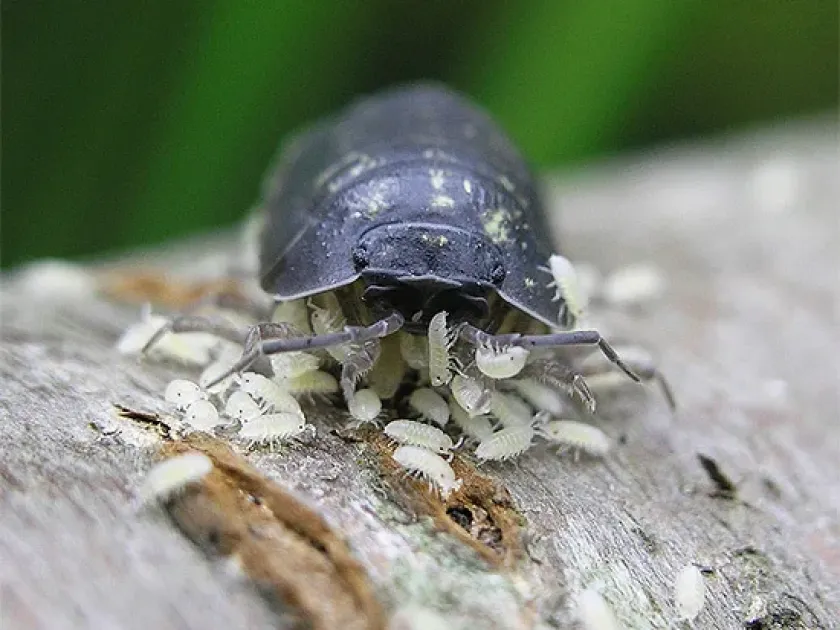
The common woodlouse (Oniscus asellus) belongs to the order Isopoda, family Oniscidae. Unlike most crustaceans, they have adapted to life on land, although they are strictly dependent on high humidity for survival.
Adults typically measure 15–18 mm in length. Their body is oval, convex, and covered with a segmented chitinous exoskeleton, usually grey or brownish-grey in color, which helps prevent dehydration.
They possess seven pairs of legs, allowing them to move quickly when disturbed. Their head features two pairs of antennae, one of which is rudimentary, while the other is longer and sensory-rich.
Reproduction involves the female carrying eggs in a brood pouch, known as a marsupium, located on the underside of her body. After hatching, the juveniles undergo several molts before reaching maturity.
These pests are nocturnal and thrive in dark, damp environments. They are commonly found under rotting wood, stones, damp leaves, and in greenhouse cracks where moisture levels remain consistently high.
What it damages
Woodlice primarily damage plants in greenhouses, nurseries, and indoor settings. They frequently attack seedlings, strawberries, cucumbers, and various ornamental plants, especially those in containers.
They cause damage by feeding on young roots, tender stems, and leaves that touch the soil surface. Young seedlings are particularly vulnerable and can be destroyed in a very short period due to woodlouse grazing.
In addition to live plant tissues, they often feed on decaying organic matter. However, when populations are high or moisture is scarce, they readily attack vegetable crops, including tubers like potatoes or carrots.
Their feeding activity leaves irregular holes in leaves and scars on stems. These wounds not only stunt plant growth but also serve as entry points for various bacterial and fungal pathogens, leading to rot.
Damaged fruits, particularly low-hanging ones like strawberries, lose their market value and shelf life. The lesions created by woodlice quickly become sites for secondary infections such as gray mold.
When it appears
Woodlice are active throughout the growing season. Their reproductive cycle is heavily influenced by humidity levels, with peak population growth occurring during wet spring and summer months.
In managed greenhouse environments, woodlice can remain active and reproduce throughout the entire year, as these facilities typically provide the high humidity and organic waste they require.
Populations often surge following periods of heavy rain or excessive irrigation. During such times, they migrate from their hiding spots to find food, frequently ending up on the stems and leaves of vulnerable crops.
As temperatures begin to drop in late autumn, woodlice seek shelter for overwintering. They usually aggregate in deep soil layers, beneath garden debris, or within the structural crevices of greenhouse frames.
Effective management requires consistent monitoring of environmental conditions within the greenhouse to identify peaks in activity before they translate into significant crop damage.
Signs of infestation
The first sign of an infestation is often the presence of irregular, notched holes along the edges of leaves, especially those close to the ground. In severe cases, only the leaf veins may remain.
Seedlings may show signs of girdling or deep lesions near the soil level. These damaged areas often darken and decay, eventually leading to the collapse or wilting of the affected plant.
Discovering individual woodlice under mulch, rocks, or pots is a definitive sign of infestation. They are sensitive to light and movement and will quickly retreat into darker crevices when disturbed.
Tiny dark granular frass (excrement) deposited on the soil surface near the base of the plant is another indicator of their presence. You may also find shed exoskeletons left behind during their molting process.
On harvested produce or low-hanging fruits, look for shallow, irregular wounds with ragged edges. These marks are distinct and confirm that the fruit has been grazed upon during the night.
Control measures
The most effective approach is maintaining high sanitation standards. Removing decaying plant matter, wood debris, and unnecessary boards from the garden or greenhouse reduces hiding places.
Managing moisture is critical. Ensure proper ventilation in greenhouses to allow the soil surface to dry out between waterings, as woodlice cannot survive in dry, well-aerated soil.
- Placing damp traps (cloths or boards) overnight and disposing of the woodlice collected in the morning.
- Applying a barrier of lime or diatomaceous earth around sensitive plants to deter movement.
- Using biological control agents such as nematodes or fungal pathogens in organic greenhouse management.
- Applying specific insecticides only as a last resort and in accordance with local regulations for crop safety.
Preventive soil maintenance, including deep cultivation before the season, disrupts the habitats of overwintering populations and prevents them from establishing a colony in the new crop.
Regular inspections of the greenhouse base and under pots allow for early detection, enabling gardeners to control the population through cultural practices before chemical intervention becomes necessary.
Taxonomy
- Latin name
- Oniscus asellus
- Family
- Oniscidae
- EPPO code
- ONISAS
Discussion
No discussions yet — be the first.