
Omophoita quadrinotata
Omophoita quadrinotata
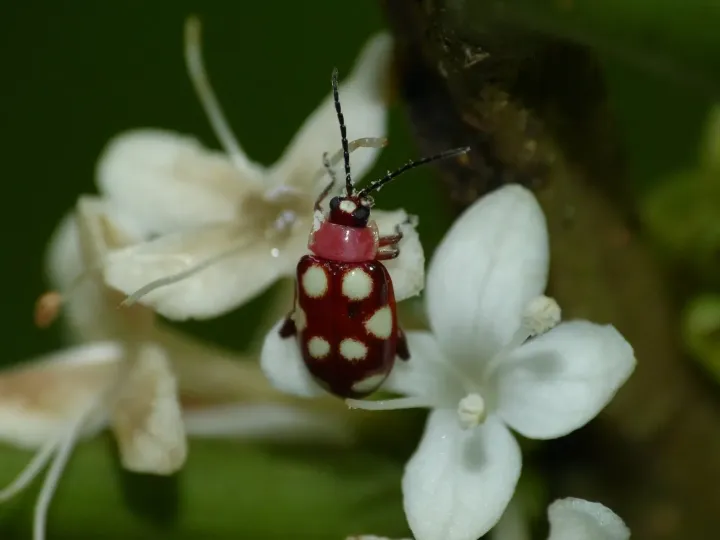
Description
How to identify
Omophoita quadrinotata is a species of beetle belonging to the family Chrysomelidae, specifically known as a type of flea beetle. They are characterized by their small size and ability to jump using enlarged hind legs.
The adult beetles are typically about 6–8 mm long. They display a bright, conspicuous coloration, often yellow or orange, with four distinctive dark spots on their elytra, which serves as an aposematic signal to predators.
The larvae are typically soft-bodied and exhibit chewing mouthparts, specifically adapted for consuming the epidermis and mesophyll of plant leaves.
As members of the flea beetle group, they are highly active and mobile, often changing their location on the plant or migrating to adjacent plants when disturbed.
The life cycle is fully metamorphic, with eggs typically laid on or near the host plant, ensuring that larvae have immediate access to food upon hatching.
What it damages
This pest primarily attacks members of the Solanaceae family, with potatoes, tomatoes, peppers, and eggplants being among the most vulnerable crops.
Damage is inflicted by both adults and larvae. Adults graze on the leaves, creating small, circular holes, while larvae can cause more severe defoliation and root or stem damage in some species.
The consumption of leaf tissue significantly impairs the plant's photosynthesis, which directly leads to reduced growth rates and poor yields.
Severe infestations can lead to complete defoliation of the plant, especially if the infestation occurs during the critical seedling or early vegetative growth stages.
In addition to physical damage, the pest's feeding activity can create entry wounds for various viral and fungal pathogens, complicating the overall health of the crop.
Signs of infestation
The most recognizable sign of an Omophoita quadrinotata infestation is the "shot-hole" appearance of the leaves, where numerous small holes cover the leaf surface.
Leaves may show yellowing or browning around the feeding sites, which eventually leads to tissue necrosis and premature leaf drop in heavy infestations.
Growth stunting is frequently observed, as the plant directs its energy toward leaf recovery rather than flower or fruit development.
Observation of the adult beetles on the undersides of leaves, especially during the cooler hours of the day, confirms their presence in the field.
The presence of fine, granular frass (insect excrement) on the leaf surfaces is a clear indication that active feeding is occurring.
Control measures
Effective management requires a combination of cultural practices, mechanical barriers, and, when necessary, targeted chemical applications.
Sanitation is key; removing alternate host plants such as wild nightshades from around fields significantly reduces the pest population pressure.
Row covers or fine-mesh netting can be extremely effective in protecting young plants from colonization by adult beetles during the early season.
- Applying systematic insecticides during the early stages of infestation.
- Encouraging natural predators and using biological insecticides like Beauveria bassiana.
- Implementing strict crop rotation schedules to break the pest's life cycle.
Regular field scouting using sticky yellow traps helps in determining the precise timing for intervention, ensuring minimal impact on the environment.
Taxonomy
- Latin name
- Omophoita quadrinotata
- Order
- Coleoptera (beetles)
- Family
- Chrysomelidae
- EPPO code
- OMOHQU
Discussion
No discussions yet — be the first.