
Cabbage stem weevil
Omobaris
Description
How to identify
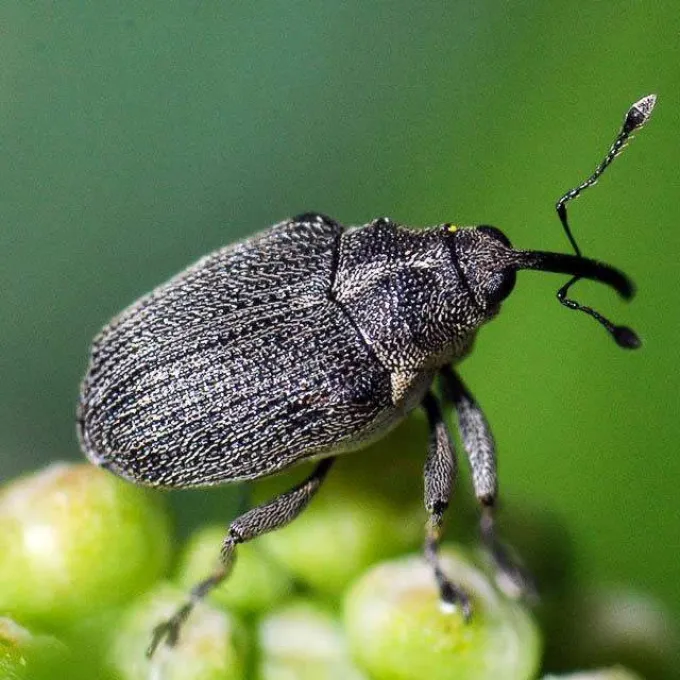
The cabbage stem weevil (scientific name Omobaris) is a member of the Curculionidae family, commonly known as weevils. These insects are characterized by their distinct snout, known as a rostrum, which is used for both feeding and egg-laying.
Adult weevils are small, typically dark-colored, ranging from black to brownish-gray. Their bodies are often covered with fine scales, which provide natural camouflage on plant foliage, making them difficult to spot during routine field inspections.
The life cycle of this pest follows complete metamorphosis, consisting of four stages: egg, larva, pupa, and adult. They spend the winter months in a state of diapause, hidden in the soil or protected under crop debris.
The larvae are white, legless, and have a curved, fleshy appearance with a hardened, darkened head capsule. They spend their entire developmental period inside the plant tissues, shielded from external environment.
With high reproductive potential, this species can establish itself quickly in vegetable production areas, especially when host crops like cabbage or radish are cultivated in close proximity to each other.
What it damages
The cabbage stem weevil primarily attacks plants belonging to the Brassicaceae family. Major host plants include various types of cabbage, radish, swede, and turnip, which suffer the most significant economic loss.
The damage is primarily caused by larvae burrowing into the stems and leaf stalks. By creating extensive tunnels, they disrupt the plant's vascular system, preventing the flow of water and nutrients to the upper parts of the plant.
This internal damage causes significant growth stunting, leaf wilting, and in severe cases, the complete collapse of the plant. The destruction of the stem integrity is often irreversible once the larvae reach maturity.
Adults also feed on the foliage by nibbling small, circular holes, which, while aesthetically unappealing, are significantly less harmful than the deep tissue destruction caused by the larval stage.
Additionally, the feeding sites often become infection points for secondary pathogens, such as bacterial soft rot, which can destroy the crop even faster than the weevil itself.
When it appears
Adults typically emerge from their overwintering sites in early spring as soon as temperatures rise. Their first activity usually involves feeding on early-season brassica weeds or young seedlings.
Egg-laying begins shortly after emergence, with females using their snouts to puncture host plant stems. They insert individual eggs into these punctures, which are then protected by the plant's own tissue.
The larval stage is the most prolonged and active phase of the cycle. After hatching, larvae tunnel toward the center of the stem, feeding on the soft pith tissue throughout their developmental journey.
Pupation generally occurs either inside the stem or, in some species, by exiting the plant to pupate in the soil. This transformation stage marks the preparation for the emergence of the next adult generation.
The new generation of adults usually emerges in mid-to-late summer. They continue to feed on host foliage for a period before seeking suitable sites to enter diapause and survive the winter.
Signs of infestation
Initial signs of infestation are subtle, often manifesting as minute pinprick marks on the petioles or stems. These marks are sometimes surrounded by small, discolored necrotic rings.
As the larvae develop internally, the plant may show external symptoms such as leaf yellowing, wilting during mid-day heat, and overall loss of vigor. These signs indicate that the plant's vascular system is being compromised.
A closer inspection of a suspected plant often reveals internal galleries filled with fine, brown frass (larval waste). If the stem is split, the larvae themselves can often be found deep within the tissues.
- Stunted plant growth and reduced vigor.
- Wilting of lower leaves that does not resolve with irrigation.
- Distortion or bending of the main stem or leaf stalks.
- Presence of internal tunneling and necrotic patches.
Severely infested plants may become fragile at the base, often breaking off or toppling over under wind stress or mechanical pressure due to the hollowed-out structure of the stem.
Control measures
Effective management begins with rigorous cultural practices, such as removing brassica weeds around the farm perimeter to eliminate early-season host reservoirs and reduce initial pest pressure.
Implementing a strict crop rotation cycle is essential to prevent the buildup of local populations. Spatial isolation between new and old cabbage fields helps in slowing down the spread of adults to younger, more vulnerable crops.
Post-harvest soil tillage can be highly beneficial, as it disturbs the pupation sites and exposes overwintering adults to frost or predatory insects, effectively lowering the overall population density.
In cases of high pest pressure, systemic insecticides are the most effective solution, as they are absorbed by the plant and target the larvae hidden inside the stem tissues.
Integrated Pest Management (IPM) programs often include monitoring using pheromone traps and biological agents, which can suppress the weevil population without causing excessive environmental impact.
Taxonomy
- Latin name
- Omobaris
- Order
- Coleoptera (beetles)
- Family
- Curculionidae
- EPPO code
- OMOBSP
Discussion
No discussions yet — be the first.