
Banks grass mite
Oligonychus pratensis
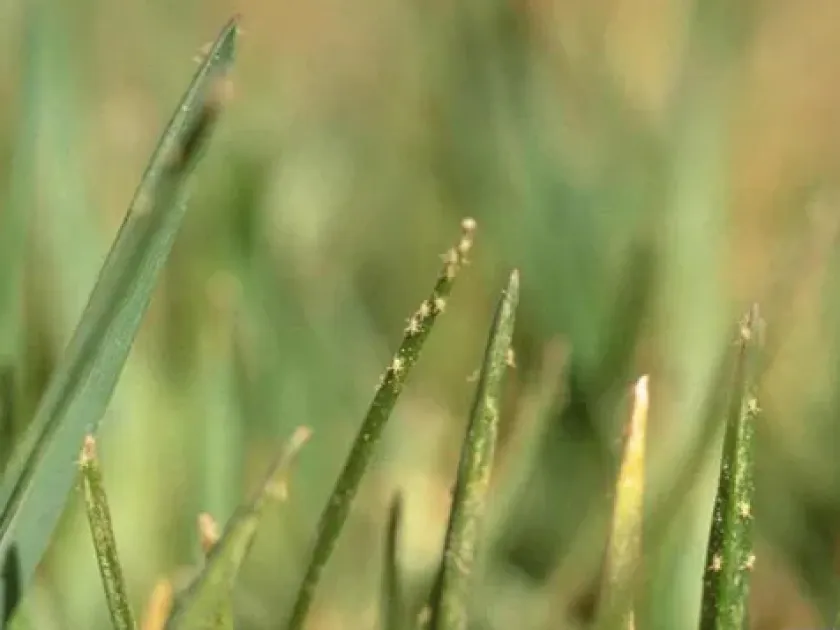
Description
How to identify
The Banks grass mite is a member of the Tetranychidae family (spider mites), order Trombidiformes. It is a microscopic pest measuring approximately 0.3–0.4 mm in length.
Adult mites are oval-shaped and range in color from yellowish-green to brownish. Larvae are smaller and possess only three pairs of legs, while adults have four pairs.
The life cycle consists of egg, larva, protonymph, deutonymph, and adult stages. Under favorable temperatures, the cycle can be completed in just 7–10 days.
Fertilized females overwinter in the soil, under plant debris, or within bark crevices, exhibiting high tolerance to harsh environmental conditions.
Females deposit spherical eggs on the underside of leaves, often securing them with fine silk webbing that provides protection from environmental stresses and natural predators.
What it damages
This pest is a specialized phytophagous mite that primarily targets grass crops. Its major hosts include corn, sorghum, and various wild grass species.
In corn fields, the mites typically inhabit the underside of the leaves, starting from the lower levels and moving upwards as the population density increases.
In areas with irrigation, the mite can cause significant economic losses in wheat and barley, especially during prolonged periods of hot and dry weather.
The pest is also known to infest certain varieties of sugarcane, posing a threat to a broad range of agricultural and industrial crop systems.
Widespread feeding activity leads to chlorophyll depletion, impairment of photosynthesis, reduced grain weight, and overall loss of yield potential.
When it appears
Activity begins in the spring when average daily temperatures exceed 15°C, prompting females to emerge from their overwintering sites.
Population peaks are typically observed during hot, dry summer months when air humidity drops below 50% and temperatures consistently reach over 28°C.
In arid climates, the Banks grass mite can produce up to 10–12 generations during a single growing season, leading to rapid population explosions.
As autumn approaches, decreasing temperatures and shorter photoperiods trigger females to enter a diapause state for overwintering.
Wind currents play a major role in the dispersion of the pest, carrying silk strands with larvae attached to neighboring fields and new host plants.
Signs of infestation
Initial signs of infestation appear as small yellow or whitish stippling on the leaves, which gradually merge into large, discolored necrotic zones.
Fine, delicate silk webbing becomes visible on the infested plant tissues, often trapping debris and dust, which makes the colony easier to spot.
Leaves curl, dry out, and undergo premature senescence, which significantly reduces the metabolic activity and overall vigor of the affected plants.
- Yellowing of leaf tips and margins
- Presence of fine silk webs under leaves
- Premature drying of the leaf surface
- Stunted growth and reduced plant height
Severe infestations on corn can lead to poor ear fill and shriveled kernels, which results in significant weight loss and decreased market quality.
Control measures
Effective agricultural management involves the removal of alternative host weeds, which act as reservoirs for mite populations at the start of the season.
Proper crop rotation and deep fall plowing can significantly reduce the overwintering population density of females residing in the soil.
Maintaining proper soil moisture and increasing the relative humidity of the field microclimate creates conditions unfavorable for mite reproduction.
When the economic injury threshold is reached, chemical intervention with selective acaricides is recommended, ensuring compliance with pre-harvest intervals.
It is critical to rotate chemical compounds with different modes of action to prevent the development of resistance within the mite population.
Taxonomy
- Latin name
- Oligonychus pratensis
- Order
- Mites
- Family
- Tetranychidae
- EPPO code
- OLIGPR
Discussion
No discussions yet — be the first.