
Avocado spider mite
Oligonychus perseae
Description
How to identify
The avocado spider mite (Oligonychus perseae) is a member of the Tetranychidae family within the order Trombidiformes. These microscopic pests measure approximately 0.3–0.5 mm in length and exhibit a yellow-green to brownish body color.
Adult females are distinguished by two dark spots on their dorsal side, which can be seen under a magnifying glass. Larvae and nymphs are significantly smaller and appear much paler, making them difficult to spot without specialized tools.
These mites prefer to live on the underside of leaves, specifically along the leaf veins. They construct a delicate, thin webbing that acts as a protected site for egg-laying and development.
Their life cycle is temperature-dependent and extremely rapid. Under favorable conditions, the mite can complete its development from egg to adult in less than 20 days, leading to multiple generations per season.
High reproductive rates allow populations to explode during warm and dry periods. During these times, the natural predatory mite populations often fail to keep the pest numbers under control.
What it damages
The primary host for Oligonychus perseae is the avocado tree (Persea americana). It is recognized as a major economic pest in avocado-growing regions worldwide, causing significant losses to orchard health.
The mites feed by piercing the leaf epidermis and extracting cell contents. This feeding pattern causes localized cell death and disruption of the photosynthetic process within the leaf tissue.
Severe infestations result in extensive leaf drop, which weakens the tree. The loss of foliage exposes the fruit to direct sunlight, which can lead to sunburn damage and reduced commercial quality of the crop.
In addition to direct damage, tree stress caused by mite activity makes avocado trees more susceptible to secondary fungal infections and other opportunistic pests that thrive on weakened plant tissue.
Over time, chronic infestations lead to a decline in tree vigor, reduced fruit size, and significant decreases in overall orchard yield, which can affect profitability for several harvest seasons.
Signs of infestation
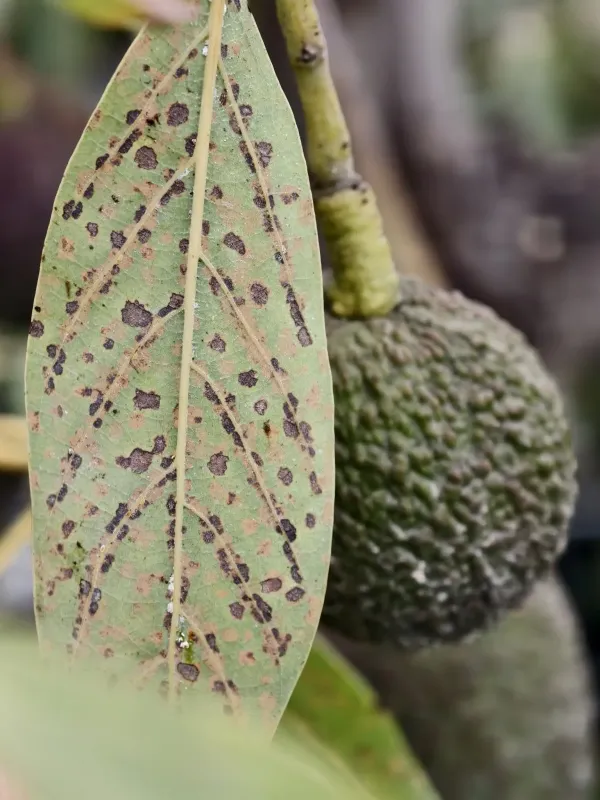
The initial signs of infestation appear as small yellow dots on the underside of the leaves. As the population grows, these spots evolve into irregular, brown necrotic areas bounded by the leaf veins.
A tell-tale sign of an active infestation is the presence of silk webbing on the underside of the leaves. In heavy infestations, this webbing can become clearly visible even to the naked eye.
Leaf tissue within the affected areas eventually becomes dry and brittle, leading to premature leaf drop. The overall appearance of the tree canopy can take on a scorched or "rusty" color.
Early detection requires inspecting the undersides of the leaves near the midribs, as this is where the mites usually establish their initial colonies before spreading across the entire leaf surface.
Monitoring for color changes in the canopy is crucial. If the foliage begins to show uniform yellowing or bronzing during dry summer months, it is highly likely that a mite outbreak is occurring.
Control measures
Biological control is the most effective long-term management strategy. Introducing predatory mites, such as those from the Phytoseiidae family, helps maintain the pest population below economic damage thresholds.
Orchard management practices, such as proper irrigation, are essential. Stressed trees are more prone to spider mite damage; therefore, maintaining adequate water levels can increase the tree's natural resilience.
Chemical control should be used sparingly and only when necessary. Choose selective acaricides that target the mite specifically while minimizing harm to beneficial insects and predatory mites.
Rotate the use of different chemical products to prevent the development of resistance in the mite population. Always follow local regulations regarding pesticide residues on fruit before harvest.
Regular monitoring using sticky traps or scouting of individual leaf samples is recommended to detect early outbreaks. Early intervention allows for spot-treatment, which is more cost-effective and environmentally friendly.
Taxonomy
- Latin name
- Oligonychus perseae
- Order
- Mites
- Family
- Tetranychidae
- EPPO code
- OLIGPA
Discussion
No discussions yet — be the first.