
Conifer spider mite
Oligonychus hondoensis
Description
How to identify
The conifer spider mite (Oligonychus hondoensis) belongs to the order Trombidiformes and the family Tetranychidae. It is a microscopic pest with an oval body measuring less than 0.5 mm, ranging in color from yellowish-green to brownish.
Adults and larvae have eight and six legs respectively, a typical feature for arachnids. Identification is difficult due to their tiny size, so a 10x magnifying glass is usually required for field diagnosis.
The pest's life cycle is closely synchronized with the seasonal rhythms of coniferous trees. Mites pass through egg, larva, protonymph, deutonymph, and adult stages, reproducing rapidly under favorable climatic conditions.
They overwinter primarily as eggs, which are deposited by females at the base of needles or on the bark of young shoots. The eggs are often reddish, helping them remain camouflaged on the needles.
High fecundity allows the mite to produce several generations in a single growing season, leading to a rapid population spike by mid-summer.
What it damages
The primary hosts for Oligonychus hondoensis are members of the Pinaceae family. Spruce and fir species are most frequently affected, while pines and cedars may also be targeted.
The pest feeds by piercing the epidermis of the needles and sucking out cellular contents. This disrupts the photosynthetic process and the tree's overall metabolism.
Young nursery seedlings and ornamental trees in urban landscapes are particularly vulnerable to mass attacks due to their less developed immune defenses.
In hot and dry weather, the damage becomes particularly critical for the tree's aesthetic value. Severe infestations can lead to defoliation and gradual branch dieback.
The conifer spider mite often occurs in mixed plantings, spreading from one conifer species to another, making it a dangerous pest for a wide range of evergreen plants.
Signs of infestation
The first sign of infestation is the appearance of a characteristic yellowish or grayish speckled pattern on the needles. These are the marks from the feeding punctures where the mite extracts cell sap.
As the colony develops, the needles take on a brown, "scorched" appearance and begin to drop prematurely. The tree loses its aesthetic appeal and looks stunted.
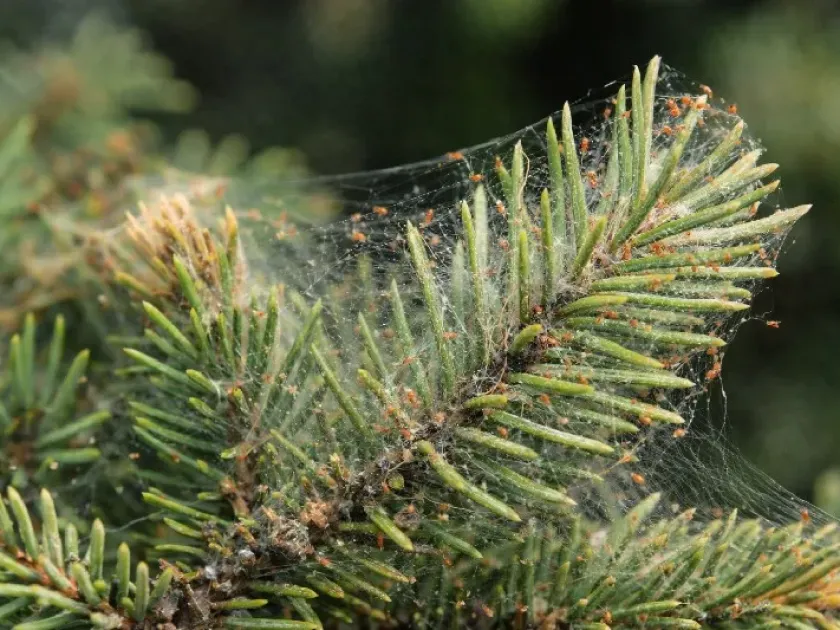
The presence of fine, barely visible webbing between needles is a key diagnostic sign that confirms the presence of a spider mite colony.
Upon closer inspection of the underside of the needles or the branch axils, one can observe clusters of mites and larvae, as well as empty eggshells left behind after hatching.
In severe cases, affected parts of the crown dry out, and overall tree growth is significantly reduced, making the plant susceptible to secondary fungal infections.
Control measures
Control involves the use of acaricides or insecto-acaricides with systemic or contact action. It is crucial to apply treatments early, as soon as the first signs of damage are observed.
It is recommended to rotate products from different chemical groups to prevent the development of resistance in the pest population.
Agrotechnical measures include maintaining optimal soil moisture and regular overhead watering (sprinkling), as mites thrive in dry conditions and are discouraged by high humidity.
Sanitary pruning and the removal of heavily infested branches, which may contain overwintering stages, are vital parts of a management strategy.
- Application of biological pesticides based on entomopathogenic fungi.
- Use of specialized acaricides based on avermectins.
- Regular monitoring of needle health during the growing season.
- Weed removal around the tree base to reduce breeding grounds.
Taxonomy
- Latin name
- Oligonychus hondoensis
- Order
- Mites
- Family
- Tetranychidae
- EPPO code
- OLIGHO
Discussion
No discussions yet — be the first.