
Coffee red spider mite
Oligonychus coffeae
Description
How to identify
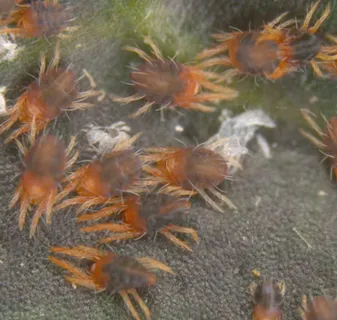
The coffee red spider mite (Oligonychus coffeae) belongs to the family Tetranychidae within the order Acariformes. These microscopic pests are rarely larger than 0.4 mm, making them extremely difficult to detect with the naked eye until a significant infestation occurs.
Adult mites have an oval body typically ranging in color from reddish-brown to dark brown. Larvae appear lighter, often yellowish, and possess only three pairs of legs, whereas nymphs and adults have four pairs.
Females deposit tiny, spherical eggs on the undersides of leaves, usually along the veins. The life cycle is remarkably rapid, allowing for the completion of a generation in less than two weeks under optimal temperature and humidity conditions.
These mites typically live in dense colonies protected by a fine, silken webbing. This web acts as a shield against environmental fluctuations and some larger predatory insects.
Overwintering usually occurs in the adult female stage, hiding in tree bark crevices, decaying organic matter, or within the surface layer of the soil until the return of favorable warm weather.
##damage##While known primarily for infesting coffee (Coffea spp.) and tea (Camellia sinensis) plantations, this polyphagous pest affects a wide range of woody and shrub species throughout tropical and subtropical regions.
The mites feed by piercing the leaf cells and extracting the sap. This process severely disrupts the photosynthetic efficiency of the plant, leading to stunted growth and a general decline in plant vitality.
Severe infestations result in heavy defoliation. In commercial agriculture, this damage leads to massive yield losses and significantly degrades the quality of the harvested produce, whether coffee beans or tea leaves.
The puncture wounds caused by the feeding mites also serve as entry points for various fungal and bacterial infections. This secondary damage can complicate recovery and further weaken the infested crop.
Economic damage is substantial, as infected plants require increased investment for recovery and pest management, and the overall productivity of the plantation is often compromised for the duration of the season.
##season##The activity of Oligonychus coffeae is strongly correlated with periods of high temperature and low rainfall. Dry, hot weather conditions are critical triggers for rapid population growth.
In tropical environments, the pest can remain active throughout the year, though population spikes often occur during the transition from the rainy season to the dry season. In temperate zones, their life cycle aligns with the crop's growing season.
Temperatures ranging from 30 to 35 degrees Celsius accelerate the developmental rate of each generation, necessitating intense monitoring and proactive management during these climatic peaks.
High humidity and consistent rainfall are unfavorable for the mite's survival. These conditions restrict their movement and can lead to natural mortality of both eggs and larvae.
Agrotechnical monitoring programs should prioritize frequent leaf sampling during the early dry season to detect the first signs of colony establishment before they become uncontrollable.
##signs##Initial signs of infestation appear as minute chlorotic spots (pale dots) on the upper surface of the leaves, which correspond to the feeding activity of the mites on the undersides.
As the infestation progresses, these spots coalesce, giving the leaf a characteristic bronzed or brownish, scorched appearance. This «bronzing» is the most distinct symptom of Oligonychus coffeae damage.
The presence of fine webbing covering the underside of the leaves is a definitive diagnostic feature. One can often observe dust particles and cast-off skins (exuviae) trapped within this web.
At advanced stages, leaves may curl, become brittle, and eventually drop prematurely. The plant loses its natural luster and appears generally withered and stressed.
Severe damage results in a noticeable rust-colored appearance of the entire canopy, making affected plants stand out distinctly from healthy ones in the field.
##control##Integrated pest management (IPM) is essential for effective control, starting with cultural practices like the removal and destruction of heavily infested branches to reduce the initial pest load.
Maintaining proper irrigation, especially overhead sprinkling, can significantly suppress mite populations by increasing local humidity, which is detrimental to their development.
Chemical control should rely on the application of selective acaricides. It is vital to rotate different chemical classes to prevent the mites from developing resistance to specific active ingredients.
Conservation of natural predators, including phytoseiid mites, lacewings, and ladybirds, is a highly effective long-term strategy for suppressing mite populations naturally.
- Regular inspection of the underside of leaves using a magnifying lens.
- Application of acaricides only when economic thresholds are reached.
- Optimization of irrigation to maintain favorable plant water status.
- Strict quarantine measures for the movement of plant stock to avoid infestation spread.
Taxonomy
- Latin name
- Oligonychus coffeae
- Order
- Mites
- Family
- Tetranychidae
- EPPO code
- OLIGCO
Discussion
No discussions yet — be the first.