
Fruit moth leafroller
Olethreutes ferriferana
Description
How to identify
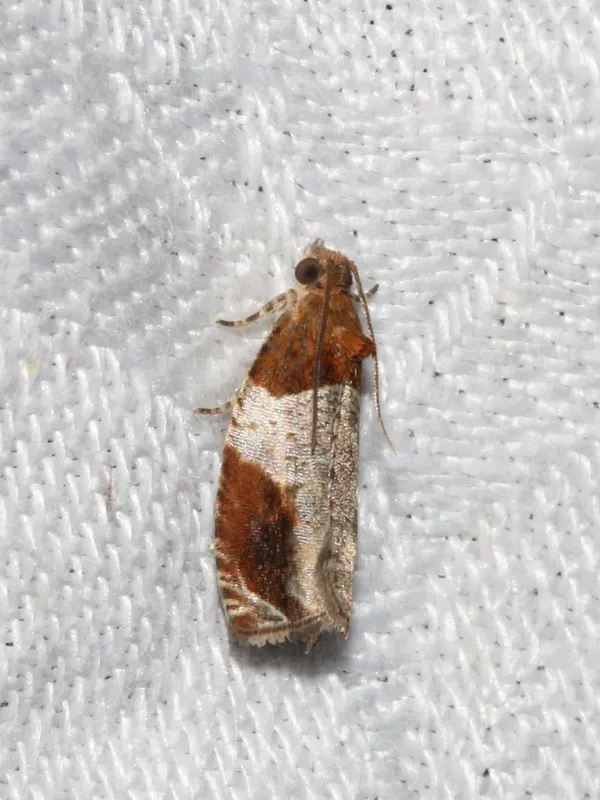
The fruit moth leafroller Olethreutes ferriferana belongs to the order Lepidoptera and the family Tortricidae. It possesses the typical characteristics of this family: a compact body and wingspan ranging from 15 to 20 mm.
The forewings of the moth feature a camouflaged pattern that helps it blend in with tree bark and leaves. The coloration is primarily ochre or grayish-brown with dark bands and spots, which is a key diagnostic feature for identification.
The larvae (caterpillars) go through several developmental stages, changing color from light beige to greenish or brownish. A dark plate on the head is a distinct feature, and the body is covered in fine setae to assist in movement on plants.
Pupae of this species develop either inside rolled leaves or in the topsoil layer, depending on temperature and generation. Overwintering typically occurs as a pupa or late-stage larva within a dense cocoon.
Adults are primarily active at twilight, often remaining hidden in the canopy during the day. Studying the morphology of this pest is crucial for the correct installation of pheromone traps during the flight period.
What it damages
The primary food source for Olethreutes ferriferana larvae includes the reproductive and vegetative parts of woody and shrubby plants. Damage is inflicted on fruits, buds, and young leaves, leading to significant yield losses.
The pest affects both forest and orchard crops, with larvae boring into the fruit and creating tunnels. This ruins the commercial quality of the produce and often causes premature fruit drop.
Bud damage in early spring can lead to a reduction in leaf surface area, weakening the plant and hindering photosynthesis. Severely damaged shoots often become deformed or die off entirely.
Beyond direct tissue consumption, larval tunnels serve as entry points for fungal and bacterial infections. Damaged fruits are more susceptible to rot and are unsuitable for long-term storage.
The economic threshold of damage depends on population density within the orchard. In outbreak years, crop losses can be substantial, necessitating immediate intervention by agronomic teams.
When it appears
The life cycle of Olethreutes ferriferana is closely tied to the phenological phases of host plants. The onset of adult activity typically coincides with the bud-break and flowering periods, providing optimal food resources.
The first generation is most active in spring when larvae begin feeding on young bud tissue. This is a critical period during which the plant is highly vulnerable to infestation.
During the summer, with stable high temperatures, development can accelerate. Depending on the climate, the species may produce one or two generations per season, which must be considered when planning treatments.
By autumn, larvae finish their feeding cycle and prepare for overwintering. They migrate into tree bark crevices, plant debris, or soil to pupate or enter diapause.
Seasonal dynamics are monitored using light traps and pheromone monitors placed within plantations. These data allow for the precise timing of protective measures.
Signs of infestation
The first sign of infestation is the appearance of characteristically rolled leaves tied with silk. Larvae use silk threads to form "houses" where they remain protected from external factors.
Entrance holes can be found on fruit surfaces, often surrounded by larval frass. Damaged fruits are frequently covered in mold due to the introduction of fungal spores into the tissue.
On shoots, you can detect eaten buds that appear dry or deformed. This leads to the cessation of lateral branch growth and disrupts the normal architecture of the tree crown.
Inspecting the foliage reveals "windows" where the larva has eaten only the parenchyma, leaving the epidermis intact. In areas of high pest density, significant defoliation of shoots can be observed.
Adult presence is confirmed during evening hours. Adult moths show high flight activity, making them easy to spot with the use of auxiliary light sources in the orchard.
Control measures
Cultural practices include the mandatory removal of fallen leaves and plant debris in autumn where larvae and pupae hibernate. Deep cultivation of the soil around the base of trees is also effective.
Mechanical removal of rolled leaves is feasible on smaller areas and at low infestation levels. Regular pruning and disposal of damaged shoots help reduce the population in the following season.
Biological control, such as using Bacillus thuringiensis, is highly effective against early-instar larvae without harming beneficial insects.
Chemical insecticide treatments should be carried out based on monitoring data. It is essential to rotate products from different chemical classes to prevent the development of pest resistance.
- Using pheromone traps for mating disruption.
- Attracting beneficial insects and insectivorous birds to the orchard.
- Maintaining spatial isolation of crops.
- Timely insecticide application during larval emergence.
Taxonomy
- Latin name
- Olethreutes ferriferana
- Order
- Lepidoptera (butterflies)
- Family
- Tortricidae
- EPPO code
- OLETFE
Discussion
No discussions yet — be the first.