
Poplar flea weevil
Odontopus calceatus
Description
How to identify
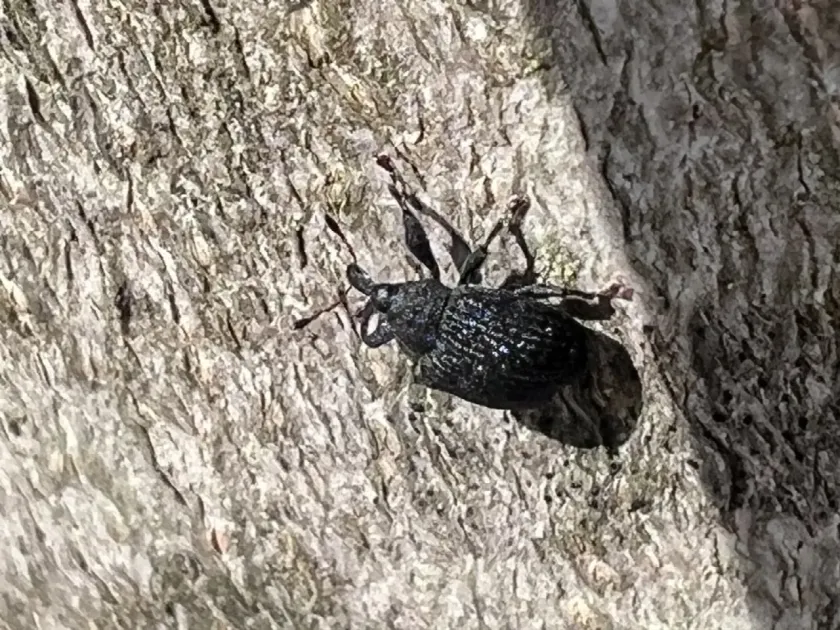
The poplar flea weevil (Odontopus calceatus), also known as the yellow-poplar weevil, belongs to the Curculionidae family. It is a small, robust beetle known for its agility and jumping behavior when disturbed.
Adult beetles are typically 3-4 mm long with a dark body, often featuring reddish or brownish markings on the elytra and legs. Like other weevils, they possess a distinct rostrum (snout) which they use for feeding and egg-laying.
The life cycle involves complete metamorphosis, including egg, larva, pupa, and adult stages. The larval stage is uniquely specialized for living inside the leaf tissue, which protects it from many environmental factors.
This pest is highly specialized in its host selection, primarily targeting trees in the Salicaceae family. The insect's development is closely synchronized with the phenology of its host plants.
Identification often relies on observing the specific patterns of leaf damage, as the adult beetles are small and often shy, retreating quickly when they perceive potential threats.
##damage##The poplar flea weevil primarily attacks trees of the genus Populus (poplars) and Salix (willows). Young plantations and nursery stock are particularly vulnerable to heavy infestations.
Adult weevils cause damage by feeding on young leaves, creating numerous small, irregular holes. This feeding damage reduces the overall photosynthetic capacity of the tree, potentially slowing growth rates.
The larvae are leaf miners. They bore into the leaf tissue, creating mines that initially appear as small spots and gradually expand. This internal feeding leads to the destruction of the leaf's mesophyll.
As the mines grow, the infested parts of the leaf turn brown, necrotic, and brittle. Heavy infestations can lead to premature leaf drop, which significantly stresses the tree, especially in young saplings.
Cumulative damage across the canopy can lead to an overall thinning of the foliage, making the trees more susceptible to secondary environmental stressors and opportunistic pathogens.
When it appears
Adult weevils emerge from hibernation in early spring, synchronized with the bud break of their host trees. They immediately begin feeding on newly emerged foliage to build energy for reproduction.
Mating and egg-laying occur over a period of several weeks during the spring. Females deposit eggs directly into the leaf tissues, ensuring that the hatched larvae have immediate access to nutrients.
Larval development takes place during the late spring and early summer months. During this time, the characteristic mining damage becomes most visible on the canopy leaves.
New generation adults emerge in mid-to-late summer. They continue to feed on host foliage for a period before seeking out suitable sites for their winter diapause.
As temperatures decline in autumn, the beetles migrate toward the base of the trees. They overwinter in leaf litter or under loose bark, remaining dormant until the following spring.
Signs of infestation
The first sign of activity is the presence of small, shotgun-like holes in the leaves. These are caused by the adults' feeding behavior early in the season.
Blotch-like mines are a diagnostic sign of larval infestation. These areas are initially pale or translucent, eventually turning brown as the internal tissue is consumed and dies.
When examining the leaves closely, one can often see small black spots of frass (larval waste) inside the mines. Holding the leaf against the light reveals the hollowed-out chambers created by the larvae.
Extensive infestations cause the tree to appear prematurely scorched or brown. This aesthetic and health-related decline is particularly noticeable in susceptible poplar stands by mid-summer.
The presence of the beetles themselves can be detected by gently shaking branches over a white sheet, which will cause the small weevils to fall and reveal their distinct jumping behavior.
Control measures
Effective management requires a multi-faceted approach, incorporating cultural practices and targeted chemical interventions when the infestation pressure is high.
Sanitation is a key cultural control method. Removing and destroying fallen leaves in the autumn significantly reduces the overwintering population, lowering the pest pressure for the next season.
Chemical control is most effective when applied during the early spring adult emergence period. Contact insecticides can eliminate the breeding adults before they can lay eggs in the new leaves.
If mining activity is already widespread, systemic insecticides may be necessary, as these chemicals are absorbed by the leaf tissue to control the larvae feeding internally.
Integrated Pest Management (IPM) strategies, including the preservation of natural predators and the selection of resistant cultivars, are recommended for long-term reduction of weevil populations in commercial forests.
Taxonomy
- Latin name
- Odontopus calceatus
- Order
- Coleoptera (beetles)
- Family
- Curculionidae
- EPPO code
- ODONCA
Discussion
No discussions yet — be the first.