
Bud moth
Notocelia suffusana
Description
How to identify
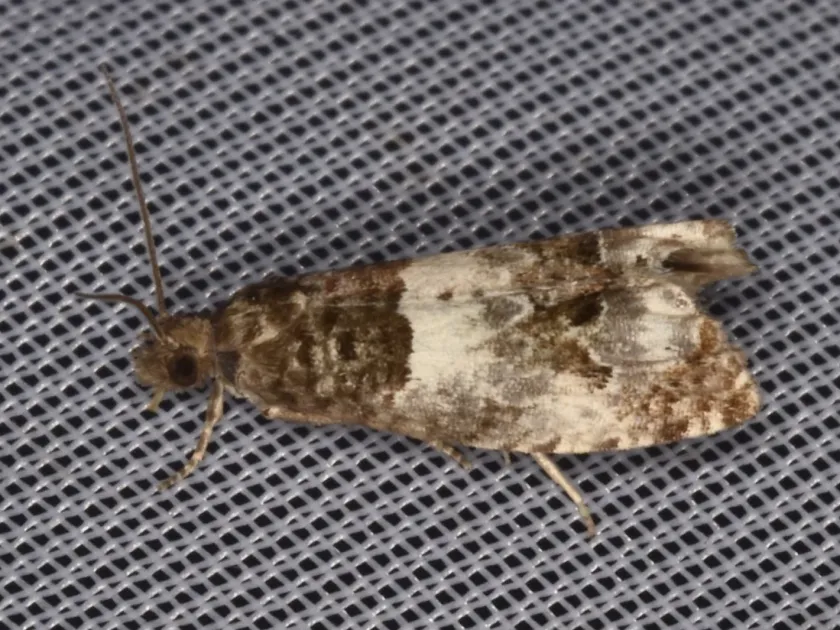
The bud moth (Notocelia suffusana) belongs to the Tortricidae family of moths. The adult moth has a wingspan of 14–18 mm, featuring brownish-grey forewings with distinct darker markings at the base.
The larvae, or caterpillars, grow up to 15 mm in length. They possess a characteristic brownish-green or greyish body with a shiny, dark-brown or black head and thoracic shield.
The species undergoes a complete metamorphosis, consisting of egg, larval, pupal, and adult stages. The life cycle is univoltine, meaning one generation per year.
Young larvae overwinter in dense silk cocoons hidden within bark crevices or branch bifurcations, which provides them with significant protection against winter conditions.
In spring, the larvae emerge from their winter shelters synchronized with the bud-burst stage of the host trees, allowing them immediate access to nutrient-rich plant tissues.
What it damages
This pest primarily affects plants within the Rosaceae family, with apples, pears, hawthorn, and rose bushes being the most common hosts for the larvae.
The primary damage occurs in spring when larvae bore into swelling buds, devouring their contents. This effectively destroys the future flower and leaf buds before they can open.
As the larvae mature, they move to the leaves, spinning them together with silk to form shelters. Inside these structures, they skeletonize the leaves, leading to wilting and premature leaf drop.
Severe infestations weaken the tree significantly, causing stunted growth of new shoots and reducing the tree's overall vigor and resistance to other environmental stressors.
In cases of high population density, the larvae may also damage the developing fruitlets, causing malformation or premature fruit drop, which leads to substantial harvest losses.
When it appears
Adult moths are typically active during the summer months, specifically from June through July, during which mating and egg-laying on the leaves occur.
After hatching, the larvae feed throughout the summer, but the most economically damaging phase happens in early spring when the overwintered individuals start feeding again.
Pupation occurs during late May or early June. The larvae create a protective pupal chamber within rolled leaves or bark scales, where they transition into the adult moth form.
The entire life cycle is tightly synchronized with the phenological stages of the host tree, ensuring that the critical larval stages align with the availability of preferred food sources.
By late autumn, the young larvae search for protected hibernation sites, such as thick bark sections or branch joints, to survive the cold season.
Signs of infestation
The most prominent sign of an early-spring infestation is the presence of withered, unexpanded buds that have been hollowed out by the feeding larvae.
Rolled or tied leaves found at the tips of new shoots are a clear indicator of a larval nest. These shelters are often visible due to the silk webbing holding the leaves together.
Feeding damage, often described as «window-paning,» where the leaf tissue is eaten away, leaving only the veins, indicates the activity of the larvae within their shelters.
Small, inconspicuous silk cocoons found under old, peeling bark during winter pruning are a sign that the pest is overwintering in the orchard.
The flight of adult moths in the evenings during mid-summer confirms the presence of the population, though this phase often goes unnoticed without specific monitoring efforts.
Control measures
Cultural control measures include regular cleaning of tree trunks to remove loose, dead bark, which serves as an overwintering site for the larvae, and collecting fallen debris.
Chemical control is most effective when applied at the green-tip or bud-burst stage, when larvae are most vulnerable to contact or systemic insecticides.
- Utilization of pheromone traps to monitor adult flight and determine the precise timing for protective applications.
- Application of Bacillus thuringiensis or other biological agents to suppress larval populations without broad-spectrum chemical impact.
- Manual removal and destruction of infested leaf clusters during regular field scouting in late spring.
Encouraging natural predators such as lacewings and ladybirds can help maintain the population at a sub-economic level through biological suppression.
Constant observation of the orchard is critical, especially during the early spring growth period, to detect early signs of damage and implement localized control before widespread infestation.
Taxonomy
- Latin name
- Notocelia suffusana
- Order
- Lepidoptera (butterflies)
- Family
- Tortricidae
- EPPO code
- NOTCSU
Discussion
No discussions yet — be the first.