
Tiger weevil
Neoplinthus tigratus
Description
How to identify
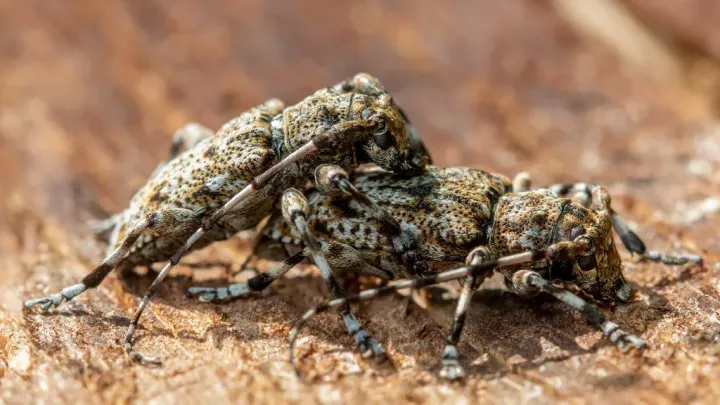
The tiger weevil (Neoplinthus tigratus) belongs to the order Coleoptera and the family Curculionidae. It is a cryptic insect well-adapted to life on tree bark due to its unique appearance.
The adult body is covered in scales forming a distinct pattern resembling tiger stripes, providing excellent camouflage against natural surfaces.
Like other members of its family, the tiger weevil features a prominent snout (rostrum) which is highly functional for feeding and drilling oviposition sites.
The larvae are typically apodous (legless), white in color, and dwell within plant tissues, making them difficult to detect until substantial damage has occurred.
These weevils are strictly nocturnal, remaining hidden in bark crevices or soil debris during daylight hours to avoid predators and desiccation.
What it damages
The tiger weevil primarily targets various trees and woody shrubs, posing a significant risk to fruit orchards and nursery stock.
Adult feeding involves consuming buds and stripping bark, which can stunt tree growth and lead to the loss of vital photosynthetic area.
Larval infestation occurs beneath the bark, where they feed on cambium and phloem, often resulting in girdling that disrupts nutrient transport.
Open wounds left by the weevils serve as entry points for pathogens, significantly increasing the risk of secondary fungal or bacterial infections in the host plant.
In high-density infestations, the cumulative damage can lead to the wilting and eventual death of young seedlings or weakened established trees.
When it appears
Tiger weevil activity typically initiates in early spring as temperatures rise, signaling the emergence of overwintering adults from the soil.
The insects remain active throughout the summer, with feeding and mating occurring primarily at night to avoid harsh light and dehydration.
Oviposition is a prolonged process, occurring continuously during the warmer months, ensuring that generations are staggered throughout the season.
Larval development proceeds through the late summer and autumn months, with individuals preparing for pupation within the host tissue.
Adults exhibit high cold tolerance and survive the winter by hibernating in soil, beneath leaf litter, or deep within protective bark fissures.
Signs of infestation
The most reliable sign of an infestation is the presence of small, puncture-like holes in the bark or buds, created by the weevil's rostrum.
Observing the plant at night using a flashlight may reveal the presence of adult weevils moving across the bark or feeding on buds.
Wilting of new growth or yellowing leaves can indicate that the vascular system is being compromised by larval feeding activity.
- Small, precise boreholes in tree bark.
- Unexpected dieback of terminal branches.
- Presence of frass or debris near the base of the tree.
- Visible adult weevils in bark crevices during night inspections.
Reduced vigor and poor seasonal growth are common indicators that a tree is struggling with internal damage caused by these pests.
Control measures
Managing the tiger weevil requires an integrated approach focusing on mechanical barriers and targeted chemical interventions.
Mechanical removal of loose or dead bark helps destroy potential daytime shelters and overwintering sites for adult populations.
Sticky bands or traps applied to tree trunks serve as an effective non-chemical barrier, preventing the nocturnal movement of adults into the crown.
Insecticidal sprays applied during the peak emergence of adults in spring can significantly reduce the population before egg-laying occurs.
Maintaining optimal tree health through proper fertilization and irrigation is essential to ensure plants have the vigor to recover from minor pest damage.
Taxonomy
- Latin name
- Neoplinthus tigratus
- Order
- Coleoptera (beetles)
- Family
- Curculionidae
- EPPO code
- NPLIPO
Discussion
No discussions yet — be the first.