
Yellow-striped weevil
Naupactus xanthographus
Description
How to identify
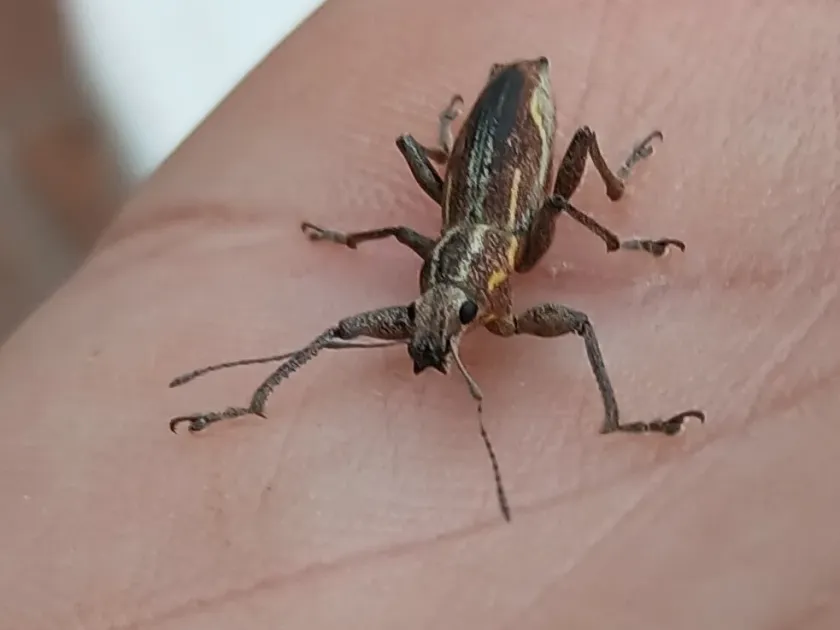
Naupactus xanthographus is a member of the Curculionidae family, commonly known as the yellow-striped weevil. Adult beetles are roughly 10–12 mm long and possess a greyish-brown body covered with distinct yellow stripes along the elytra.
The larvae of this species are legless, C-shaped, and creamy-white in color, with a well-defined head capsule and strong mandibles designed for feeding on plant roots.
The life cycle undergoes complete metamorphosis, including egg, larval, pupal, and adult stages. Each stage requires specific ecological conditions for survival and development.
These weevils are highly adaptable, capable of thriving in various agricultural environments, from large orchards to small vineyards and greenhouses.
Adults are known for their defensive behavior, often dropping to the ground or hiding in plant debris when disturbed, making them difficult to spot during routine inspections.
What it damages
This pest is highly polyphagous, attacking a vast range of crops including grapevines, apples, peaches, citrus, and various ornamental plants. It poses a dual threat to both roots and foliage.
Larval feeding causes the most severe damage by consuming root hairs and larger structural roots, which severely compromises the plant's nutrient and water uptake capabilities.
Adult beetles feed on leaves, creating a characteristic scalloped edge pattern. While this rarely kills mature trees, it weakens the plant and reduces overall vigor and yield.
The feeding lesions on roots provide entry points for soil-borne pathogens, leading to secondary infections such as crown rot, which can prove fatal to young or stressed trees.
Economic losses are particularly high in nurseries and young plantations, where the loss of root biomass can lead to stunted development or the death of the plants.
When it appears
Adult emergence typically occurs during the warmer months, corresponding with late spring and summer, when beetles emerge from the soil to mate and feed on foliage.
Females deposit eggs in crevices, usually in the bark or on leaves, and the neonate larvae drop to the ground and burrow into the soil to begin their feeding cycle.
Larval activity within the soil profile is continuous but peaks during periods of moderate moisture and favorable temperatures, usually in the autumn and spring months.
Overwintering occurs primarily at the larval stage within the soil, at depths where temperature fluctuations are minimal, allowing the population to survive cold spells.
Pupation takes place in soil cells, usually in early spring, after which the new generation of adults completes its metamorphosis and prepares to surface.
Signs of infestation
Visual identification of adults is based on the notched or scalloped edges found on the leaf margins, often referred to as "fringe feeding" or marginal damage.
Symptoms of root damage include progressive chlorosis, wilting during hot days, and a general lack of vigor that cannot be explained by nutrient deficiency alone.
In severe infestations, the root system is so decimated that the plant becomes loose in the ground and can be easily pulled or tilted with minimal force.
Stunted growth of new shoots and premature leaf drop in mid-summer are major warning signs that the root system is failing due to pest interference.
Confirmation of the pest is achieved through soil sampling around the base of the trunk or main rootstock to search for the distinct larvae of the weevil.
Control measures
Chemical control usually involves the application of systemic or contact insecticides during the adult emergence phase to disrupt the life cycle before egg-laying occurs.
Soil-applied insecticides are necessary to manage larval populations, requiring careful application and sufficient irrigation to ensure the chemical reaches the root zone.
Cultural practices such as frequent tillage around the base of trees help disrupt pupation sites and reduce the number of emerging adults in the following season.
Biological control using entomopathogenic nematodes, such as Heterorhabditis spp., has shown great success in suppressing larval populations within the soil naturally.
Monitoring using traps is highly recommended to determine the optimal timing for interventions, thereby reducing the environmental impact of unnecessary pesticide applications.
Taxonomy
- Latin name
- Naupactus xanthographus
- Order
- Coleoptera (beetles)
- Family
- Curculionidae
- EPPO code
- NAUPXA
Discussion
No discussions yet — be the first.