
Naupactus glaucus
Naupactus glaucus
Description
How to identify
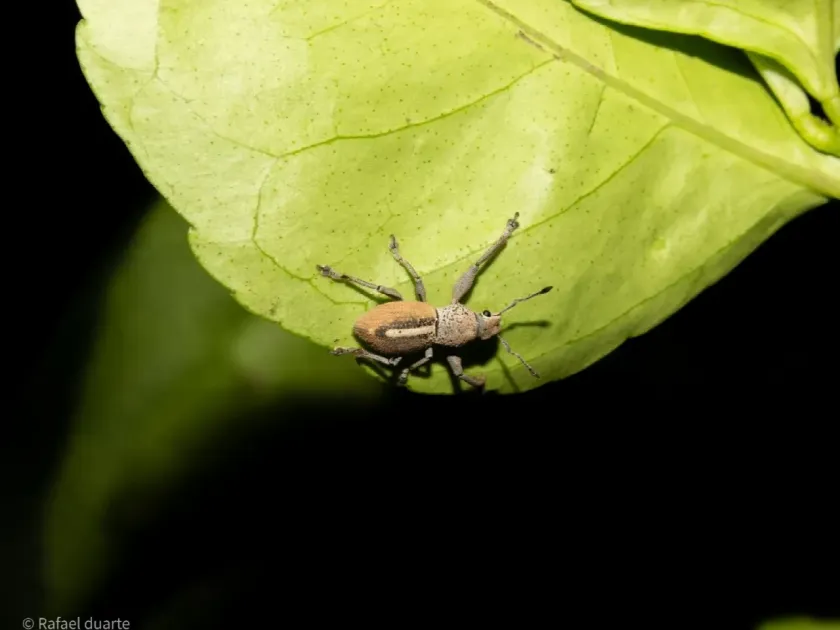
Naupactus glaucus is a species of snout beetle belonging to the family Curculionidae, order Coleoptera. Adult beetles are characterized by a medium-sized body covered with dense scales, which give them a distinctive glaucous or greenish-grey appearance.
The snout, or rostrum, of this beetle is relatively short and broad, a feature common among members of the Naupactus genus. While the species exhibits some level of sexual dimorphism, the general morphological traits remain consistent across the population.
The larvae are white, legless, and have a curved, C-shaped body. They possess a highly sclerotized head capsule, which allows them to move efficiently through compacted soil layers.
The life cycle involves complete metamorphosis, progressing through egg, larval, pupal, and adult stages. Adults are known for their resilience and ability to colonize large areas quickly.
Identifying the pest can be challenging as adults often hide during the day. Monitoring using light traps during night-time hours is the most effective method for population detection in agricultural settings.
What it damages
This pest has a wide range of host plants, causing significant economic damage to legumes, citrus, and various woody ornamental plants. It is considered a multi-crop pest.
Larval stages are the most destructive, as they feed on the root system, stripping away the bark of the taproot and smaller roots. This weakens the plant's structural integrity and nutrient uptake.
Adult beetles feed on the foliage, leaving distinctive scalloped or notched patterns along the margins of the leaves. This damage is often the first visual indicator of a Naupactus glaucus infestation.
Heavy infestations lead to severe defoliation, which reduces the plant's photosynthetic capacity, resulting in poor fruit quality, stunted growth, and potential death of young saplings.
In nursery environments, root damage caused by larvae facilitates the entry of soil-borne pathogens, leading to secondary root rot infections that can devastate young plant batches.
When it appears
Adult activity typically begins in late spring and continues throughout the summer months. Peak feeding and mating periods are highly dependent on local climatic conditions and temperature spikes.
Eggs are deposited in the soil or on the underside of leaves near the soil surface. Upon hatching, larvae immediately move into the soil profile to begin their development cycle.
Larvae overwinter in the soil at various depths, depending on soil moisture and ambient temperature. As the soil warms in the spring, larvae resume feeding before entering the pupal stage.
Emergence of adults from the soil is often staggered. This extended emergence period requires a precise understanding of degree-day models to effectively time chemical or biological interventions.
In regions with mild winters, the life cycle may be less synchronized, leading to an overlapping of generations and continuous pest pressure on crops throughout the entire growing season.
Signs of infestation
The primary symptom of infestation is the notched or scalloped edges of leaves caused by adult feeding. These jagged leaf margins are highly characteristic of snout beetle activity.
Below the surface, inspections of the root zone will reveal larvae and visible damage to the root bark, including grooves and signs of necrotic tissue where the larvae have been feeding.
Plants may show sudden wilting or lack of vigor, often interpreted as water stress, but this is frequently the result of significant root destruction caused by the larval stage.
Adults are nocturnal and can be observed feeding on the foliage after dark. When disturbed, they typically drop to the ground and remain motionless, a typical defensive behavior.
- Scalloped leaf margins
- Reduced plant growth and vigor
- Presence of C-shaped white larvae in the soil
- Root bark scarring and necrosis
- Dieback of young shoots
Control measures
Managing Naupactus glaucus requires an integrated pest management (IPM) approach that combines cultural, biological, and chemical control measures.
Cultural practices, such as deep tilling or cultivation between rows, help disrupt the soil environment and expose larvae to desiccation and natural predators like birds.
Biological control involves the application of entomopathogenic nematodes (e.g., Steinernema spp.) to the soil, which are highly effective at parasitizing and killing larvae in their subterranean environment.
Chemical control focuses on targeting adults before they begin egg-laying. Systemic or contact insecticides are applied based on monitoring data to coincide with the main emergence peak.
Consistent monitoring using traps is vital for successful control, allowing agronomists to determine the economic threshold and ensure that interventions are applied at the most vulnerable stage of the pest's development.
Taxonomy
- Latin name
- Naupactus glaucus
- Order
- Coleoptera (beetles)
- Family
- Curculionidae
- EPPO code
- NAUPGL
Discussion
No discussions yet — be the first.